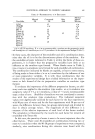
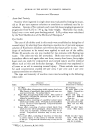
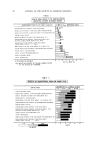
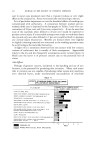
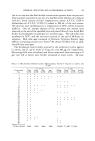
440 JOURNAL OF THE SOCIETY OF COSMETIC CHEMISTS scale includes the more commonly observed gradations of emulsion separa- tion, as given in the following descriptions of the stabilities corresponding to each rating. Numerical Emulsion Description Rating No visible separation 9 Emulsion is nearly homogeneous without definite separation 8 Emulsion shows faint cream line 6 Creaming with separation of 1% or less oil or water 5 Emulsion has creamed with separation of significant volumes of oil and aque- ous phases 4 Almost complete separation of emulsion 2 Complete separation into components with essentially their original volume 1 Typical results for each of the twelve preparative methods for one oil- emulsifier pair are illustrated by those for paraflinic mineral oil and Tween 60 emulsifier in Table 2. In some cases, as in method 10 in this set, it was not possible to measure the emulsion type because of the poor stability of the resulting emulsion. TABLE 2--EMULSION TYPE AND STABILITY--MINEKAL OIL-TwEEN 60 EMULSIFIER Method Water, External • 'Stability ß No. % Phase Initial 24 Hr. 1 Wk. 1 90 w 4 4 4 2 90 w 4 4 4 11 90 w 5 4 4 12 90 w 4 4 4 5 50 w 4 4 4 8 50 w 4 4 4 9 50 w 5 4 4 10 50 .. 2 2 1 3 30 o 2 2 1 4 30 o 2 2 2 6 30 o 2 2 1 7 30 w 9 5 4 Emulsion Type The results of the statistically designed experiment may be analyzed for both emulsion type and for stability. Some emulsifier-oil combinations, indicated in Table 3, produced predominantly o/w emulsions. Such com- binations, leading mainly to o/w emulsions, ,nay be divided into three groups: (1) those forming only o/w emulsions with all 12 methods, desig- nated in Table 3 by o/w those forming o/w emulsions or emulsions of nonmeasurable type, designated in Table 3 by X and those forming one w/o emulsion together with o/w emulsions and nonmeasurable types, designated in Table 3 by the method number forming a w/o emulsion.

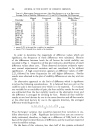
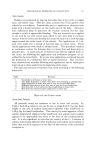
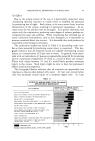
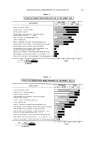
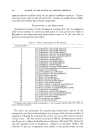
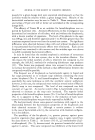
STATISTICAL APPROACH TO COMMON VARIABLES 441 TABLE 3--PREDOMINANTLY O/W EMULSIONS Methyl- Mineral Cottonseed Oleic phenyl Emulsifier Oil Oil Acid Silicone G-263 #3 o/w IPADBS o/w o/w G-2159 X Brij 35 //3 o/w Tween 60 //6 o/w Tween 80 //6 //6 o/w Renex 678 X o/w Myrj 45 //6 //6 //6 Tween 81 //6 o/w Span 20 Span 60 #4 Span 80 Span 85 o/w -- all o/w emulsions X -- o/w or nonmeasurable numbers are the preparative meth- ods forming one w/o emulsion per set of 12 procedures in the experimental design (Table 1). In these cases, the character of the emulsifier and oil in combination deter- mine that the oil is to be the discontinuous phase of the emulsion. For the emulsifier-oil pairs indicated in Table 3, within the limits of these ex- periments, it is evident that the preparative variables have little or no influence on the emulsion type formed. Where blanks occur in Table 3, two or more w/o emulsions were formed for each emulsifier-oil combination. The combinations indicated by blanks are capable, at least to some extent, of being made to form either o/w or w/o emulsions by the influence of one or more preparative variables. It is with these combinations that the results of the experimental design have yielded information on the impor- tance or lack thereof of the six preparative variables on emulsion type formed. To evaluate the importance of the different preparation factors, an arbi- trary scale was applied to the emulsion type results: an o/w emulsion was assigned a value of -3-1, a w/o emulsion, a value of - 1 and a nonmeasurable type a value of zero. (Stability of emulsions was not considered in connec- tion with the emulsion type evaluations.) The indicated numerical values were algebraically summed for each factor for the four experiments with 90 per cent of water and for the four experiments with 30 per cent of water, the 'difference between these two groups determined and divided by four to obtain average values. The magnitude of this difference is a measure of the relative importance of each level of the factor studied. The calculation is illustrated by the results for each factor for mineral oil emulsified with Tween 60. In this case, the quantity of water is seen to be more important than the other factors. There were 30 emulsifier-oil combinations forming two or more w/o emulsions when the 90-30 groups of experiments were compared similarly, nine combinations fitting this criterion were found with the
Purchased for the exclusive use of nofirst nolast (unknown)
From: SCC Media Library & Resource Center (library.scconline.org)