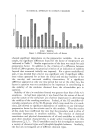
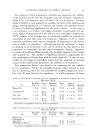
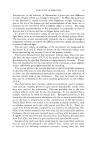
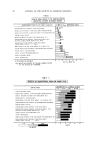
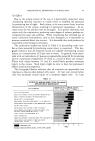
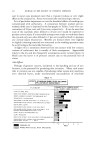
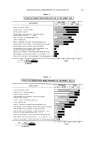
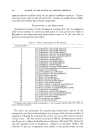
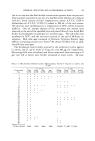
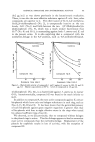
CHEMICAL STRUCTURE AND ANTIMICROBIAL ACTIVITY 481 (0.2 •g./ml.) as was shown previously in the bacteriostatic evaluation. There, it was also the most effective substance against E. co/i here, other compounds are superior to it. The other isomer of G-11, 2,2'-methylene- bis(4,5,6-trichlorophenol) (No. 2), is unexpectedly inactive at the test levels G-f1 (No.1) itself falls between the two. 2,2'-Methylenebis(5,6- dichlorophenol) (No. 9), which was a much weaker bacteriostat than G-5 © (No. 8) and G-11, is outstanding against both S. aureus and E. co/i in the present series. It is also surprising that a compound with the methylene-linkage in the 4,4' position, such as 4,4'-methylenebis(2,3,6- Controls •2- o 25 Compound No.I I I 4 I Compound No. 3 x,•5 I I I0 20 :$0 I0 20 30 Exposure time (min.) Exposure time (min.) Figure 1.--Bactericidal activity of compounds 1 and 3 against S. aureus in 100, 50 and 25 •g./ml. Maxine soap solution at 40øC. Level of compounds is 1.0 •g./ml. trichlorophenol) (No. 42), is as bactericidal against S. aureus as its isomer G-11 bacteriostatically, compound 42 was found to be much inferior to GAl. In addition to compound 9, the most active compounds against E. coli are bis-phenols which have only one halogen substituent in each ring, such as Nos. 6, 15, 20, 30 and 31. It has been shown that the germicidal potency of such bis-phenols against gram negative organisms is greater than that of Ns-phenols with four to eight chlorine atoms in the rings when tested by a phenol coefficient type of test (2). We observed, as we did previously, that no compound without halogen in the phenol rings is active. The thio-linkage appears to lead to somewhat more active compounds than the methylene-bridge. Replacement of the phenols by naphthols results in loss of activity, with the exception of compound 39.

482 JOURNAL OF THE SOCIETY OF COSMETIC CHEMISTS SUMMARY A number of bis-phenols were evaluated for bactericidal activity in the presence of a non-lethal level of a synthetic anionic surfactant. Those compounds demonstrating 95 per cent and 99 per cent kill in twelve minutes at 20øC. are reported. Results of the bactericidal evaluation revealed both similarities and differences with the previously reported bacteriostatic properties of bis-phenols. Bactericidal action of several of the bis-phenols was observed to occur at surprisingly low levels against both S. aureus and E. coli. (Received April 20, 1962) REFEKENCES (1) Gump, W. S., and Walter, G. R., 5 t. Soc. Cosmetic Chemists, 11, 307 (1960). (2) Cade, A. R., and Gump, W. S., "The Bis-phenols" in "Antiseptics, Disinfectants, Fungi- cides, and Chemical and Physical Sterilization," edited by G. F. Reddish, 2nd edition, Philadelphia, Lea & Febiger (1957), p. 319. (3) Gal, I., Fette-Seifen-/lnstrichmittel, 63, 539 (1961). (4) Banks, C. J., and Huyk, C. L., ,,tm. 2 t. Hosp. Pharm., 19, 132 (1962). (5) Gump, W. S., and Cade, A. R., Mfg. Chemist, 24, 143 (1953). (6) Pritchard, H., Ibid., 23, 227 (1952). (7) Wendel, K., Zentr. Bakteriol. Parasitenk., Abt. II, 110, 145 (1957). (8) Ayliffe, G. A. J., Alder, V. G., and Gillespie, W. A., Lancet, 2, 456 (1959). (9) Berthet, R., Schweiz. ,,tpotheker-Ztg., 85, 833 (1947). (10) Engler, V., and Mirimanoff, A., Pharm. atcta Helv., 26, 59 (1951). (11) "Official Methods of Analysis of the Assoc. of Official Agricultural Chemists," 9th edition, 2 t. ,'tssoc. O•c. Atgr. Chemists, Washington, D.C. (1960), p. 63. (12) Lawrence, C. A., and Erlandson, A. L., Jr., •. aim. Pharm. atssoc. Sci. Ed., 42, 352 (1953). (13) Bean, H. S., and Berry, J., 5 t. Pharm. & Pharmacol., 3, 639 (1951). Atlantic Refining Co., Philadelphia, Pa. Consolidated Laboratories, Inc., Chicago, Ill. Difco Laboratories, Inc., Detroit, Mich. Atlas Chemical Industries, Inc., Wilmington, Del. Swift and Co., Chicago, Ill.
Purchased for the exclusive use of nofirst nolast (unknown)
From: SCC Media Library & Resource Center (library.scconline.org)