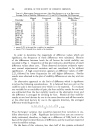
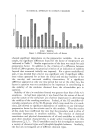
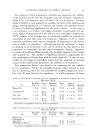
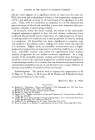
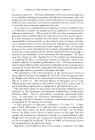
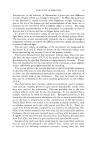
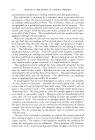
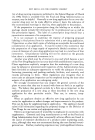
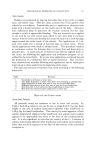
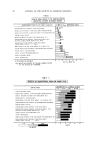
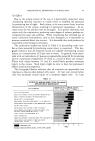
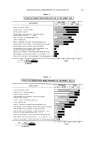
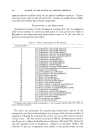
444 JOURNAL OF THE SOCIETY OF COSMETIC CHEMISTS TabLE 6--EsluLSXrtER CONC•N•:R.•:toN•ON• D.•¾ Sx.•m•n:¾ oF o/w Esltr•s•oNs Average Value of Stability Differences of 1% and 2.5% Emulsifier (90-30 groups) Mineral Cottonseed Oleic Methyl Phenyl Emulsifier Oil Oil Acid Silicone G-263 1.25 1.25 2.25 - 0.50 IPADBS 2.25 2.00 1.25 1.25 G-2159 2.25 2.25 1.25 0 Brij 35 2.25 1.00 0.50 0.25 Tween 60 1.25 2.25 1.75 --0.25 Tween 80 1.25 2.25 2.00 --0.25 Renex 678 0.25 1.00 2.25 --0.25 Myrj 45 4.00 3.00 --0.50 2.75 Tween 81 0.75 2.50 --0.75 0 Span 20 1.25 1.50 2.50 0.75 Span 60 4.25 2.00 2.25 2.25 Span 80 2.00 1.25 2.25 1.25 Span 85 1.00 1.00 --0.50 1.00 + means 2.5% is favored for a stable o/w emulsion. .-- means 1% is favored for a stable o/w emulsion. In order to determine the magnitude of difference values which arel significant, the frequency of these differences were tabulated. Results l of the differences between levels for all factors for initial stability arel recorded in Fig. 1. Inspection of this plot indicates a distribution of small' difference values about zero. These observed deviations evidently repre-I sent normal experimental variation and are considered to be withouri significance. A high concentration appears at difference values of 2.00- 2.25, followed by lower frequencies for still higher differences. Similar results were obtained in the plot of stability differences at one day and one week. An alternative approach to the limit of difference which is significant involves the following considerations. It is believed that one unit on the stability scale is the maximum error which is to be expected. To evaluate one variable for an emulsifier-oil pair, the four stability results for one level are subtracted from the four stability results at the alternative level, and the difference is averaged by dividing by four. Should all four stability results at one level deviate by one in the same direction and all four results at the other level deviate by one in the opposite direction, the averaged difference would be given by: (+l+l+l+l) - (-i-I-I-' 1) = 2.00 4 Thus the largest variation that would be expected from variations in sta- bility observation is 2.00. Significant deviations from zero are conserva-I tively estimated, therefore, to begin at a difference of 2.00, both on the, basis of the observed distributions of differences and the maximum expectedl errors in stability ratings. On the basis of this criterion, less than half of the systems evaluated'

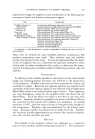
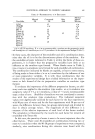
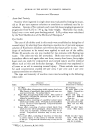
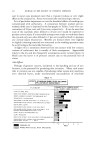
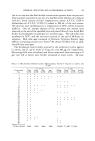
STATISTICAL APPROACH TO COMMON VARIABLES 445 .25 .50 .75 1.00 1.25 1.50 L75 2.00 2.25 2.50 2.75 5.00 5.25 5.50 5.75 4.00 4.25 4.50 Initiel Stability Figure I--Differences between levels- all factors i showed significant dependence on the preparative variables. As an ex- •ample, the significant differences found for the factor of temperature are indicated in Table 7. Similar organization of the data was made for each I preparative factor. In addition to the criterion of a difference between [levels of 2.00 or greater, the practical criterion of an indication of stability beyond that measured initially was imposed. For a given emulsifier-oil pair, it was decided that a factor was significant only if significant differ- •ence values appeared for at least the initial and one-day stability or for 'the one-day and one-week stability observations. If a significant 'difference appeared at only one time period but not at the other two, the If actor in question was not considered to be important in contributing to i the stability of the emulsion obtained from the oil-emulsifier pair in lquestion. Stability of the o/w emulsions formed was greater than that of the w/o ,emulsions. As had been expected, it was found that the nature of the oil •and the nature of the surfactant are of prime importance in determining Ithe stability of the resulting emulsions. Indeed, of the 312 emulsifier-oil- Ivariable comparisons of the 90-30 groups which were made for o/w emuL isions, 226 showed no significant dependence of stability on any individual 'preparative factor by the criteria used in this analysis. Thus the results •of this study have reaffirmed the view that the procedure used is often ot7 isecondary importance in emulsion stability. The relation of chemical ,constitution and physical characteristics of oil and emulsifier to stability ,and other emulsion characteristics is under active investigation in this Ilaboratory (2, 3, 7). The 13 emulsifiers used in this investigation represent a variety of chemical types and hydrophile-lipophile balances. Similarly, Ithe four oils investigated are of different chemical types.
Purchased for the exclusive use of nofirst nolast (unknown)
From: SCC Media Library & Resource Center (library.scconline.org)