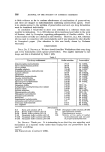
380 JOURNAL OF THE SOCIETY OF COSMETIC CHEMISTS Inocula of 10 and 100/ml Ps.aeruginosa cells were sterilized in aqueous suspension at 18 ø in 30 min by benzalkoniurn chloride 0.05% and 0.08% respectively (32). Recovery was on media containing an inactivator. Benzalkonium chloride has been accepted officially in the U.S.A. for many years but has not been widely used in Britain despite the large amount of favourable published work. There have been criticism against benzalkonium chloride on grounds other than bacteriological. Klein et al (27) stated "Quaternary ammonium compounds as a preservative for eye-drops should be used only in exceptional cases. Ginsburg and Robson found that detergents could prove harmful by causing 'solubilization' of the intercellular cement of the corneal epithelium." This reference to the work of Ginsburg and Robson (40) has been quoted by others (41). Recently, Anderson et al (30) have also quoted this work as evidence that benzal- konium chloride dissolves the intercellular cement substance of the cornea. Ginsburg and Robson (40) did not use a quaternary ammonium compound but worked with anionic and nonionic wetting agents. These workers found that the anionic detergent, dodecyl sodium sulphate (1%) damaged the cornea. They also found that although 1% nonionic Lissapol N caused slight temporary oedema, 0.5% caused no observable effect. These results are in accord with those of Buschke (42) who made direct measure- ments on intercellular cohesion in corneal epithelium. He found that six out of seven anionic detergents" . . . produced marked effects in con- centrations of 1% or sometimes even in lower concentrations." Not one of a wide selection of nonionic or cationic detergents caused loss of inter- cellular cohesion. Benzalkonium chloride was used in concentrations up to 10%. Recently, Anderson et al (43) have stated" . . . Swan has shown that wetting agents such as benzalkonium chloride are injurious to the corneal epithelium and especially to the endothelium .... " Swan (44) found that intraocular concentrations of benzalkonium chloride in excess of 0.01ø/0 caused serious damage. He also found that instillation of 0.1% benzal- konium chloride produced a severe reaction, and that 0.03% to 0.04% used over periods of up to 8 weeks produced a less severe reaction. In most cases the conjunctiva and cornea were normal within 12 hr. Never- theless, Swan concluded, "The minimal concentrations of wetting agents producing irritation in the conjunctival sac are greater than those that are effective." Hughson and Styron (45) replaced the aqueous humour of rabbits' eyes with benzalkonium chloride in saline, and found that concentrations of

THE PRESERVATION OF OPHTHALMIC PREPARATIONS 381 1 in 3000 and 1 in 6000 produced endothelial oedema which disappeared in 6 to 8 weeks. The use of a concentration of 1 in 7500 gave no visible evidence of damage. Bell (46) used a 1 in 10,000 concentration of a quaternary ammonium agent as a routine irrigant in eye surgery for three years, and observed no hypersensitivity or allergic reaction, nor was there any evidence of irritation. Lawrence (39) has quoted numerous other workers with similar experiences using quaternary ammonium compounds. Polymyxin Wiggins (47) found that 85 strains of Ps.aeruginosa were sensitive to polymyxin B sulphate. He found that the minimum inhibitory concen- tration at 37 ø in broth lay between 0.08 to 2.5 •g/ml. Antibiograms for 152 strains of Ps.aeruginosa showed that while there was marked resistance to several antibiotics, all strains were sensitive to polymyxin B (3). Riegelman et al (11) found that 1000 units/ml polymyxin B sulphate sterilized Ps.aeruginosa (108/ml) in aqueous suspension within 30 min. Lecithin was found to be an effective inactivator for polymyxin. In vivo tests confirmed the in vitro results. Polymyxin B sulphate was found to be only slowly bactericidal in aqueous solution against 13 strains of Ps.aeruginosa (2 x 10⁶/ml). Sterility was achieved in 12 hr using 2000 units/ml, and in 18 hr using 1000 units/mi. The results of in vivo experiments were in agreement with results of recovery using lecithin broth (25). Agents not widely used as preservatives Anderson and Stock (37) showed that chlorhexidine acetate 0.01% in aqueous solution sterilized three strains of Ps.aeruginosa within 15 min, and one strain of Staph.aureus within 30 min using cell concentrations of about 105/ml. Egg yolk medium was used to inactivate the chlorhexidine on recovery. Much useful work on formulation of ophthalmic solutions with chlorhexidine has been done in Australia (48,49), and it has been included in the Australian Pharmaceutical Formulary. No instance of sensitivity had been detected after several years' hospital use of chlor- hexidine preserved drops (6). Crompton (6) has stated that" . . . Chlor- hexidine at present is the bacteriostatic of choice." He quoted evidence of the personal communications of two workers to support this belief but omitted to give sufficient detail to allow evaluation of experimental methods. Anderson et al (30) tested ch!orhexidine against single strains of Staph.
Purchased for the exclusive use of nofirst nolast (unknown)
From: SCC Media Library & Resource Center (library.scconline.org)