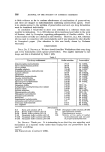
THE PRESERVATION OF OPHTHALMIC PREPARATIONS 373 unsatisfactory (23). A practical ideal at present would appear to be the aseptic preparation of ophthalmic ointments, using sterile ingredients. Preservation of solutions The possibility of contamination from pathogenic organisms subsequent to sterilization makes it necessary for multidose containers to be preserved using a suitable antibacterial agent. The capacity of small inocula of Ps.aeruginosa to cause infection, together with the neutralizing properties of the cornea towards anti- bacterial agents, make it preferable that these agents be capable of maintaining sterility. Much of the earlier work assessing preservatives is of reduced value because of inadequate experimental procedures. Riegelman et al (11) quoted numerous papers which did not state the precautions taken to ensure the absence of bacteriostatic concentrations of preservative in sub- cultures testing for recovery. They discussed the inadequacy of dilution techniques designed to inactivate preservatives and introduced in vivo procedures as well as in vitro tests involving chemical antagonists. They consistently found that organisms would produce infections, and could be recovered from the cornea while in vitro cultures were apparently negative. Subsequent improvement of the antagonist/recovery broth reduced the discrepancy. Kohn et al (24,25) further developed this important principle of comparing in vivo with in vitro procedures and obtained exact correlation. Several chemical agents have been proposed as suitable ophthalmic preservatives and it seemed appropriate to consider each separately. Esters of p-hydroxybenzoic acid A combination of methyl and propyl phydroxybenzoates has been used in the form of "Solution for Eye Drops" until this preparation was replaced by chlorocresol in the British Pharmaceutical Codex 1963. Subsequently this Codex was amended (26), and Solution for Eye Drops reintroduced. Brown et al (4) have commented on these changes. Klein et al (27) tested two combinations of the esters at three concentrations up to 0.16% against 108/ml Ps.aeruginosa present in three eye-drop preparations--Sodium fluorescein 2%, atropine sulphate 0.5%, eserine salicylate 0.25%. Contact times were up to 24 hr after which subcultures were made testing for sterility. They found that both combinations 1 (Nipasept) and 2 (Nipa 82727) were ineffective at all concentrations in fluorescein drops, and growth occurred after subculture at each contact time up to 24 hr. 0.16%

374 JOURNAL OF THE SOCIETY OF COSMETIC CHEMISTS Nipasept was necessary to produce sterility after 1 hr contact in atropine drops, while 0.106% sterilized after 2 hr. In eserine drops 0.16% Nipasept sterilized after 3 hr, and 0.106% after 5 hr. Combination 2 was more effective than Nipasept in the presence of atropine and eserine, and 0.08% sterilized after 1 hr. The esters were effective in some cases at 0.16%, but nevertheless it was found that this strength caused some burning sensation when introduced on the eye. The value of their results is reduced because they used a broth dilution experimental procedure, and inactivation of the agents was uncertain. Nonionic detergents are generally known to inactivate phydroxybenzoic acid esters (28) and Kohn et al (24) have recommended Tween 20 as an antagonist of these esters. Lawrence (29) found that a mixture of 0.16% methylparaben and 0.02% propylparaben sterilized within 1 to 6 hr in every case with 26 strains of Ps.aeruginosa, and four species of Proteus in simple buffer at pH 6.2. He used undiluted 24 hr cultures as inocula. Activity was also tested against four strains of Ps.aeruginosa in the presence of non buffered aqueous solutions of several drugs. Sterility was achieved in less than 30 min in several cases and never after more than 6 hr. He did not use inactivating substances in the recovery broth for the parabens. Ridley (16) stated that 0.1% methyl phydroxybenzoate had been used successfully as a preservative in hospital practice for three years. He stated that 0.1% methyl phydroxybenzoate was" . . . effective against a wide range of bacteria tested, including Ps.pyocyanea, Streptococcus pyogenes, and Staphylococcus aureus at room temperature, in conjunction with the drugs commonly used and in normal clinical concentrations, in three hours." No experimental evidence was provided to support this statement and the definition of "effective" was not given. Kohn et al (24) found that a mixture of 0.2% methyl paraben and 0.04% propyl paraben sterilized Ps.aeruginosa suspensions (2 x 10ø/ml) in 3 hr. A mixture of 0.18% propyl paraben sterilized in 6 hr. These workers used 13 strains of Ps.aeruginosa, and the effectiveness of the inactivating agents in their recovery broth was established by a correlation between in vivo and in vitro results. Anderson et al (30) tested 0.1% methyl hydroxybenzoate in six final eye drop preparations using Staphylococcus pyogenes, Proteus vulgaris and Ps.aeruginosa in concentrations of about 5 • 10a/ml. They found that sterility was achieved within one day in every case except two. The viable count increased during 11 days with Ps.aeruginosa in gelatin eye drops, and sterility was achieved after two days but not after one day
Purchased for the exclusive use of nofirst nolast (unknown)
From: SCC Media Library & Resource Center (library.scconline.org)