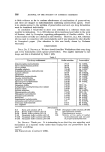
400 JOURNAL OF THE SOCIETY OF COSMETIC CHEMISTS plant used in the processing of food, milk, beer and textiles, and gives the advantages and disadvantages of several procedures. Chlorine or hypochlorite is the best sterilant for most purposes as it is active against almost all organisms, is cheap, and is easy to prepare for use. Its odour is, of course, a disadvantage when hot solutions are used, and it is also corrosive at pH lower than 9. Above this pH, however, 'corrosion is not a problem in stainless steel machinery, although it should not be used in aluminium vessels. Cold solutions of hypochlorite to give 200 to 250 ppm of available chlorine will sterilize metal and glass surfaces after 5 min provided all organic matter has been washed away previously. Formaldehyde or formalin is also a convenient sterilizing material for use after plant washing. Like chlorine, it is substantially inactivated by organic matter, and although its action on micro-organisms is rapid, its use suffers from the disadvantage that many plant operators are sensitive to its yapours. Intense irritation in the mucous membranes of the eyes, nose and throat can develop in people who are hypersensitive, and cases of these symptoms have been known even if the cork is removed from a formalin bottle in the vicinity of one of these unfortunate victims. For this reason, a cold solution should be used at a concentration of about 0.5 per cent formalin (0.2 per cent formaldehyde) and then only when non-allergic operators are present. This concentration will sterilize surfaces, free from organic matter, in 10 minutes. Quaternary ammonium compounds, although weight for weight less effective than chlorine and formaldehyde, have advantages such as being relatively odourless, much less toxic to man, and far less corrosive than chlorine. They do not, however, have such a wide spectrum of anti- microbial action and are more effective against gram positive bacteria and vegetative forms of fungi than against gram negative bacteria. As well as being rendered less effective by organic matter, they are also inactivated by anionic detergents. Being surface active themselves, they can in some cases be used to clean the plant as well as to sanitize, although their detergent action may be too weak where water-in-oil emulsions are manufactured. A concentration of 0.5 per cent of benzalkonium chloride at about !30øC will sterilize previously cleaned smooth surfaces in less than 10 minutes. Iodophors are prepared by the action of iodine on nonionic detergents in acid solution, and have both mild detergent and sterilizing actions. It is claimed that iodine in this form is as effective as the available chlorine in hypochlorite, but as these compounds are relatively untried in treating

HYGIENE IN MANUFACTURING PLANT AND EFFECT ON EMULSIONS 401 emulsion manufacturing plant, definite recommendations about usage cannot be made. TREATMENT AFTER PLANT STERILIZATION Residues of disinfectant solution must be removed from the plant after sterilization without recontaminating the machinery, and the best way of doing this is to irrigate with sterile water. The risk of recontaminating sterile machinery is high if cold water from a distilled or demineralized water storage tank is used, and boiled or autoclaved water is preferable, particularly if the plant is to be left idle before the next batch of product is made. Ideally, equipment should be washed, sterilized and rinsed immediately before use, but if it is necessary to stop operations at some point during this 3-stage process, the safest point to break off is after chemical steriliza- tion, and before rinsing. Leaving the plant idle after detergent washing or after final rinsing is potentially dangerous from the microbiological point of view unless the machinery is thoroughly dried inside and out. (Received ß 77 th September 7964) REFERENCES (1) Wedderburn, D. L. Advances in pharmaceutical sciences I 195 (1964) (Academic Press, London and New York). (2) Baker, J. H. J. Soc. Cosmetic Chemists 10 133 (1959). (3) Elsman, P. C., Kull, F. C. and Mayer, R. L. J. Am. Pharm. Assoc. Sci. Ed. •t8 88 (1949). (4) Cruickshank, G. A. and Braithwaite, D. G. Ind. Eng. Chem. 41 427 (1949). (5) Sokolski, W. T., Chidester, C. G. and Honeywell, G. E. Developments in industrial microbiology 3 179 (1962) (Plenum Press, New York). (6) Davis, J. G. J. Pharm. Pharmacol. Suppl. 12 29T (1960). Introduction by the lecturer In the cosmetic industry in particular many types of formulations are made in the same plant, and the intervals between making one formula and the next can vary from days to weeks, and the time during which the plant is idle can be very dangerous indeed from a microbiological point of view. Although most of the people concerned with the formulation of emulsions are fully aware of these dangers, plant operatives seldom are and a lot more ought to be done in their training. They are very seldom aware that an adequately preserved emulsion, under clean conditions, will behave very differently when there is massive and accidental contamination, either through faulty plant cleaning or through the use of a certain raw material that might, by chance, have been very heavily contaminated. Factory hands also cannot possibly be expected to know how quickly bacteria can multiply and change raw materials completely. Nor can they be expected to know which of the many raw materials handled are likely to be very heavily
Purchased for the exclusive use of nofirst nolast (unknown)
From: SCC Media Library & Resource Center (library.scconline.org)