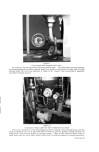
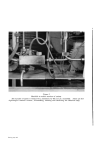
HYGIENE IN MANUFACTURING PLANT AND EFFECT ON EMULSIONS 399 piece of machinery is to be left idle for even a few hours, as thin films of product may trap and protect organisms beneath them, and diluted pools of product will allow infected foci to develop. Hot detergent solutions are satisfactory for most emulsion plants, but, particularly in plants used to make w/o emulsions, it is usually necessary to couple circulation of the solution with mechanical scrubbing and the dismantling of all inaccessible joints. This inevitably calls attention to plant design, and the necessity for smooth surfaces to working parts, the absence of "blind ends," and the need for easily opened joints cannot be stressed too strongly. If these conditions cannot be met in older machinery, it is often better to leave equipment unwashed before idle time, assuming the last made product contained an effective preservative, than to wash through and risk dilution of the product and the ensuing dangers of growth in stagnation areas. Figures 7 and 2 show examples of parts of plant which are difficult to dismantle and clean, while Fig. $ illustrates equipment of better design. PLANT STERILIZATION Cleaning and the removal of product residues should always be followed by steriliza.tion, especially if the plant is not to be used again immediately. The fact that a single bacterium can give rise in five hours to over 1,000,000 like itself shows the risks of delaying sterilization after washing, which in itself can never remove all micro-organisms. Sterilization by heat is the most effective means of ensuring destruction of all micro-organisms. Vegetative bacteria and fungi are destroyed by boiling for 5 to 10 minutes, but the only certain methods of destroying bacterial and fungal spores are by autoclaving at 120øC for 20 min or by holding at dry heat of 170øC for 2 hours. These procedures are, of course, not practicable for large manufacturing plants, and pasteurization which involves holding at 65øC for half-an-hour is not recommended since this, although effective against some pathogenic bacteria, does not affect heat resistant bacteria or spores. Chemical sterilization is an alternative to heat treatment, and is effective in most instances but, because spores are not always destroyed, must be preceded by thorough washing to remove mechanically as much con- tamination as possible. The use of strong concentrations of chemical disinfectants at very high temperatures is a safeguard if contamination from spores is suspected, but these measures are often difficult to carry out. Davis (6) has reviewed the application of chemical sterilization of

400 JOURNAL OF THE SOCIETY OF COSMETIC CHEMISTS plant used in the processing of food, milk, beer and textiles, and gives the advantages and disadvantages of several procedures. Chlorine or hypochlorite is the best sterilant for most purposes as it is active against almost all organisms, is cheap, and is easy to prepare for use. Its odour is, of course, a disadvantage when hot solutions are used, and it is also corrosive at pH lower than 9. Above this pH, however, 'corrosion is not a problem in stainless steel machinery, although it should not be used in aluminium vessels. Cold solutions of hypochlorite to give 200 to 250 ppm of available chlorine will sterilize metal and glass surfaces after 5 min provided all organic matter has been washed away previously. Formaldehyde or formalin is also a convenient sterilizing material for use after plant washing. Like chlorine, it is substantially inactivated by organic matter, and although its action on micro-organisms is rapid, its use suffers from the disadvantage that many plant operators are sensitive to its yapours. Intense irritation in the mucous membranes of the eyes, nose and throat can develop in people who are hypersensitive, and cases of these symptoms have been known even if the cork is removed from a formalin bottle in the vicinity of one of these unfortunate victims. For this reason, a cold solution should be used at a concentration of about 0.5 per cent formalin (0.2 per cent formaldehyde) and then only when non-allergic operators are present. This concentration will sterilize surfaces, free from organic matter, in 10 minutes. Quaternary ammonium compounds, although weight for weight less effective than chlorine and formaldehyde, have advantages such as being relatively odourless, much less toxic to man, and far less corrosive than chlorine. They do not, however, have such a wide spectrum of anti- microbial action and are more effective against gram positive bacteria and vegetative forms of fungi than against gram negative bacteria. As well as being rendered less effective by organic matter, they are also inactivated by anionic detergents. Being surface active themselves, they can in some cases be used to clean the plant as well as to sanitize, although their detergent action may be too weak where water-in-oil emulsions are manufactured. A concentration of 0.5 per cent of benzalkonium chloride at about !30øC will sterilize previously cleaned smooth surfaces in less than 10 minutes. Iodophors are prepared by the action of iodine on nonionic detergents in acid solution, and have both mild detergent and sterilizing actions. It is claimed that iodine in this form is as effective as the available chlorine in hypochlorite, but as these compounds are relatively untried in treating
Purchased for the exclusive use of nofirst nolast (unknown)
From: SCC Media Library & Resource Center (library.scconline.org)