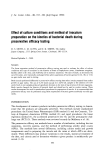
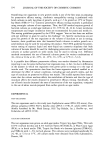
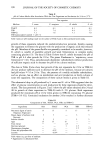
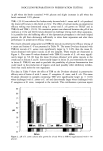
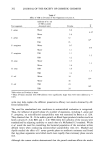
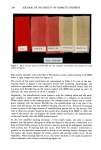
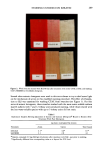
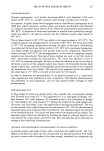
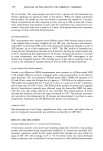
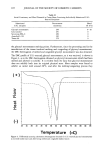
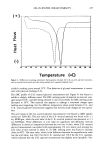
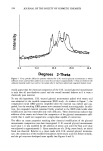
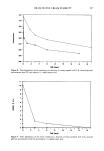
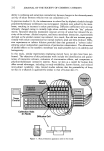
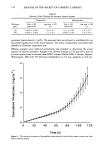
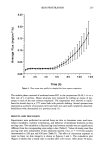
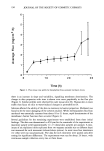
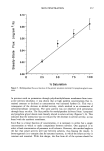
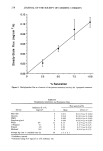
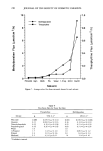
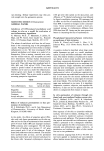
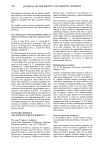
220 JOURNAL OF THE SOCIETY OF COSMETIC CHEMISTS •20 11o 290 280 270 260 240 I I I • '" I i I i I i I • I 0 2 4 6 B 10 12 14 16 nu,= (day,) Figure 1. Time dependence of the consistency as a function of storage temperature for cream prepared using U.K.-sourced ingredients. Data are shown for 5øC (+), 24øC ([•) and 33øC (•) storage tempera- tares. 10 7 6 nuE (d•y•) 10 12 14 Figure 2. Time dependence of the extent of bleed as a function of storage temperature for cream prepared using U.K.-sourced ingredients. Data are shown for 5øC (q-), 24øC ([2]) and 33øC (•) storage tempera- tares.

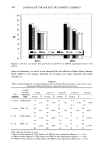
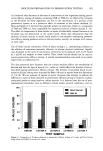
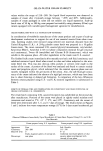
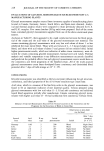
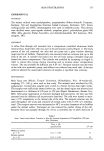
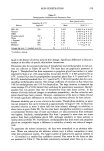
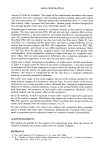
OIL-IN-WATER CREAM STABILITY 221 formation, promoted firmer consistency, and eliminated the bleed potential of the cream. Storage at 5øC for 3 to 6 days inhibited or delayed gel formation, promoted a softer consistency, and increased the bleed potential of the cream. Storage at 24øC for 3 to 6 days gradually increased the consistency firmness and decreased the bleed potential of the cream. Microscopic observations were made in studying the effects of storage temperature on the consistency and bleed potential of the bulk cream. Initially after manufacture, the cream had the appearance of discrete microscopic spheres of internal phase, closely packed, but floating freely in the aqueous external phase. The spheres were not fused together and a rigid three-dimensional gel structure was not observed, which accounted for the soft cream consistency and bleed propensity. The presence of uniformly distrib- uted droplets of clear aqueous phase loosely entrapped throughout the internal oil-wax phase also signified an increased bleed potential. Microscopic examination of the cream sample stored at 33øC showed that the internal phase spheres were fused together and that the aqueous external phase was securely entrapped in the matrix. Through the use of polarizing optical microscopy it was con- cluded that the gel structure was liquid crystalline in nature. These properties yield firm cream consistency without the potential for the cream to bleed. The 5øC-stored sample of the cream was similar microscopically to the sample stored at 24øC. The oil-wax spheres were packed more closely due to shrinkage of the wax struc- ture at 5øC, but after the sample equilibrated at 24 ø __ 3øC, it was observed that the spheres were not fused and a rigid gel structure was not present. The physical shrinkage of the wax structure at 5øC apparently expelled or "squeezed out" a larger portion of the aqueous external phase from the loosely bound matrix, which resulted in a greater amount of bleed after 6 days storage at 5øC. EFFECT OF INDIVIDUAL U.K. EXCIPIENTS ON CREAM CONSISTENCY AND BLEED POTENTIAL A series of 20-kg cream batches was prepared using a 10-gallon Groen mixer. The batches consisted of the U.S.-sourced excipients and a systematic substitution by U.K.- sourced excipients. Penetrometer and bleed testing indicated that the cream base containing U.K.-sourced glyceryl monostearate (with all other excipients U.S.-sourced) demonstrated softer con- sistency and extensive bleed. U.K.-sourced cetyl alcohol, Syncrowax ERL-C, Tween 60, and Amerchol L-101 did not promote bleed in the cream bases prepared using the Groen mixer (Table II). The results of this study led to a focus on the differences between U.S.- and U.K.-sourced glyceryl monostearate. ANALYTICAL AND THERMAL ANALYSIS TESTING OF U.S.- AND U.K.-SOURCED GLYCERYL MONOSTEARATE Thermal analysis, including DSC and powder x-ray diffraction measurements, were determined for each cream excipient. No significant differences were observed between U.S. and U.K. excipients except for glyceryl monostearate. Differential scanning calorimetry was used as the first characterization tool for glyceryl monostearate since slight variations in chemical composition could yield variations in
Purchased for the exclusive use of nofirst nolast (unknown)
From: SCC Media Library & Resource Center (library.scconline.org)