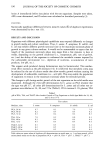
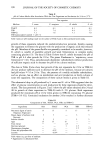
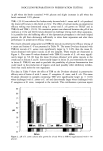
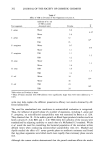
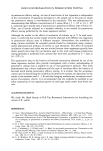
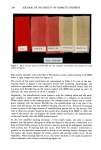
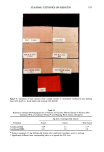
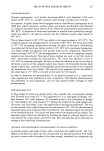
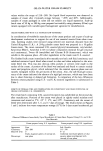
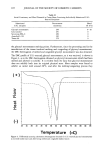
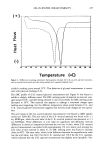
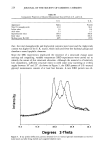
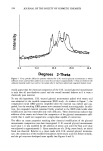
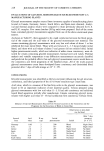
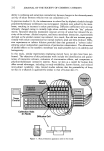
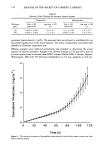
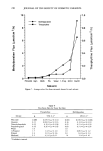
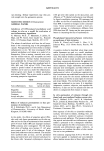
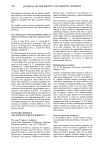
224 JOURNAL OF THE SOCIETY OF COSMETIC CHEMISTS Table III Comparative Properties of Glyceryl Monostearate Sourced From U.S. and U.K. U.S. U.K. Appearance Flakes Powder Total % monoglyceride 41.0 36.3 Iodine value 1.6 0.6 Acid value 5.1 1.1 Saponification value 164.0 168.0 Ester value 158.9 166.9 Melting point By DSC 60øC 65øC ther, the total monoglyceride and diglyceride contents were lower and the triglyceride content was higher for the U.K. source, which indicated fewer free hydroxyl groups and therefore a more lipophilic character. Since the DSC experiments implicated the existence of a structural change upon melting and congealing, variable temperature XRD experiments were carried out to identify the nature of this structural alteration. Although the material is of relatively low crystallinity, sufficient structure exists to yield some x-ray scattering at 2-theta angles between 18 ø and 25 ø. As shown in Figure 5, the XRD pattern of U.S.-sourced glyceryl monostearate consists of at least four features. A new XRD pattern was ob- 18.8 15.6 Degrees 2-Theta Figure 5. X-ray powder diffraction patterns obtained for U.S.-sourced glyceryl monostearate as received (solid trace) and after being melted and congealed (dashed trace).

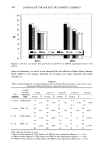
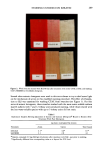
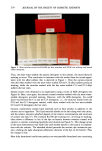
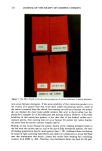
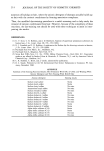
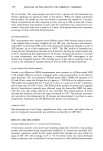
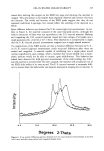
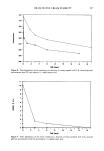
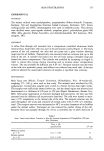
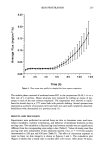
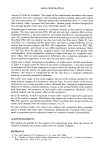
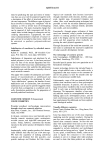
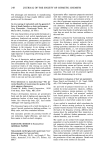
OIL-IN-WATER CREAM STABILITY 225 tained after melting this sample on the XRD hot stage and allowing the material to congeal. This new pattern is far simpler than originally observed and consists of at least two features. The width and location of the XRD peaks suggest that they do not represent individual d-spacings, but instead reflect the ordering of the material as a whole. Quite different behavior was observed for U.K.-sourced glyceryl monostearate. As evi- dent in Figure 6, the material consisted of the same four-peak system, although the relative intensities of these were not equivalent to the U.S.-sourced material. Melting and congealing the U.K.-sourced material caused the total collapse of all peaks into a single gaussian peak, centered at 22 ø 2-theta. This observation is interpretated to imply that the U.K.-sourced glyceryl monostearate congeals into a single-phased material. The implications of the XRD studies are that a chemical difference between the U.S.- and U.K.-sourced glyceryl monostearate yields structural differences after these are melted and congealed. A material capable of solidifying into a single phase would contract significantly upon cooling, while a material that would solidify into a multi- phasic mixture would not be able to contract upon solidification. This behavior has indeed been observed for bulk glyceryl monostearate: if the slide holding the U.K.- sourced material is inverted after the melt congeals, the material will actually fall out of the XRD slide holder of its own accord. The U.S.-sourced material is extremely diffi- cult to remove from the slide holder and requires mechanical scraping for its removal. It 10.0 15.0 •0.0 •5.• 30.8 Degrees 2-Theta Figure 6. X-ray powder diffraction patterns obtained for U.K.-sourced glyceryl monostearate as received (solid trace) and after being melted and congealed (dashed trace).
Purchased for the exclusive use of nofirst nolast (unknown)
From: SCC Media Library & Resource Center (library.scconline.org)