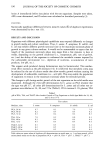
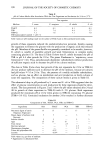
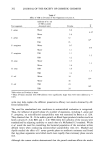
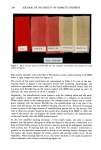
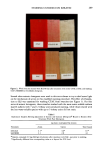
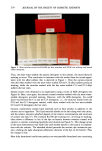
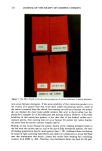
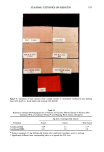
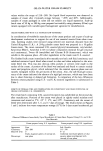
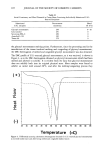
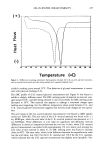
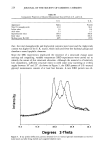
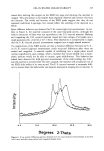
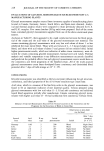
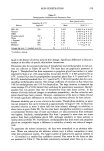
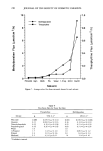
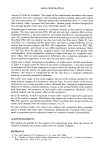
228 JOURNAL OF THE SOCIETY OF COSMETIC CHEMISTS EVALUATIONS OF GLYCERYL MONOSTEARATE SOURCED FROM NON-U.S. MANUFACTURING PLANTS Glyceryl monostearate samples sourced from inventory supplies of manufacturing plants located in Canada, Germany, Greece, South Africa, and Spain were obtained. Analyt- ical and thermal analysis results were compared to those previously obtained for U.S. and U.K. samples. Five cream batches (20 kg each) were prepared. Each of the cream bases contained glyceryl monostearate supplied from one of the above-mentioned plant sources. As shown in Table IV, there appeared to be a rank correlation between the bleed poten- tial of the cream and the acid value of the glyceryl monostearate raw material. The creams containing glyceryl monostearate with very low acid values of about 1 or less exhibited the most initial bleed. Those with acid values of 2-3.5 showed slight initial bleed, and those with acid values of about 5 and greater did not exhibit bleed. Initial higher penetrometer results, which are indicative of softer cream consistency, were ob- tained for creams containing glyceryl monostearate, having lower acid values. Thermal analysis and variable temperature x-ray diffraction measurements accurately classified and predicted the probable effects that each glyceryl monostearate source would have on the consistency and bleed propensity of the finished cream. All of the multi-sourced glyceryl monostearate cream bases developed firmer consistency and diminished bleed potential after 7 days of bulk storage at 24 ø ___ 3øC. CONCLUSIONS Glyceryl monostearate was identified as the key excipient influencing the gel structure, consistency, and bleed properties of the oil-in-water emulsion-type cream base. Acid value, which is a measure of the free fatty acids in the glyceryl monostearate, was found to be an important indicator of raw material quality. Creams prepared using glyceryl monostearate with low acid value (1-3.5) had soft consistency and exhibited liquid bleed separation initially after manufacture. Creams containing glyceryl mono- stearate with higher acid value (5- 15) had satisfactory firm consistency without bleed. Table IV Influence of Glyceryl Monostearates Sourced From Various Countries on the Consistency and the Propensity for the Occurrence of Bleed in Cream Base Observation on wire-mesh test for bleed After 7 days Sourced Acid X-ray Initial storage at from value type penetrometer Initial 24 + 3øC Germany 0.85 2 298 Bleed Slight bleed U.K. 1. ! 2 317 Bleed Slight bleed Greece 2.0 2 297 Slight bleed No bleed Spain 3.5 2 293 Slight bleed No bleed U.S. 5. ! ! 285 No bleed No bleed Canada 10.0 1 266 No bleed No bleed South Africa 14.9 ! 284 No bleed No bleed

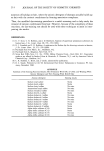
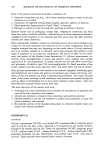
OIL-IN-WATER CREAM STABILITY 229 DSC and VTXRD thermal analysis methods were used to characterize and classify multi-sourced grades of glyceryl monostearate. These accurately predicted the effects that each lot of glyceryl monostearate would have on the consistency and bleed propen- sity of the finished cream. Cone penetrometer and wire-mesh screen testing were utilized for assessing consistency and bleed potential of the bulk cream immediately after manufacture and during bulk cream storage prior to approval for packaging. Based on this study, in order to overcome variable consistency and bleed problems, the following recommendations can be made: 1. If possible, use only glyceryl monostearate with higher acid value (5-15) and op- timal thermal analysis VTXRD pattern. 2. Cream batches prepared using glyceryl monostearate with low acid value (below 5) should be stored at 20ø-33øC until a firm consistency develops and no bleed is evident when tested by the wire-mesh screen method. REFERENCES (1) G. L. Flynn, "Unique Physicochemical Systems Used Topically," in Modern Pharmaceutics, G. S. Banker and C. T. Rhodes, Eds. (Marcel Dekker, New York and Basel, 1979), Vol. 7, pp. 298-309. (2) H. Schott, "Rheology: Self-Bodying Action of Mixed Emulsifiers," in Remington's Pharmaceutical Sciences, 17th ed., A. J. Gennaro, Ed. (Mack Publishing Company, Easton, Pennsylvania, 1985), pp. 341-342. (3) R. G. Harry, "Polyhydric Alcohol Esters of Fatty Acids," in The Principles And Practice of Modern Cosmetics, W. W. Myddleton, Ed. (Chemical Publishing Company, New York, 1963), pp. 357-367. (4) "Glyceryl Monostearate," in Handbook of Pharmaceutical Excipients (American Pharmaceutical Associa- tion, 1986), pp. 125-126. (5) R. M. Cornish, Studies ofglyceryl monostearate, J. Soc. Cosmet. Chem., 19, 109-117 (1968). (6) N.H. Kuhrt, R. A. Broxholm, and W. P. Blum, Conjoined crystals. 1. Composition and physical properties,J. Am. Oil Chemists Soc., 4, 725-733 (1963).
Purchased for the exclusive use of nofirst nolast (unknown)
From: SCC Media Library & Resource Center (library.scconline.org)