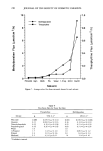
j. Soc. Cosmet. Chem., 40, 231-242 (July/August 1989) The effect of solvents on solute penetration through fuzzy rat skin in vitro JOHN N. TWIST AND JOEL L. ZATZ, Rutgers University College of Pharmacy, P.O. Box 789, Piscataway, NJ 08854. Received December 19, 1988. Synopsis Solvents common to cosmetic and pharmaceutical formulations, including water, dimethylisosorbide, three aliphatic alcohols, and three polyols, were studied using theophylline and methylparaben as model per- meants. The integrity of fuzzy rat skin was maintained for about two days when fully hydrated and only one day when exposed to methanol. The maximal permeation rate of each solute was markedly dependent on the solvent, indicating that solvent/skin interactions contributed significantly to permeation. Flux ratios for the solvents relative to water were computed for each permeant. A perfect rank order correlation between permeants was observed. Among the alcohols, methanol was most effective in enhancing flux of both compounds, followed by ethanol and then 1-propanol. Propylene glycol had a small negative effect, while the more polar polyols markedly reduced the flux ratio. Flux-concentration profiles for methylpar- aben and flux differences between the alcohols suggest that the interaction mechanism differs from that with polydimethylsiloxane membranes. INTRODUCTION In addition to industrial toxicologic considerations, the permeability characteristics of skin are of paramount importance in the development of pharmaceuticals and cos- metics. Topically applied drug entities may be used to achieve either local or systemic pharmacologic actions (1). Often, to avoid allergic or toxic reactions, it is desirable to prevent or limit the penetration of materials that have been applied to the skin. Cos- metic preparations should be formulated to reduce penetration of components that are irritating or can induce allergic responses. Contact with solvents can markedly alter the physical-chemical properties, including permeability, of membranes. Solvent interaction may alter membrane resistance by affecting solute mobility and/or capacity of the membrane to contain solute. In order to quantirate interactive effects it is necessary to account for any changes in solute release from the vehicle. Suspensions should yield equivalent solute flux in the absence of solvent-induced membrane damage. The literature on solvent effects on skin perme- John N. Twist's current address is E. R. Squibb and Sons, 1 Squibb Drive, New Brunswick, NJ 08903. 231

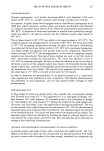
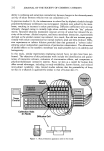
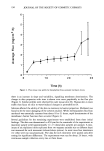
232 JOURNAL OF THE SOCIETY OF COSMETIC CHEMISTS ability is confusing and sometimes contradictory because changes in the thermodynamic activity of solute between vehicles were not considered (2,3). In previous studies (4-6), the enhancement in solute flux by aliphatic alcohols through polydimethylsiloxane membranes was investigated. Alcohols were sorbed by the mem- brane, resulting in increases in solute partitioning. Diffusion coefficients were not sig- nificantly changed owing to initially high solute mobility within the "dry" polymer matrix. Saturated solutions maintained constant activity of solute but reduced the ac- tivity of the solvent. Alcohol sorption, and hence membrane interaction, exponentially declined as the alcohol content was reduced. As a result, flux did not increase propor- tionally with solute concentration but instead reached a peak and then declined. Diffu- sion experiments at infinite dilution provided data that generated a "solvent index" allowing solute independent quantitation of permeation enhancement. The delineation of alcohol effects on the synthetic membrane was made possible due to its stability and homogeneity. In this study, similar experiments employing excised fuzzy rat skin have been per- formed. The objectives of this preliminary work include the identification and quanti- tation of interactive solvents, evaluation of concentration effects, and comparison to polydimethylsiloxane interactive systems. Fuzzy rat skin as a model for human skin offers several advantages, including its ready availability, known history, and reduced inter-subject variability. Also, limited studies indicate that the permeability of fuzzy rat skin to n-alkanols is qualitatively similar to that of human skin (7). Heatin Bh ?: ..(. O :.-"e '? 'e i Collection Vials (In Rack) Diffusion Cell Figure 1. Skin permeation apparatus used in this study.
Purchased for the exclusive use of nofirst nolast (unknown)
From: SCC Media Library & Resource Center (library.scconline.org)