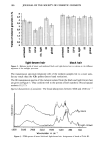
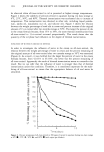
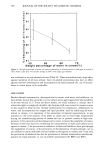
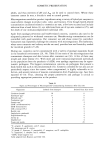
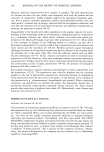
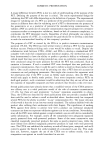
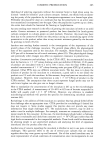
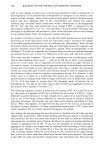
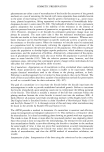
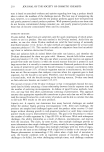
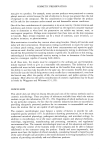
194 JOURNAL OF THE SOCIETY OF COSMETIC CHEMISTS be observed when all-trans-retinol in oil is preserved at higher storage temperatures. Figure 2 shows the stability of all-tram-retinol in squalane during ten days storage at 0øC, 25øC, 50øC, and 80øC. Thermal isomerization was accelerated due to increase of temperature. This isomerization was observed in other oils, including liquid petrola- turn, jojoba oil, macadamia nut oil, and silicone oils. Figure 3 shows the relation between the weight percentage of total oils in cream and percent increase of the original amount of 13-cis-retinol after two months storage at 50øC. The larger the percent of oils in the cream formula became, from 15% to 38%, the more thermal isomerization from all-trans-retinol to 13-cis-retinol occurred proportionally. This result shows that the quantity of the oil phase had influence on the degree of thermal isomerization. INFLUENCE OF WATER IN CREAM ON RETINOL In order to investigate the influence of water in the cream on all-tram-retinol, the relation between the weight percentage of water in cream and the percent remaining of the original amount of all-trans-retinol after two months storage at 50øC was examined (Figure 4). As a result, it was clarified that the larger the percent of water in the cream formula became, from 42.03% to 65.03%, the lower was the percent remaining of all-tram-retinol. Apparently the result of thermal isomerization seems to contradict this result. But we can infer that the influence of water is stronger than that of thermal isomerization under this condition. Therefore, it is considered important for the stabi- lizing of all-trans-retinol in cream that the appropriate balance of oil and water be identified. lOO 80 70 •0 50 40 30 2O lO o o 5 lO Time(days) Figure 2. Percent remaining of all-trans-retinol in 500 ppm of retinol in squalane during ten days storage at 0øC O, 25øC ', 50øC &, and 80øC ß (with argon gas blanket).

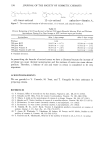
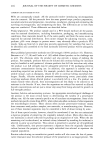
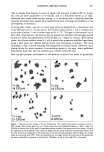
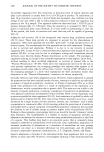
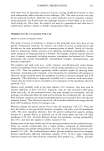
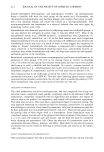
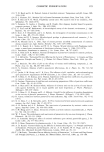
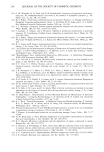
ALL-TRANS-RETINOL IN CREAM 195 35O o • 300 ii ii • 250 o '" 200 '" 150 100 ' • ' ' ' 10 20 30 40 Weight percentage of total oils in cream(%) Figure 3. Weight percentage of total oils and percent increase of 13-cis-retinol in 400 ppm of retinol in oil-in-water cream after two months storage at 50øC. Next, we checked the influence of the possibility of contact of water with all-trans- retinol by controlling the quantity of water or adding a surface-active agent in retinol- ethanolic solution. Figure 5 shows the relation between the percent of water in the retinol-ethanolic solutions, with or without a surface-active agent, and the percent remaining of all-trans-retinol in the solutions after ten days storage at 50øC. All-trans- retinol in ethanolic solutions decreased as the contact between all-trans-retinol and water was enhanced by an increase of water and surface-active agent. As all-trans-retinol was decreasing, one main product was found on the HPLC chromatogram. Figure 6 shows the UV spectra of this product in retinol ethanolic solution with a surface-active agent, after ten days storage at 50øC. This product was identified as anhydrovitamin A by using experimentally obtained standard anhydrovitamin A (7). This result corresponds with the findings of Anmo eta/., who reported that anhydrovitamin A was recognized as the product of purified vitamin A alcohol when the stability of vitamin A alcohol ethanolic solutions was investigated (8). The contact between all-trans-retinol and water acceler- ated the increase of dehydration and decreased all-trans-retinol without increasing 13- cis-retinol. We supposed the contact between 13-cis-retinol and water also promoted the decrease of 13-cis-retinol, and we could not observe an increase of 13-cis-retinol. The structural formulas of all-trans-retinol, 13-cis-retinol, and anhydrovitamin A are shown in Figure 7. EFFECT OF ANTIOXIDANTS The effect of BHT, BHA, vitamin E, and vitamin C as antioxidants against oxidation
Purchased for the exclusive use of nofirst nolast (unknown)
From: SCC Media Library & Resource Center (library.scconline.org)