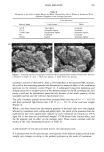
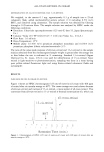
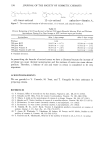
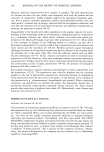
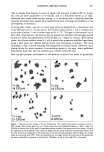
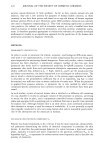
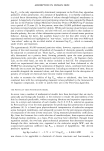
184 JOURNAL OF THE SOCIETY OF COSMETIC CHEMISTS COLOR MEASUREMENTS Before irradiation, color measurements were carried out using the CIELAB-system with notation of L* for lightness and a* and b* for the red and yellow values, respectively (Table I). As expected, the black hair shows a low L* value (L* = 17.3) and minimal a* and b*. The light brown hair is distinctly lighter (L* = 32.6), more red (a* = 6.9), and more yellow (b* = 14.4). Therefore, we suggest a contribution of the reddish-brown pheomelanin pigments to its original color. The photochemically induced color changes of black and light-brown hair were subjec- tively assessed and discussed in the first part of this publication (14). They are referred to in the present paper in Table II to complete the discussion about pigment alterations. The data in Table II indicate that the light-brown hair photobleaches more extensively than the black hair, a fact already observed in real life by others (16). However, it has become possible for the first time to assign the extent of these color changes to specific segments of the sunlight. The results clearly show that the photobleaching of hair is dependent on the initial color of the hair as well as on the segment of the sunlight spectrum. ISOLATION OF THE MELANIN PIGMENT After enzymatic dissolution of the keratin, the insoluble residue consists of the cell membrane complex (CMC) and melanin granules. Separation of the proteins was ac- complished by an acid hydrolysis. Thioglycolic acid was added to the hydrolysis mixture to prevent oxidation of the melanin. After 120 h of hydrolysis, followed by a deli- pidization and a micropore filtration, no fibrous contaminants derived from cells or the cell membranes were present in the granular samples. In that way SEM examinations attested to the satisfactory purity of the melanin obtained (Figure 1). The pigment granules isolated from black hair show a typical rice-like appearance, with a length of 0.7-1.0 p•m and a width of 0.4-0.5 p•m (Figure la). On the other hand, the melanin granules from the light-brown hair (Figure lb) are generally smaller and of irregular shape. Some are similar to those of black hair (0.65 p•m X 0.3 p•m). Most of them appear more circular and smaller (0.35 p•m to 0.46 p•m in length and 0.17 p•m to 0.23 p•m in width), which is characteristic of granules consisting of pheomelanin (1). This would suggest that the color of the light-brown hair is primarily due to the pheomelanin pigment and to a much smaller extent to eumelanin. EFFECT OF IRRADIATION OF HAIR ON THE CONTENT OF MELANIN It was found that 5-9 % of the melanin, including the CMC, could be isolated upon Table I Color Measurements of Nonirradiated Black and Light-Brown Human Hair Black 17.3 1.8 1.6 Light-brown 32.6 6.9 14.4

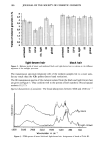
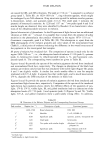
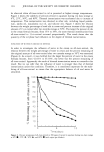
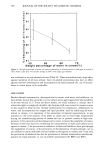
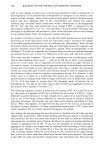
HAIR MELANIN 185 Table II Alterations in the Color of Light-Brown and Black Human Hair After 6 Weeks of Irradiation With Simulated Segments of the Sunlight Spectrum Color alteration Spectral range Light-brown Black UV-B Tips lighter Unaltered UV-A Somewhat lighter Unaltered Visible light Significantly lighter Somewhat lighter IR Unaltered Unaltered Global Lighter Somewhat lighter a,b Figure 1. Scanning electron micrographs of isolated melanin granula from untreated human hair. The bars correspond to length of 1 Ixm. a: Black hair granula. b: Light-brown hair granula. enzymatic removal of the keratin. After a 24-h hydrolysis of the melanin-CMC mixture, the yield of the remaining granules was determined to assess the effect of the irradiation spectrum on the melanin content (Figure 2). A subsequent long-term hydrolysis and delipidization led to a higher purity of the melanin sample for the IR investigations, but purity could not be determined quantitatively because of the small quantity of the available material and the inherent experimental error. The yield of melanin granules derived from untreated black hair was 4.8 % (+/- 0.25 %) and from untreated light-brown hair 3.95 % (+/- 0.3 %) of the total hair weight (Figure 2). While it has been found that the melanin granules of the black hair were only slightly affected by irradiation with visible and global light, the yields of the granules from the light-brown hair were significantly reduced by such irradiation and mostly by UV-A light (44 % less than the unirradiated sample). UV-B showed only limited effect, and the IR segment had no effect on the melanin yield. These results correlate with the results of the color measurements given in Table II. IR SPECTROSCOPY OF THE MELANIN FROM INTACT AND IRRADIATED HAIR It is assumed that the IR spectroscopic investigation of the melanin might provide some insight into changes occurring in the melanin polymers as the result of irradiation.
Purchased for the exclusive use of nofirst nolast (unknown)
From: SCC Media Library & Resource Center (library.scconline.org)