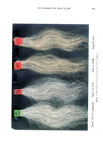
106 JOURNAL OF COSMETIC SCIENCE UV-A, respectively. The hair tresses were rotated constantly to assure uniform exposure to the UV irradiation. On days 3, 7, 15, and 20, fifty fibers from each hair tress were collected for evaluation. HAIR COLOR Computer images of the four test hair tresses were taken after UV irradiation and used to assess changes in color by naked eyes. The color of the treated samples, tresses 2, 3, and 4, was viewed and compared to the color of tress 1, the control without UV exposure. The color of the hair tresses was also measured analytically with a LabScan XE spectrophotometer (Hunter Laboratories, Virginia). The changes in color before and after UV irradiation for each tress were expressed as the total difference in color (DE), difference in light index (DL), difference in blue-yellowing index (Db), and difference in yellowing index (DYI) using the CIEL*a*b* system. HAIR DIAMETERS AND CROSS-SECTIONAL AREA A laser-scanning micrometer (Mitutoyo, LSM-5000) was used to measure the diameters and the cross-sectional areas at the middle section of each fiber. This instrument employs a 1.0-mw 670-nm wavelength laser. The micrometer was calibrated using standard calibration wires of known cross-sectional area. Test hair fiber samples for the laser- scanning micrometer were 3.0 cm in length and prepared using a metal-tube sample mounting system supplied by Dia-Stron Limited, UK. After measuring the cross- sectional area, test samples were transferred to the autosampler attached to a miniature tensile tester (MTT-670, Dia-Stron Ltd, UK) for tensile strength measurements. TENSILE STRENGTH The breakage resistance of single fibers was measured using a Dia-Stron MTT-670 attached to an autosampler in an environmentally controlled chamber at a constant temperature of 23øC and a relative humidity of 50%. The cross-sectional area data of each tested hair fiber was imported into MTTWIN software for automatic calculation of Young's modulus of each single fiber. The original cross-sectional area of each hair fiber was also used to calculate the contracted cross-sectional area at its break extension (strain-to-break). Then the revised cross-sectional area at the strain-to-break was used to calculate the stress-to-break. The average values of these parameters were calculated for 15 fibers randomly collected from each hair tress. WET COMBING FORCE The wet combing forces (peak load and total work) of test hair tresses were determined using a Dia-Stron MTT-160 at room temperature. Each test hair tress had a length of 18 cm. MTT operational parameters were set to the following: hair sample size of 30 mm force range of 2000 gram and combing speed of 120 mm/min. Five combing trials for each tress were conducted to calculate the average value. The percent changes in wet combing forces were calculated using the control value of the same hair tress before UV irradiation.

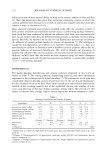
UV DAMAGE ON GRAY HAIR 107 DYNAMIC CONTACT ANGLE The dynamic advancing contact angle at the interface between a hair fiber and de-ionized water was measured automatically using a Cahn DCA-315 dynamic contact angle ana- lyzer at room temperature. The average dynamic advancing contact angle value was obtained from measurements of ten fibers randomly collected from each hair tress. TRANSVERSE SWELLING The change in the central cross-sectional areas of hair fibers immersed in 0.1 N NaOH solution was automatically measured using the Mitutoyo LSM-5000 for five minutes at room temperature. The average percent increase in the cross-sectional area of ten fibers randomly collected from each hair tress was calculated and used as the average extent of transverse swelling. RESULTS AND DISCUSSION In the following section, the data will be presented to showcase the effects that a quaternized UV absorber, CATC, had on various properties of gray hair under UV irradiation. The performance of CATC is compared to the performance of a conventional neutral sunscreen agent, OMC. The substantivity of CATC or OMC on a hair surface, as delivered from a simple shampoo test system--aqueous 10% SLS solution containing 2.0% actives of UV filter--was determined for comparison. It was found that CATC was quite substantive on gray hair, its substantivity being 4.50 mg per 100 grams of hair. On the other hand, only a trace amount of OMC was detected on the hair surface treated with the same surfactant system. This significant difference in substantivity likely explains why CATC is superior as a UV protector on hair in comparison to the con- ventional UV filter, OMC, as delivered from the tested shampoo system. DIFFERENCES BETWEEN GRAY AND BLACK HAIR Four pairs of hair samples were obtained from four panelists, respectively, including three men and one woman. Each pair of hair samples consisted of 20 black and 20 gray hair fibers from one individual head. The fifth pair of hair samples consisted of 20 black and 20 gray hair fibers, which were randomly collected from a commercial 90% gray hair tress. Data on maximum center diameter, Dmax, minimum center diameter, Drain, center cross-sectional area, A, center ellipticity, E, strain-to-break, stress-to-break, and swelling are summarized in Table I. A t-test was performed for statistical analysis of the data using Microsoft Excel. Based on t-test results, no statistically significant differences were found between these black and gray hair fibers in terms of their center maximum diameter, center ellipticity, center cross-sectional area, stress-to-break, strain-to-break, and transverse swelling. The only difference observed was the center minimum diameter: the black fibers had slightly larger center minimum diameters than those of gray fibers.
Purchased for the exclusive use of nofirst nolast (unknown)
From: SCC Media Library & Resource Center (library.scconline.org)