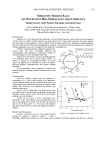
2000 ANNUAL SCIENTIFIC MEETING 145 concentration was sufficiently high. The mechanism of emulsification can be briefly described as follows. Initially water diffused rapidly into the oil phase, converting it to an oil-continuous microemulsion. However, as octanol diffused gradually into the aqueous phase, the ratio of alcohol to surfactant in the films covering the microemulsion droplets decreased, making them more hydrophilic and leading to an increased capability of the microemulsion to solubilize water and a decreased capability to solubilize oil. Eventually, the microemulsion was no longer able to solubilize all the oil present, and oil droplets nucleated. Moreover, the microemulsion itself inverted to become water- continuous and miscible with water, so that the final state was oil droplets dispersed in an aqueous phase, the size distribution of the droplets depending largely on their rate of coalescence. When enough surfactant was present, coalescence was relatively slow, and the droplets remained sinall. No intermediate liquid crystalline phases were formed for this system. However, an intermediate lamellar phase was seen for systems where the surfactant was tetradecyldimethylamine oxide (C14DMAO). Emulsions with small oil droplets were obtained with lower surfactant concentrations in this system, apparently because the lamellar phase reduced the rate of coalescence of the droplets. Nevertheless, both the liquid crystal and the microemulsion eventually became miscible with water as they lost alcohol by diffusion into the aqueous phase. This mechanism of emulsification may be summarized as causing the microemulsion to become supersaturated in oil by shifting it from lipophilic to hydrophilic conditions. However, achieving this behavior by diffusion of a medium- chain alcohol into the aqueous phase may not be desirable for some purposes. Later work showed that emulsification could also be produced in a similar system with octanol replaced by oleyl alcohol, which has a minimal solubility in water 2. In this case equilibrium phase behavior and videomicroscopy observations indicated that, when the system was near its PIT, water diffused into the oil phase, causing first transformation to the lamellar liquid crystalline phase and then nucleation of oil droplets and conversion of the liquid crystal to a water-continuous phase. Use of ionic surfactants instead of nonionic or zwitterionic surfactants may have advantages. For instance, electrical repulsion may help stabilize the emulsion once formed. Accordingly, more recent work utilized the anionic surfactant Aerosol OT (AOT) with no alcohol and effected microemulsion inversion by a reduction in ionic strength s. This reduction was produced by a combination of water diffusion into the injected drop and AOT diffusion into the aqueous phase. Inversion and spontaneous emulsification can also be produced by chemical reactions which convert lipophilic surfactants to more hydrophilic ones. As is well known, one such reaction is conversion of fatty acids to soaps by increasing pH. However, spontaneous emulsification produced by other reactions has been investigated recently in our laboratory, including enzymatic splitting of a double-chain.phospholipid into a lysolecithin and a fatty acid. References. 1. Rang, M.J. and C.A. Miller, Progr. Colloid Polym. Sci. 109, 101 (1998). 2. Rang, M.J. and C.A. Miller, J. Colloid Intel face Sci. 209, 179 (1999). 3. Nishimi, T. and C.A. Miller. Langmuir, in press.

146 JOURNAL OF COSMETIC SCIENCE CALCIOTROPIC HORMONES AND THE SKIN: A MILLENNIUM PERSPECTIVE Michael F. Holick, Ph.D. Boston University School of Medicine, Boston, MA It has been estimated, that within 50 years, that almost one million Americans will reach the age of 100 years. One of the major consequences of aging on the body is its effect on the skin. Retinoids have been found to be very effective in stimulating epidermal cell growth and rejuvenating the dermis to help relieve the ravages of aging on the skin. Retinoids can cause some side effects including skin irritation. There is a need to develop new safe effective approaches for maintaining skin and hair follicle health and rejuvenating skin health. It is well known that the most beneficial effect of exposure to sunlight on the skin is the production of vitamin D3. Vitamin D3 is equated with bone health. However, it is now appreciated that the skin is not only the organ responsible for making vitamin D3 but is a target tissue for activated vitamin D3. It is well established that once vitamin D• is made in the skin, it is converted in the liver to 25-hydroxyvitamin D3 and then in the kidney to 1,25-dihydroxyvitamin D3 (1,25(OH)2D3). 1,25(OH)2D3 is responsible for enhancing intestinal calcium absorption and mobilizing calcium stores from the bone to maintain physiologically acceptable blood levels of calcium for promoting metabolic functions and maximum bone health. It is now recognized that the skin also has the enzymatic machinery to make 1,25(OH)2D. 1,25(OH)2D is a potent inhibitor of proliferation and inducer of terminal differentiation of human epidermal cells One practical advantage of this unique biologic property is that activated vitamin D compounds are effective in treating the hyperproliferative skin disorder, psoriasis. It is remarkable that although 1,25(OH)2D3 is a potent inhibitor of epidermal proliferation, it does not have any adverse effects on the epidermis when topically applied for up to 10 years. It appears that this calciotropic hormone normalizes proliferative activity, and
Purchased for the exclusive use of nofirst nolast (unknown)
From: SCC Media Library & Resource Center (library.scconline.org)