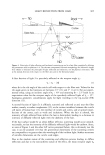
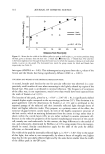
302 JOURNAL OF COSMETIC SCIENCE light reflection and scattering is potentially a direct, quick, and non-destructive method to monitor such changes to the hair surface. Fundamental investigations of light reflection from hair applied goniophotometry to single or arrays of parallel fibers (1-6). For single fibers this method gives detailed insight into the interaction between light and the fiber surface, and a variety of param- eters can be defined in terms of the properties of specularly and diffusely reflected light. However, inherent large variations between individual hairs, be they of color, size, etc., on the one hand, and the long recording time for standard goniophotometric techniques (approx. 15 min), on the other, prevented a broader application (2,6). For our investigations this limitation of goniophotometry was overcome by adapting a multichannel instrument, developed by Haertl et al. (7), with fast access to the complete angular distribution of reflected light from which the intensity distributions for three different components of reflected light can be determined. For a first, fundamental investigation of the methodology, the angular positions and widths of the various components of reflected light and the cuticle angles derived thereof were determined along the length of hairs differing in color and ethnic origin, in order to better under- stand the connection between hair surface and bulk morphology and light scattering. DETERMINING LIGHT REFLECTANCE FROM HUMAN HAIR FIBERS The measurement of light reflectance and scattering from single human hairs, described in this paper, is based on the determination of the angle-dependent intensity of the light from a green laser (X = 532 nm) reflected from a single fiber. The wavelength was chosen such as to be in that range were the daylight sensitivity of the human eye is at a maximum (8). Figure 1 shows the experimental setup for the investigations. At the center of the setup, a hair (length: 10 cm) is held horizontally in a special holder at a constant tension of 200 mg and under ambient, though stable, room conditions (approx. 22øC, 50% RH). The holder contains up to ten hairs in parallel and allows vertical movements to select a hair and horizontal movements in order to select the position to be studied. Three types of hair were investigated, namely brown and blonde Caucasian, and black Asian hair. Each sample was taken from the head of a female volunteer and exceeded in all cases 20 cm in length. The hairs were shampooed (LES 15%, pH 5.5), rinsed, dried, and stored under ambient conditions until usage. The laser beam (approx. 50 laW) is vertically polarized (see Figure 1) and meets the hair fiber, arranged horizontally, at an incident angle of 40 ø (beam spot size 100 lam). The detection of the reflected light is conducted in the horizontal plane containing the fiber and the incident light beam with an Optical Multi-Channel Analyzer (OMA), described in reference (7). The detector contains 167 windows arranged such that each window covers 1 ø, with an overall range for the recording angle of 6.5 ø to 173.5 ø around the center of light scattering and with respect to the direction of the laser beam. The windows are con- nected to light guides that transform the signals into a rectangular array, where the light intensity distribution is observed by a CCD camera, digitized, and analyzed. The data are corrected for the transmission characteristics of the individual light guides and for

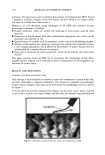
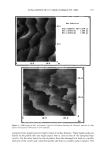
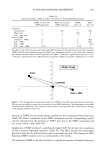
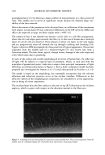
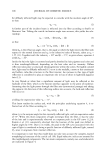
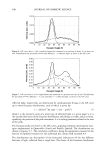
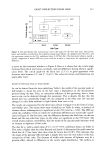
304 JOURNAL OF COSMETIC SCIENCE goniophotometry (2), by allowing a large number of measurements in a short period of time. This enables one to arrive at significant results despite the inherent large vari- ability of the hair material. Due to the nature of the parameters to be discussed here, no calibration of the instrument with respect to luminance (9) was conducted. Influences on the GP curves by diffraction effects are expected at large incidence angles only (=60 ø ) (3). The surface of hair is not smooth but features cuticle cells in a tile-like arrangement, where the cell scale edges point towards the fiber tip. In the case of human hair, multiple layers of cuticle cells are observed. They amount to about ten layers in the root region and are progressively worn off towards the tip through combing and brushing (10). Figure 3 shows an SEM micrograph of a Caucasian hair of typical appearance. The section originates from the middle part of a medium-length (25 cm), brown hair from a Caucasian female. The hair shows typical, though minor, damage of the scale edges and a few lifted scales due to grooming. In view of the surface and overall morphological structure of human hair, the reflection of light will be subject to a special type of geometry, which, in turn and with the principles of geometrical optics, leads one to expect three principal components of light reflection, as schematically shown in Figure 4. Such a three component model has been proposed and investigated by Stamm et al. (11) and subsequently by Guiolet et al. (4). The model is based on the simplifying, but reasonable assumption that the relevant reflection and refraction processes occur at the air/hair interface. Differences in the refractive indices of the morphological components are considered in a first approxima- tion as being of minor importance. The incident beam hits the fiber surface in the root-to-tip (RT) direction at the incident angle ½i, which is given with respect to the direction normal to the fiber axis. Figure 3. Scanning electron micrograph of a typical Caucasian human hair. The section originates from the middle part of a medium-length (25 cm) brown hair taken from a Caucasian female.
Purchased for the exclusive use of nofirst nolast (unknown)
From: SCC Media Library & Resource Center (library.scconline.org)