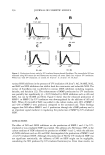
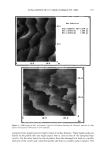
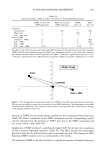
304 JOURNAL OF COSMETIC SCIENCE goniophotometry (2), by allowing a large number of measurements in a short period of time. This enables one to arrive at significant results despite the inherent large vari- ability of the hair material. Due to the nature of the parameters to be discussed here, no calibration of the instrument with respect to luminance (9) was conducted. Influences on the GP curves by diffraction effects are expected at large incidence angles only (=60 ø ) (3). The surface of hair is not smooth but features cuticle cells in a tile-like arrangement, where the cell scale edges point towards the fiber tip. In the case of human hair, multiple layers of cuticle cells are observed. They amount to about ten layers in the root region and are progressively worn off towards the tip through combing and brushing (10). Figure 3 shows an SEM micrograph of a Caucasian hair of typical appearance. The section originates from the middle part of a medium-length (25 cm), brown hair from a Caucasian female. The hair shows typical, though minor, damage of the scale edges and a few lifted scales due to grooming. In view of the surface and overall morphological structure of human hair, the reflection of light will be subject to a special type of geometry, which, in turn and with the principles of geometrical optics, leads one to expect three principal components of light reflection, as schematically shown in Figure 4. Such a three component model has been proposed and investigated by Stamm et al. (11) and subsequently by Guiolet et aL (4). The model is based on the simplifying, but reasonable assumption that the relevant reflection and refraction processes occur at the air/hair interface. Differences in the refractive indices of the morphological components are considered in a first approxima- tion as being of minor importance. The incident beam hits the fiber surface in the root-to-tip (RT) direction at the incident angle ½1, which is given with respect to the direction normal to the fiber axis. Tip Root Figure 3. Scanning electron micrograph of a typical Caucasian human hair. The section originates from the middle part of a medium-length (25 cm) brown hair taken from a Caucasian female

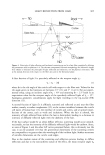
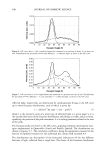
LIGHT REFLECTION FROM HAIR 305 Tip , Root //Y'b • Cortex ............. ,7 ......... r- ............... Di Laser ND Figure 4. Principles of light reflection and backward scattering on and in a hair fiber, graphically defining the parameters used in equations 1-6. The relevant components of keratin morphology are indicated. Angles were chosen to illustrate the principles of light reflection and refraction, not for physical correctness. ND is the ,ormal direction with respect to the fiber axis and in the horizontal plane. A first fraction of light S is specularly reflected at the receptor angle %: % = ½,r- 2•b (1) where •b is the tilt angle of the cuticle cell with respect to the fiber axis. Values for the tilt angle given in the literature are between 2.5 ø (11) and 3 ø (1,4,11). For our experi- mental setup, using an incident angle of ½• = 40 ø and assuming •b = 2.5 ø leads to an expectation value for the receptor angle of the specularly reflected light of % = 35 ø. Analogous geometric considerations apply for light traveling in the tip-to-root (TR) direction (11). A second fraction of light D s is diffusely scattered and reflected at and near the fiber surface, namely at surface roughnesses (12), at the various interfaces between the cuticle cell layers of human hair (11), the interface of cuticle and cortex, and at optical imper- fections of the cortex, such as voids and inclusions. When the hair is colored, the intensity of light reflected from within the hair is diminished, leading to a decrease in intensity of diffusely reflected light with the darkness of the hair. If the hair surface would be an ideal, diffuse reflector, scattering would occur omnidi- rectionally, so that the intensity of the diffusely reflected light would be uniform. Since, in view of Figure 2 and the other GP curves presented below, this is obviously not the case, it can be assumed (11) that the geometrical dimensions of the scattering centers are comparable to or greater than the wavelength of the incident light. Surface structures of suitable dimensions are the cuticle scale edges. Due to the random nature of the scattering and reflection process leading to diffuse reflection and due to the non-uniform nature of the effect, the mean receptor angle 3/d
Purchased for the exclusive use of nofirst nolast (unknown)
From: SCC Media Library & Resource Center (library.scconline.org)