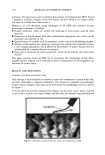
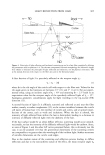
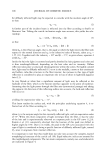
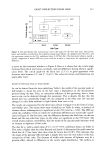
306 JOURNAL OF COSMETIC SCIENCE for diffusely reflected light may be expected to coincide with the incident angle of 40 ø , so that: 'Yd = e• (2) A further part of the incident beam is refracted into the fiber according to Snell's or Descartes' law. Taking the cuticle inclination angle into account, this yields the rela- tionship: n•c = sin(e• - 0)/sin(e• - 0) (3) so that e R = sin-l[1/nK sin(e• - 4))] + 4) (4) where eR is the refraction angle, that is, the angle at which the light enters the fiber with respect to the normal direction and nK is the refractive index of keratin, taken as nK = 1.55 (11). Together with the values e• = 40 ø and 4) = 2.5 ø, as given above, equation 4 yields e• = 26 ø. Inside the hair the light is scattered and partly absorbed by hair pigment and color and is thus wavelength-filtered, depending on the hair color and its intensity. Diffuse reflection takes place at structural inhomogeneities within the cortex. For lightly colored hair, light may be diffusely reflected (11) at or in the medulla, a more or less continuous and hollow, tube-like structure in the fiber interior. An increase in this type of light reflection is considered to play an important role in loss of shine in lightened Japanese hair (13). In very blonde or white hair a significant amount of light may be reflected at the backside of the fiber, which is the hair/air interface opposite to the point of incidence. Assuming that the light passes through the fiber axis (symmetrical passage) and taking the opposite tilt direction of this reflecting surface into account, the back-side reflection will occur at: % = e• + 20 (5) yielding the expectation value •b = 31 ø This beam reaches the surface and, with the principles underlying equation 4, is re- fracted out of the fiber according to: y, = sin-linK sin(% + 4))] - 4) (6) where % is the receptor angle for this internally reflected light, with an expectation value of 55 ø. When this third component of light reemerges from the fiber, it has the color of the hair and is experimentally observed as a separate peak in the GP curve (1,2,4). Stammet a/. (11) consistently observed that the location of this peak was shifted to higher angles by 10%. Due to its width, the peak in the GP curve associated with this type of light is considered as being a specific fraction of diffusely reflected light, termed D , since it originates from internal reflection. It is important to note that this model does not take into account the complex, layered morphological structure of the cuticle cell (10). Equal refractive indices are assumed for the morphological components. The two main components, namely exo- and endocuticle are indicated in Figure 4.

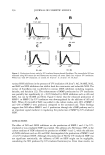
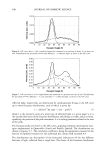
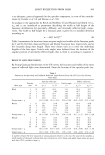
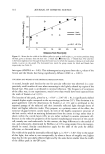
LIGHT REFLECTION FROM HAIR 307 GP CURVE ANALYSIS Figure 2 shows the raw data for the scattering profile of a dark brown, female, Caucasian hair near its root end. The data points show pronounced scattering due to the speckle effect, which results from the laser being a coherent monochromatic light source (1). To suppress the data scatter, moving average smoothing was found to be adequate, yielding the solid line in Figure 2, which is taken as the GP curve. The higher initial smoothness of scattering curves shown in the literature (e.g., 1,2,9) is attributed to the lower resolution of goniophotometric devices, the suppression of the speckle effect by the use of a white light source, and the testing of hair collectives. Figure 5 shows the GP curve for a virtually black Asian hair. By fitting Gaussian peaks to the curves, as described below, it is shown that the curve prominently features a strong peak at a receptor angle of 36 ø and a width at half height of 9 ø. This peak is attributed to specular reflection. With equation 1 the location of this peak yields the tilt angle for the cuticle cells. The underlying, low-intensity, broad peak derives from diffuse reflection effects. Figure 6 shows the GP curve of a medium brown hair, similar to the one for Figure 2, but measured at about 30 cm from the root. The curve shows a similar peak for specular reflection as the Asian hair, but superimposed on a broad background peak for Ds, that is, for diffuse scattering. Due to the lighter color of the hair closer to the tip compared to a position near its root end, a substantial fraction of the light enters the fiber, where it is not completely absorbed, but re-emerges in a diffuse manner. The D s intensity shows a pronounced angular dependence with a directional preference of around 50 ø. Figure 7 shows the GP curve for a light blonde hair, originating from the tip region of a light brown hair. The curve features the strong and narrow specular peak, superim- posed on the strong, underlying intensity distribution of diffuse reflectance. A further peak is observed at 65 ø, which is attributed to D i, that is, to internally reflected light. The angle-dependent intensities of specularly (S), diffusely (D,), and internally (Di) 0,6 'E 0,5 • 0,4 ._• 0,3 = 0,2 -= 0,4 0,0 --- ' ................................... 0 10 20 30 40 50 60 70 80 90 Receptor Angle [ø] Figure 5. GP curve data (--) for a black Asian hair about 5 cm from its root end. Distributions for specularly (----) and diffusely (---) reflected light, as fitted to the GP curve.
Purchased for the exclusive use of nofirst nolast (unknown)
From: SCC Media Library & Resource Center (library.scconline.org)