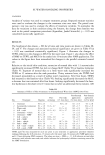
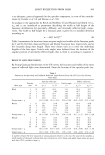
310 JOURNAL OF COSMETIC SCIENCE thermore, the tilt angle of the cuticle scales with respect to the fiber axis (cuticle angle) was derived. By far, most GP curves could well be analyzed by the two-component approach, with a narrow peak attributed to specular and a broad peak to diffuse reflection, respectively. Only for the very blonde hair, Di, as a further component of diffuse reflection, had to be considered. All data were checked for outliers, prior to further analysis, by assessing them in so-called normal probability plots as implemented in the applied statistics software (15). In this type of plot, cumulative data frequencies follow a straight line, when the data are normally distributed. A small number of obvious outliers was readily identified ( 10%) in these plots and was removed prior to further analysis of the parameter values. For the cuticle angle, a small number of data ( 10%) with negative values were removed on the basis of physical implausibility. The data given in Table I represent the accepted data and are arithmetic means for measurements taken at a given position on a number of hairs (N) of the same type. For a given hair type, the data are summarized in group means. For a given parameter, data are further summarized over all hair types in the form of grand means. Effects of measurement position and hair type on the parameters were assessed for significance by analysis of variance (ANOVA) and linear regression (LR). In those cases where ANOVA indicated inhomogeneity, multiple comparison of means analysis was conducted, applying the nonconservative LSD test (15). The statistical significance of effects (ANOVA: inhomogeneity of data LSD: differences between data groups LR: slope of regression line) is characterized throughout by the or-value (16), which is the probability of committing a so-called type I-error, namely, by finding an effect that in fact does not exist. In cases where ot 0.05, effects are significant at the usual 95% level and beyond. SPECULAR REFLECTION AND CUTICLE ANGLE With an angle of incidence of 40 ø on the hair for light traveling in the root-to-tip direction, the data in Table I show that the angular position of specularly reflected light is, as expected from the surface structure of human hair (see Figures 3 and 4), system- atically shifted to 36 ø (grand mean). From the results for the receptor angle given by the angular position of the peak for the specular component %., cuticle angles were derived according to equation 1 and are summarized in Table I. There are some apparent changes of cuticle angles along the hair length, namely, a slight increase towards the tip for black hair (LR: ot = 0.07), no change for brown hair (LR: ot = 0.85), and a slight decrease for blonde hair (LR: tx = 0.09). Though none of this is really pronounced, such as being statistically significant at the 95% level, the results are considered to reflect the two counteracting effects of hair grooming, namely, cuticle lifting on the one hand and polishing through abrasion on the other (10,17-19), de- pending on hair diameter, cross-sectional shape, and length. The results for the three hair types are summarized in Figure 8 in the form of a box-and- whisker plot. Analysis of variance shows that the data are inhomogeneous well beyond the 95% level (or = 0.005), where the LSD test identifies the ot levels for the differences,

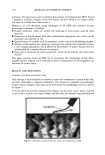
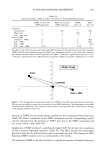
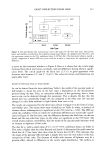
LIGHT REFLECTION FROM HAIR 311 3,5 3,0 2,5 2,0 1,5 1,0 I I 0.07 0.001 I I o.12 --I-- +1.96'Std. Err. [--I +1.00*Std. Err. ß Mean black brown blonde Hair Type Figure 8. Box-and-whisker plot summarizing cuticle scale angles for the three hair types. Data points, boxes, and whiskers are defined by the arithmetic group means (Mean), the standard errors (Std. Err.), and the expectation values for the 95% confidence limits (1.96*Std. Err.). The horizontal whiskers signify a specific comparison of means (LSD test) given with the (x-value to characterize the significance of the difference. as given on the horizontal whiskers in Figure 8. Here it is shown that the cuticle angle decreased from black over brown to blonde, with all differences having relevant signifi- cance levels. The cuticle angle for the black hair (2.5 ø ) is in good agreement with literature data between 2.5 ø and 3 ø (1,4,11). The values for brown and blonde hair are appreciably lower. WIDTH OF SPECULAR PEAK AT HALF HEIGHT As can be derived from the data underlying Table I, the width of the specular peaks at half height w s shows for none of the hair types a dependence on the measurement position along the hair. Thus, no continuous influence of hair grooming, that is, from root to tip, can be detected through this parameter. This is despite the fact that the blonde hair was considerably longer (30 cm) compared to the other ones (20 cm) and changed its color from medium to light blonde from root to tip. The results are summarized for the three types of hair in Figure 9 in the form of a box- and-whisker plot. The means show some variability (see Table I), where, as analysis of variance shows, inhomogeneity is significant at the 95% level (o• = 0.02). The LSD test yields the confidence levels on which the individual differences are statistically signifi- cant (see Figure 9). On this basis, only the differences between the black hair, on the one hand, and the two other hair types, on the other, are significant at the 95% level. The overall results indicate, nevertheless, that the width of the specular peak decreases with an increase in lightness of hair color. The data for w s yield a grand mean of 9.5 + 0.35 ø (95% confidence limits see Table I). This value is higher than the value Bustard and Smith (1) determined for gold-coated or black hair (8.3 ø ) but lower than their value for brown hair (10.8ø). This indicates that the origin of the specular reflected light is largely from near the very surface of the hair, irrespective of hair color. The decrease of width with increase of lightness may be a genuine effect, related to differences in the cuticle angle distribution. The authors, at
Purchased for the exclusive use of nofirst nolast (unknown)
From: SCC Media Library & Resource Center (library.scconline.org)