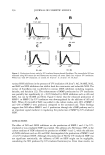
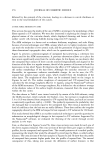
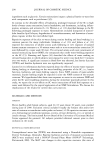
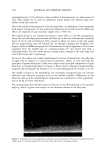
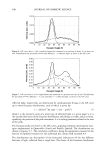
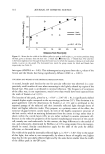
312 JOURNAL OF COSMETIC SCIENCE 11,5 -•- 11,0 ß 10,5 --• 10,0 • 9,5 • 9,0 ß 13 8,5 8,0 I t 0,035 t t0.005 --[-- _+1.96'Std. Err. • +1.00*Std. Err. ß Mean I to.5o black brown blonde Hair Type Figure 9. Box-and-whisker plot, summarizing the values for the width of the specular peak at half height, ws, for the three hair types (see Figure 8). this stage of the investigation, would tend to assume, however, that the effect is related to a tendency of the fit algorithms to detect narrower distributions for specularly reflected light with decreasing prominence of the related peak in the GP curve. Gen- erally, the width of the specular peak for a given type of hair is a measure of the distribution of cuticle angles and can serve to assess surface damage, for a hair before and after a cosmetic treatment. LOCATION OF THE DIFFUSE REFLECTION PEAK For an ideal diffuse reflector, diffuse backward scattering would be uniform in intensity. With the strong directional component for this type of light, this condition is obviously not fulfilled for the surface of hair. The results in Table I for the different fiber types at their root ends (1 cm), where all hairs are largely undamaged, show values between 43 o and 46 ø that are not significantly different (ANOVA: o• = 0.64). The values are higher than those of the respective receptor angles for specular reflection (350-36 ø ) and even higher than that of the expected receptor angle for a fiat, specularly reflective surface (40ø). For the black, Asian hair the group means for the position of the peak location for diffuse reflection is 40 ø (see Table I). This effect is due to the fact that •/d decreases significantly from root to tip (LR: o• = 0.006 see Figure 10), paralleled by possibly a slight increase in the cuticle angle, as discussed above. There appears no straightforward explanation for this phenomenon, apart from the assumption that it is related to systematic and an- tagonistic changes of the hair surface due to grooming. For the brown hair the receptor angle for diffuse reflections remains unchanged along the hair (ANOVA: o• = 0.4), yielding a group mean of 45 ø + 1.4 ø. The apparent shift of•/o to higher angles for the blonde hair (see Figure 10) is not significant (LR: o• = 0.16), yielding the group mean of 46 ø _+ 1 ø, which is not significantly different from that for the brown hair (LSD: (x = 0.44). The 5 ø-6ø shift of the diffuse reflection peak with respect to the expectation value of 40 ø is attributed to the fact that diffuse reflection mainly occurs at various locations near the

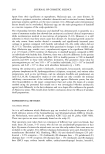
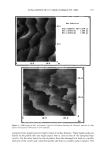
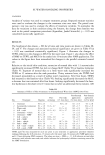
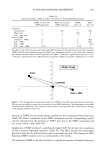
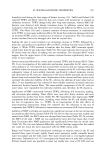
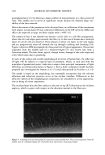
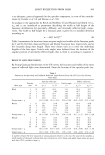
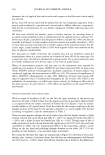
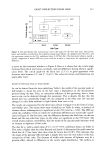
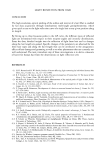
LIGHT REFLECTION FROM HAIR 313 ,• 5o .0 [•5] 0 blonde g 45 0 • 0 [] [] brown • 40 o 35 ß • y= 43.1 -0.36x o 3O •' 0 5 10 15 20 25 30 35 Distance fro• Hair Root [c•] Ei•urc tO. •ea•s Cot [he posido• o½ [he diffuse re•ecdo• peak a[ hM½ hei•b[, •, a[ vadous posido•s ato• •he hair, •ive• as distance ½rom •he hair tool ß btack hair, • brow• hair, • bto•de hair. The soiM is d•e H•ear re•ressio• i•e •hrou•h •he da•a Cot black hair, Cot which •he e•uadom retad• •o Mt resuks, is •Ne• o• •he •rap•. The horizontal t•es o• •he ri•h• mark •he •roup mea•s Cot brow• a•d hair, respecdvety (see Table D. fiber surface, that is, in the multilayered structure of the cuticle, where systematic and pronounced differences in the refractive index and/or gaps between the cuticle layers are expected to play an important role (11). It is interesting to note, however, that this effect is similar in size but opposite in direction to the shift of the specular reflection angle, due to the cuticle inclination. This effect will be the objective of further inves- tigations. WIDTH OF THE DIFFUSE REFLECTION PEAK The diffuse peaks show very similar overall widths, with group means between 47 ø and 50 ø, thus being, by a factor of about five, broader than the specular peak (see Table I). For the black Asian hair this width shows an apparent slight increase from root (43.7 ø ) to tip (48.9ø), where the slope of the linear regression line just misses to be significant at the 95% level (or -- 0.053). This effect corresponds to the systematic decrease of •/d towards the tip region for this type of hair. The data are summarized in Figure 11. For the brown hair, w d increases significantly from root to tip (LR: ot = 0.002). The regression line through the data is shown in Figure 11. For the black and the brown hair, where diffuse reflection will mainly occur at or close to the fiber surface, this change in the width of the related peak is attributed to increased damage of the hair from root to tip due to grooming, which leads to damage to the cuticle edges, chipping of exocuticle, and exposure of rough fracture surfaces in the endocuticle (10). For the blonde hair, the width of the diffuse reflectance peak has a group mean of 46.4 ø and is independent of the position on the hair. Analysis of variance shows that group-wise there are significant differences between the
Purchased for the exclusive use of nofirst nolast (unknown)
From: SCC Media Library & Resource Center (library.scconline.org)