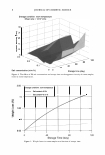
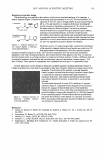
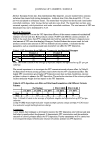
32 JOURNAL OF COSMETIC SCIENCE In the present article the tilted plane has been replaced by a horizontal plane at height (h 1 + h2)/2. (See Appendix I.) This value is obviously too low. The correct value is obtained by integration of the volume from h2 to the h value for the correct plane and by putting the value of that integral equal to the value of the integral from the plane in question to the plane at h 1 . The integrals are in principle rather simple: V = h 2J h Adh, in which the A is the area of the truncated circle. A is obtained from an integral A = 2 -dJ R (R 2 - d2)112dd, which per se has an explicit solution: J(R 2 - d2)112dd = (1/2)[d(R2 - d2) 112 + R 2 arcsin(d/R)}. The expression is simplified by putting R = 1. J(1 - d2)112dd = (1/2)[d(l - d2)112 + arcsin(d)} in which d is measured in radians. For the present case, both R and d are functions of h, a fact which complicates the inte gration process. Fortunately, the dependence of both the d and the R on h is linear and a numeric evaluation is possible. With d = ah + b and R = ch + d, dd = adh and the integral to calculate the surface of the truncated circle becomes A = [a / (c2 - a2)112} J [(h2 + 2h{dx - ab) / (c2-a2)} + (d2-b2) / (c2 -a2)}112dh. The correct value of h for the dividing plane is obtained from the equation h 2J h Adh = h J h 1 Adh.

J. Cosmet. Sci., 59, 33-40 Qanuary/February 2008) Isolation and characterization of Streptomyces hiroshimensis strain TI-C3 with anti-tyrosinase activity TE-SHENG CHANG, MIN TSENG, HSIOU-YU DING, and SORGAN SHOU-KU TAI, Department of Biological Science and Technology, National University of Tainan, 33 Sec. 2, Shu-Lin St., Tainan (T. -S. C.), Bioresources Collection & Research Center, Food Industry Research & Development Institute, Hsinchu ( M. T. ), Department of Cosmetics Science, Chia Nan University of Pharmacy and Science, Tainan (H.-Y.D.), and Department of Biotechnology, National Formosa University, Yunlin (S.S.-K.T.), Taiwan. Accepted for publication August 28, 2007. Synopsis A bacterial strain, TI-C3, was isolated and verified to display 498 U/ml of anti-tyrosinase activity. Based on morphological, physiological, and chemical analysis, gyr B sequences, and DNA-DNA hybridization analy sis, the strain TI-C3 was identified as a strain of Streptomyces hiroshimensis. The anti-tyrosinase activity of the strain was improved to 905 U/ml under cultivation, using glucose and malt extract as the sole carbon and nitrogen sources, respectively. INTRODUCTION Tyrosinase (EC 1.14.18.1) is a copper-containing monooxygenase widely distributed in nature. The enzyme catalyzes the first two reactions of melanin synthesis, the hydrox ylation of 1-tyrosine to 3,4-dihydroxyphenylalanine, 1-dopa, and the oxidation of 1- dopa to dopaquinone. This o-quinone is a highly reactive compound and can polymerize spontaneously to form melanin (1). Although the pigment melanin in human skin is a major defense mechanism against the ultraviolet light of the sun, the production of abnormal pigmentation such as melasma, freckles, age-spots, liver spots, and other forms of melanin hyperpigmentation can be a serious aesthetic problem (2). Hence, inhibiting the tyrosinase activity and preventing the abnormal pigmentations has been the subject of many studies (3-7). In our laboratory, we were interested in looking for actinomycetes with anti-tyrosinase activity. We used the high-throughput screening method by employing 48-well mi- Address all correspondence to Te-Sheng Chang. 33
Purchased for the exclusive use of nofirst nolast (unknown)
From: SCC Media Library & Resource Center (library.scconline.org)