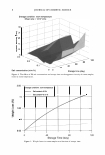
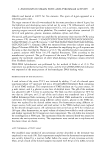
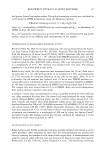
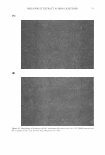
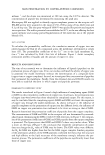
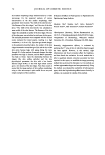
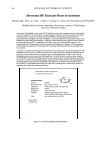
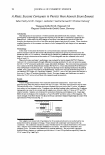
64 JOURNAL OF COSMETIC SCIENCE a) 6 a ::1. I � 4- + "C I!! + C • G) a. 0 2 c :::J E a, ♦ 0 I I I 7 0 8 16 24 32 40 48 56 64 72 80 time [h] b) 4 a :i � 3- en (!) ..... I!! 2 • C • 0 • c :::J 1 0 E (U ♦ 0 I I 0 8 16 24 32 40 48 56 64 72 time [h] Figure 1. The permeation profiles of peptide GSH from (a) copper complex GSH-Cu and (b) peptide. ESI-MS STUDY The other significant factor playing a key role in the migration processes is the equi librium of the complexes in the acceptor solution. Finally, from the obtained data and ESI-MS results, we were able to establish the form in which copper and the peptides permeate. As shown in Figure 2, we could find a lot of molecules in the acceptor cell by ESI-MS study. During the study of the penetration ability of peptides we could find species in acceptor cells (GHK and GSH).

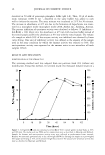
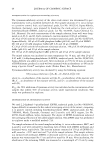
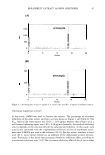
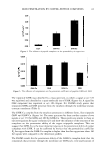
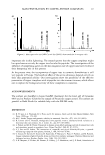
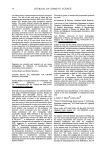
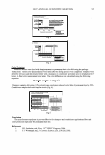
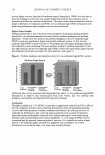
(I) E 0 U) 0 � SKIN PENETRATION BY COPPER-PEPTIDE COMPLEXES 65 2,50 2,00 ';"(I) •E 1,50 0 U) 0 � 1,00 0,50 0,00 Cu2+ GSH-Cu GHK-Cu Figure 2. The influence of peptide complexes on the permeability of copper ions. 0,020 0,015 0,010 0,005 0,000 GHK-Cu GHK GSH-Cu GSH Figure 3. The influence of complexation on the permeation coefficients of peptides GHK and GSH. The tripeptide GHK was identified by a mass spectrum, in which a signal at m/z 339 was registered and identified as a quasi-molecular ion of GHK (Figure 4a). A signal for GSH compound was registered at m/z 306 (Figure 46). ESI-MS study proves that tripeptides GHK and GSH penetrate from the emulsion through the modeling stratum corneum membrane (Table I). The GHK-Cu complex from the emulsion penetrates in different forms, like tripeptide GHK and GHK-Cu (Figure 5a). The mass spectrum for these studies consists of two signals at m/z 339 for GHK and 400 for GHK-Cu. These results are similar to those in our investigations for aquae's solution (25) and show the influence of the structure of the complexes on the penetration ability of the copper tripeptide complexes. This can suggest that GHK-Cu is the most important species in the penetration ability of copper complexes with GHK. It can be confirmed by the fact that the permeability coefficient K P for copper from the GHK-Cu complex is higher than that for copper ions alone. All the signals were compared to the theoretical profiles. The ESI-MS results for the penetration ability of the GSH-Cu complex show that the compounds that penetrate through the membrane are GSH and a very small amount of
Purchased for the exclusive use of nofirst nolast (unknown)
From: SCC Media Library & Resource Center (library.scconline.org)