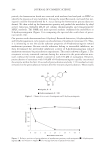
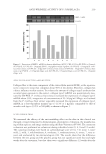
JOURNAL OF COSMETIC SCIENCE 222 was over two times higher than that of oleanolic acid (IC50 = 83.8 μg/ml). P. strobilacea fruit extract reduced the expression of MMP-1 mRNA (up to about 70% at 50 μg/ml). Ellagic acid was isolated as a main component and identifi ed using spectroscopic analysis. In the MMP-1 mRNA expression assay on human fi broblast cells stimulated by UVA radiation, ellagic acid slightly reduced the expression of MMP-1 mRNA about 15% at 1 μg/ml while P. strobilacea fruit extract reduced it about 70% at 50 μg/ml. P. strobilacea fruit extract and ellagic acid increased the expression of type I collagen mRNA in a dose- dependent manner (up to 37% and 41% at 20 μg/ml and 1.0 μg/ml, respectively), compa- rable to that of ascorbic acid (up to 39% at 500 μM). P. strobilacea fruit extract showed no cytotoxicity up to the effective concentration for anti-wrinkle activity. In this clinical study, the test and placebo formulation (the test cream contained 0.2% P. strobilacea fruit extract and the placebo did not) were compared. The visual evaluation and image analysis used in this study showed a statistically signifi cant difference (p 0.05) between the ef- fects of the tested formulation and the placebo 12 weeks after the treatment. All of these results suggest that Platycarya strobilacea fruit extract could be used as an active ingredi- ent for new anti-wrinkle cosmetics. ACKNOWLEDGMENTS This work was supported by a grant from the Korean Ministry of Commerce, Industry, and Energy, entitled “The development of cosmeceutical ingredients from natural plants like Nymphaea tetragona of Jeju plant” (Subject Number 2006-10027299), as part of a regional specialization technique development project within a regional industry promo- tional project of the Ministry of Commerce, Industry, and Energy. REFERENCES (1) B. A. Gilchrest, M. Garmyn, and M. Yaar, Aging and photoaging affect gene expression in cultured human keratinocytes, Arch. Dermatol., 130, 82–86 (1994). (2) J. H. Chung and H. C. Eun, Angiogenesis in skin aging and photoaging, J. Dermatol., 34, 593–600 (2007). (3) B. A. Gilchrest, Skin aging and photoaging: An overview, J. Am. Acad. Dermatol., 21, 610–613 (1989). (4) A. Perrin, E. Bauza, C. D. Farra, and N. Domloge, Stimulating effect of collagen-like peptide on the extracellular matrix of human skin: Histological studies, Int. J. Tissue React., 26, 97–104 (2004). (5) G. J. Fisher, The pathophysiology of photoaging of the skin, Cutis, 75, 5–8 (2005). (6) J. H. Chung, S. H. Youn, O. S. Kwon, H. C. Eun, K. H. Kim, K. C. Park, K. H. Cho, and J. I. Youn, Enhanced proliferation and collagen synthesis of human dermal fi broblasts in chronically photodam- aged skin, Photodermatol. Photoimmunol. Photomed., 12, 84–89 (1996). (7) H. Birkedal-Hansen, W. G. Moore, M. K. Bodden, L. J. Windsor, B. Birkedal-Hansen, A. DeCarlo, and J. A. Engler, Matrix metalloproteinases: A review, Crit. Rev. Oral Biol. Med., 4, 197–250 (1993). (8) P. Brenneisen, J. Oh, M. Wlaschek, J. Wenk, K. Briviba, C. Hommel, G. Herrmann, H. Sies, and K. Scharffetter-Kochanek, Ultraviolet B wavelength dependence for the regulation of two major matrix- metalloproteinases and their inhibitor TIMP-1 in human dermal fi broblasts, Photochem. Photobiol., 64, 877–885 (1996). (9) Y. Kawaguchi, H. Tanaka, and T. Okada, The effects of ultraviolet A and reactive oxygen species on the mRNA expression of 72-kDa type IV collagenase and its tissue inhibitor in cultured human dermal fi - broblasts, Arch. Dermatol. Res., 288, 39–44 (1995). (10) H. Watanabe, T. Shimizu, J. Nishihira, R. Abe, T. Nakayama, M. Taniguchi, H. Sabe, T. Ishibashi, and H. Shimizu, Ultraviolet A-induced production of matrix metalloproteinase-1 is mediated by macrophage migration inhibitory factor (MIF) in human dermal fi broblasts, J. Biol. Chem., 279, 1676–1683 (2004).

ANTI-WRINKLE ACTIVITY OF P. STROBILACEA 223 (11) P. J. Atkinson and T. Upson, Platycarya strobilacea Juglandaceae, Curtis’s Botanical Magazine, 23, 77–83 (2006). (12) T. Tanaka, Z. H. Jiang, and I. Kouno, Distribution of ellagic acid derivatives and a diarylheptanoid in wood of Platycarya strobilacea, Phytochemistry, 47, 851–854 (1998). (13) D. D. Jang, D. W. Shin, C. M. Hong, J. C. Cho, and J. H. Han, Modifying effects of ellagic acid in food on carcinogenesis, J. Food. Hyg. Safety, 13, 29–33 (1998). (14) Y. H. Kim, K. S. Kim, C. S. Han, H. C. Yang, S. H. Park, K. I. Ko, S. H. Lee, K. H. Kim, N. H. Lee, J. M. Kim, and K.-H. Son, Inhibitory effects of natural plants of Jeju Island on elastase and MMP-1 expression, J. Cosmet. Sci., 58, 19–33 (2007). (15) Y. H. Kim, C. B. Chung, J. G. Ki, K. I. Ko, S. H. Park, J.-H. Kim, S. Y. Eom, Y. S. Kim, Y.-I. Hwang, and K. H. Kim, Anti-wrinkle activity of ziyuglycoside I isolated from a Sanguisorba offi cinalis root ex- tract and its application as a cosmeceutical ingredient, Biosci. Biotechnol. Biochem., 72, 303–311 (2008). (16) M. S. Blois, Antioxidant determinations by the use of a stable free radical, Nature, 29, 1199–1200 (1958). (17) J. A. Kraunsoe, T. D. W. Claridge, and G. Lowe, Inhibition of human leukocyte and porcine pancreatic elastase by homologues of bovine pancreatic trypsin inhibitor, Biochemistry, 35, 9090–9096 (1996). (18) J. H. Chung, S. H. Lee, C. S. Youn, B. J. Park, K. H. Kim, K. C. Park, K. H. Cho, and H. C. Eun, Cutaneous photodamage in Koreans, Arch. Dermatol., 137, 1043–1051 (2001). (19) B. A. Jurkiewicz and G. R. Buettner, Ultraviolet light-induced free radical formation in skin: An elec- tron paramagnetic resonance study, Photochem. Photobiol., 59, 1–4 (1994). (20) O. Wiedow, J. M. Schroder, H. J. Gregory, A. Young, and E. Christophers, Elafi n: An elastase-specifi c inhibitor of human skin. Purifi cation, characterization, and complete amino acid sequence, J. Biol, Chem., 265, 14791–14795 (1990). (21) A. N. Corps, V. A. Curry, D. J. Buttle, B. L. Hazleman, and G. P. Riley, Inhibition of interleukin-1 beta-stimulated collagenase and stromelysin expression in human tendon fi broblasts by epigallocatechin gallate ester, Matrix Biol., 23, 163–169 (2004). (22) S. Y. Kim, D. S. Kim, S. B. Kwon, E. S. Park, C. H. Huh, S. W. Youn, S. W. Kim, and K. C. Park, Protective effects of EGCG on UVB-induced damage in living skin equivalents, Arch. Pharm. Res., 28, 784–790 (2005).
Purchased for the exclusive use of nofirst nolast (unknown)
From: SCC Media Library & Resource Center (library.scconline.org)