JOURNAL OF COSMETIC SCIENCE 206 (12,13). Among them, two hydroxylated soy isofl avone derivatives, 8-hydroxydaidzein and 8-hydroxygenistein, biotransformed by A. oryzae, possessed a vastly higher inhibitory activity than their precursors, the soy isofl avones daidzein and genistein. Based on our previous fi ndings, we are interested to know whether other kinds of fl avonoids could also be biotransformed by A. oryzae. If the answer is yes, what are the metabolites’ effects on mushroom tyrosinase activity? In the present study, a biotransformed metabolite of nar- ingenin was isolated from the fermentation broth of Aspergillus oryzae fed with naringenin and identifi ed as 8-hydroxynaringenin based on the mass and 1 H- and 13 C-NMR spectral data. The inhibitory property of the metabolite toward mushroom tyrosinase was inves- tigated. MATERIALS AND METHODS MICROORGANISMS AND CHEMICALS Lyophilized culture of A. oryzae BCRC 32288 was obtained from the Bioresources Collec- tion and Research Center (BCRC) of the Food Industry Research and Development Insti- tute (FIRDI, Hsinchu, Taiwan, ROC). The stock culture was grown on potato dextrose agar (PDA) and maintained at 25°C. Spore suspension of A. oryzae was prepared in sterile water and used for inoculation. Mushroom tyrosinase (5370 U/mg), L-DOPA, dimethyl sulfoxide (DMSO), Sephadex LH-20 gel, and naringenin were purchased from Sigma Chemical (St. Louis, MO). Yeast extract, malt extract, peptone, agar, and potato dextrose agar (PDA) were obtained from Difco Laboratories (Detroit, MI). High-performance liq- uid chromatography (HPLC)-grade acetonitrile and acetic acid were obtained from J.T. Baker (Phillipsburg, NJ). The other reagents and solvents used are commercially avail- able and were used as received. FUNGAL CULTIVATION AND METABOLITE PURIFICATION The cultivation condition and the medium used for A. oryzae BCRC32288 were exactly according to the data sheet from the BCRC of the FIRDI. The fermentation experiments were carried out in 250-ml baffl ed Erlenmeyer fl asks containing 20 ml of the medium in the presence of 250 μg naringenin per ml of the medium. Two liters of the cultivations were carried out for metabolite purifi cation. Cultures were incubated for two days with a rotary shaker at a speed of 120 rpm/min and 30°C then the cultivations were combined and extracted with two liters of ethyl acetate. The ethyl acetate extract was dried under a vacuum. The dry mass (5.8 g) was resuspended with 10 ml of methanol and then fraction- ated by Sephadex LH-20 gel column chromatography (50 cm × 2.6 i.d.) with methanol as an eluent. Every 50 ml of elution was collected and 20 μl of each fraction was analyzed by HPLC to identify the metabolite’s presence. The operational conditions for the HPLC analysis by an analytic C18 reversed-phase column (Spherisorb, 5 μm, 4.6 i.d. × 250 mm, ODS 2, phase separation, Deeside Industrial Park, Clwyd, UK) consisted of an isocratic elution for 15 min with 35% acetonitrile in 1.0% (v/v) acetic acid at a fl ow rate of 1 ml/ min, and detection of absorbance at 280 nm. Fractions 11 to 15 from Sephadex LH-20 gel column chromatography were identifi ed to contain the metabolite and were dried under a vacuum. The dried mass (2.1 g) was then purifi ed by repeated HPLC using a

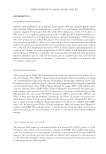
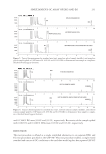
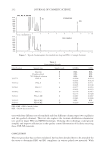
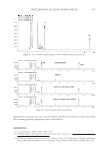
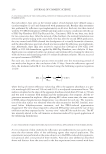
A TYROSINASE SUICIDE SUBSTRATE: 8-HYDROXYNARINGENIN 207 semi-preparative C18 reversed-phase column (Spherisorb, 5 μm, 10 i.d. × 250 mm, ODS 2, phase separation). The preparative HPLC conditions were the same as those for analytic HPLC, with the exception of the fl ow rate (3 ml/min) and the injection volume (0.2 ml). The elutions of the metabolite peak were collected and dried under a vacuum. The fi nal purifi ed metabolite (14.2 mg) was analyzed by mass and NMR spectroscopy. INSTRUMENTAL ANALYSIS OF ISOLATED METABOLITES 1 H-NMR spectra were recorded with a Varian Gemini NMR spectrometer at 400 MHz, and 13 C-NMR spectra with a Varian Gemini NMR spectrometer at 100 MHz in DMSO. FAB MS were obtained with a JEOL TMSD-100. The metabolite’s 1 H- and 13 C-NMR spectral data were consistent with those of 8-hydroxynaringenin shown in the literature (14). IRREVERSIBLE INHIBITORY ACTIVITY ASSAY In irreversible inhibitory activity assays, 20 units of tyrosinase was preincubated with 100 μM of the tested samples (dissolved in DMSO) in 1 ml of 50 mM phosphate buffer (pH 6.8) at 25°C. At intervals of 0, 0.5, 2.5, and 5 min, 200 μl of the preincubation mixture was mixed with 800 μl of 2.5 mM L-DOPA. The reaction mixture’s absorbance at 475 nm was monitored every second with a spectrophotometer. The initial reaction rate was measured from the slope of the linear time-dependent increase in absorbance at 475 nm due to the formation of dopachrome produced from L-DOPA by mushroom ty- rosinase. The sample’s relative activity was calculated by dividing its initial rate by that of the control reaction at the beginning, in which DMSO replaced the added sample. DETERMINATION OF THE PARTITION RATIO OF SUICIDE SUBSTRATES OF MUSHROOM TYROSINASE The suicide substrate’s partition ratio was determined according to Waley’s method by incubating 200 μl of preincubation mixture containing 20 units of tyrosinase (0.03 μM) and 0.9–9.0 μM of 8-hydroxynaringenin at 25°C for 30 min (15). Then 800 μl of 2.5 mM L-DOPA was added to each preincubation mixture, and the reaction mixture’s initial rate was determined as described above. Each reaction’s relative activity was calculated by dividing the reaction’s initial rate with the suicide substrate by that of the reaction with- out the suicide substrate. The suicide substrate’s partition ratio could be determined by plotting the fractional activity remaining against the ratio of the initial concentration of the suicide substrate to that of the enzyme. All enzymatic experiments were repeated at least twice in order to ensure the reproducibility of the results, and the mean values ± SD are reported here. RESULTS AND DISCUSSION In an early step of this study, we selected four fl avonoids that belong to different classes including apigenin (fl avone), quercetin (fl avonol), naringein (fl avanone), and catechin as the precursors to study the biotransformation of fl avonoids by A. oryzae. The tested fl avo- noids were added to the medium and cultivated with the fungus. For different cultivation
Purchased for the exclusive use of nofirst nolast (unknown)
From: SCC Media Library & Resource Center (library.scconline.org)