JOURNAL OF COSMETIC SCIENCE 226 This is problematic because such adulterated materials can present serious public health risks and consequences. Recent examples of EMA that resulted in deaths include the 2008 adulteration of milk and infant products with melamine (12), and the diethylene glycol adulteration of glycerin (Nigeria 2008–2009, Panama 2006, India 1998, and Haiti 1995) (9,10), which will be addressed here. In response to this, the FDA requested that the USP incorporate into the identity section of its glycerin monograph the require- ment for fi nished product manufacturers to assay and confi rm that DEG and EG meet the limit maximum of 0.10% (each) this updated glycerin monograph became offi cial in May 2009. In addition, the FDA/USP has incorporated similar DEG and EG require- ments into its updated monographs for propylene glycol and for sorbitol solutions, effective February 2010 (2,3). The monographs for these three materials detail a simul- taneous DEG and EG assay, but require different standard solutions depending upon whether the incoming sample is glycerin, propylene glycol, or a sorbitol solution. In addition, monograph GC tests for the DEG and EG in glycerin and propylene glycol use a G43 stationary phase while the test for sorbitol solutions details a G46 stationary phase. Polyethylene glycols (PEG) and polyethylene glycol monomethyl ethers (MPEG) have a USP-NF maximum level of 0.25% for the combination of DEG and EG their USP-NF test procedures utilize older technology, packed-column gas chromatography (GC). Higher-molecular-weight samples of PEG and MPEG require unwieldy, time- consuming vacuum distillation followed by separation and colorimetric quantitation of the total of DEG and EG (1). Current offi cial USP-NF test procedures (1) for these polyol-type materials detail: (1) Capillary GC using phase G43 for glycerin samples and propylene glycol samples (2) Capillary GC using phase G46 for sorbitol solutions (3) Packed-column GC using phase G13 for PEG samples with nominal molecular weight less than 450, with quantitation done by peak height (4) Packed-column GC using support S2 for MPEG samples with nominal molecular weight less than 600, with quantitation done by peak height (5) Complex vacuum distillation followed by colorimetric total assay for PEG sam- ples with nominal molecular weight 450 or above, but not more than 1000, and MPEG samples with nominal molecular weight 600 or above but not more than 1500 The FDA states that “a manufacturer may use an equivalent identifi cation procedure that includes a test to detect and quantify DEG provided it meets the relevant safety limit.” (3). Advances in capillary gas chromatography have greatly enhanced capabilities for re- solving complex mixtures frequently, the resolving capacity of capillary columns can eliminate the need for extensive sample preparations or cleanups. In reality, any EMA with DEG or EG would occur at levels much higher than the USP-NF limits, and so any test procedure that could simply determine levels at the USP-NF limits or higher should be able to be utilized if documented. Since the author had expertise (including publica- tions) for components similar to DEG and EG, and with matrices such as these, it was logical for this to be investigated using modern techniques. The sought-for analytes and the sample components themselves were reacted with BSTFA trimethylsilyl derivatizing agent, then taken for capillary GC analysis. The sample preparation is straightforward and requires approximately fi ve minutes, and GC quantitation is completely automated, including calculations of the DEG and EG levels.

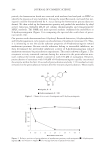
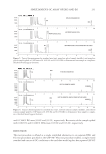
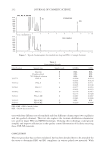
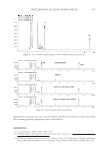
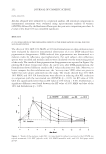
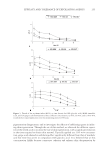
SIMULTANEOUS GC ASSAY OF DEG AND EG 227 EXPERIMENTAL INSTRUMENTS AND CONDITIONS Analyses were performed on an Agilent Technologies 5890 gas chromatograph system that included a fl ame ionization detector, a model 7673 autosampler, and ChemStation software (Agilent Technologies, Palo Alto, CA). The column was a 30-m ´ 0.32-mm i.d. HP-5 fused silica capillary column coated with 5% diphenyl–95% dimethylsiloxane co- polymer (crosslinked) at 0.25-mm fi lm thickness (Agilent Technologies #19091J-413). The inlet split liner was an SGE FocusLiner. The column was installed into a split/split- less injection port held at 300°C and connected to a fl ame ionization detector held at 300°C the carrier gas was helium held at 10 psi head pressure with a split ratio of about 30:1. The GC oven temperature was held at 90°C for four minutes, then programmed at a rate of 10.0°C/min. to reach a temperature of 280°C, where it was then held constant for fi ve minutes. With these conditions, the retention times for silylated ethylene glycol, silylated propylene glycol, silylated diethylene glycol, silylated glycerin, and silylated sorbitol were approximately 2.8 minutes, 3.1 minutes, 7.7 minutes, 8.2 minutes, and 17 minutes, respectively. REAGENTS AND SOLUTIONS ACS reagent grade DMF (N,N-dimethylformamide) was obtained from Fisher Scien- tifi c (Pittsburgh, PA). BSTFA reagent (bis[trimethylsilyl]-trifl uoroacetamide containing 1% trimethylchlorosilane) was obtained from Regis Technologies (Morton Grove, IL). Diethylene glycol, ethylene glycol, glycerin, and propylene glycol reference standards were purchased from either USP or Sigma Aldrich (St. Louis, MO). USP sorbitol solu- tion was obtained from ADM (Archer Daniels Midland). Real-world USP-grade glyc- erin samples were produced by Dial Corporation’s bar soap manufacturing facility (Montgomery, IL, now owned by VVF Corporation) PEG-6 methyl ether, PEG-8, and PEG-12 were provided by Lambent, Huntsman, and Dow. To prepare the mixed stan- dard solution, about 0.15 g each of DEG and EG were accurately weighed (± 0.0001 g) into a single 100-ml volumetric fl ask, then mixed and diluted to volume with DMF then 5.00 ml was pipetted into a 50-ml volumetric fl ask and mixed and diluted to volume with DMF. On each day of use, a 250-ml portion from the dilute mixed stan- dard was transferred to an autosampler vial where it was mixed with 500 ml of BSTFA reagent. ASSAY PROCEDURE AND CALCULATION Two and one half grams of well-mixed sample was weighed (± 0.0001 g) into a 25-ml volumetric fl ask and mixed and diluted to volume with DMF. Two hundred fi fty micro- liters was transferred to an autosampler vial where it was mixed with 500 ml of BSTFA reagent. Two microliters was then injected into the GC and compared to 2-ml injections of the silylated standard mixture. Routine external standard calculations were used to determine percent DEG and EG.
Purchased for the exclusive use of nofirst nolast (unknown)
From: SCC Media Library & Resource Center (library.scconline.org)