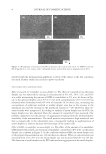
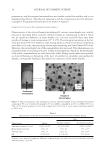
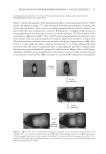
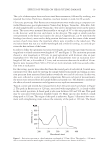
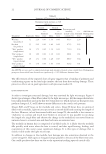
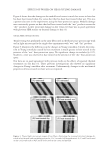
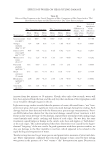
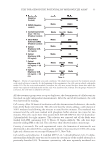
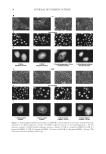
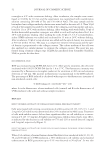
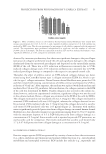
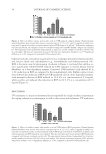
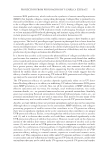
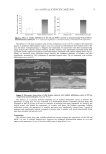
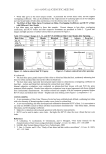
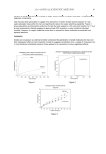
JOURNAL OF COSMETIC SCIENCE 22 The effectiveness of the repeated doses of spray suggests that a buildup of polymers and conditioning agents on the hair helps insulate the hair from heat-styling damage. These protective effects are in good agreement with previous studies (9). LIGHT MICROSCOPY In order to investigate structural damage, hair was examined by light microscopy. Figure 4 shows typical images of hair fi bers taken by the light microscope. All the images shown have been taken from fi bers used in the fi rst wet-versus-dry test, which did not use heat-protection products. Images A, C, and E show no major differences in the cuticle scale patterns. Images B,D, and F focus on the medulla and cortex. Image B shows how, in untreated fi bers with a medulla, light microscopy reveals a smooth dark band running the length of the hair. However, in hair heat treated while wet (image D), the medulla is less intense in “darkness” or contrast and much more broken in structure. It was possible to run along the length of a single fi ber and observe the change in the medulla as one moved from an untreated area to a treated area and then back into an untreated area. The medulla in human hair is comprised of air-fi lled sacks. It is likely that the medulla fi lls quickly with water when the hair is wetted, and that rapid heating, boiling, and evaporation of this water causes signifi cant damage. It is this type of damage that is clearly visible under the light microscope. In addition to changes in the medulla, heat damage was also sometimes observed in the cortex (image D). Dark spots or elongated strips (parallel to the axis of the fi ber) were seen. One could speculate that these are due to the separation/cracking apart of cortical cells. Table II Summary of Fluorescence Spectroscopy Data Treatment Replicates Normalized peak intensity at 328 nm (a.u.) Percentage peak intensity, treated versus control (%) +/− Standard error ANOVA test Homogenous groups Control Treated Mean +/− Standard error Mean +/− Standard error Wet hair (no product) 32 2.29 0.07 1.45 0.04 64.37 2.20 Dry hair (no product) 33 2.12 0.05 1.40 0.02 67.53 2.03 “Wet” product (single doses) 36 1.72 0.05 1.19 0.03 71.10 2.36 “Dry” product (single doses) 36 1.99 0.04 1.36 0.03 68.81 1.61 “Wet” product (repeat dosing) 29 1.71 0.06 1.48 0.07 88.67 3.94 “Dry” product (repeat dosing) 33 1.76 0.05 1.60 0.05 92.62 3.81 An ANOVA test was used to compare percentage peak intensity (treated versus control) data. Homogenous groups are those which have data with no signifi cant (p 0.05) difference between them.

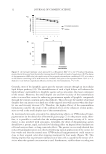
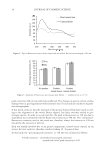
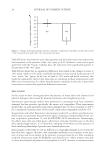
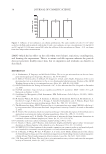
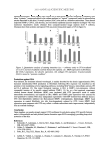
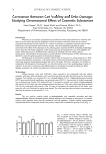
EFFECTS OF WATER ON HEAT-STYLING DAMAGE 23 Figure 4 shows that the damage to the medulla and cortex is much less severe in hair that has been heat treated when dry, versus hair that has been heat treated when wet. This was a pattern also seen in the experiments using the heat-protection sprays. Medulla damage was consistently greater on hair that had been treated with the “wet” products versus the “dry” products. Lower structural damage in dry versus wet hair was in good agreement with previous SEM studies on thermal damage to hair (4). SINGLE-FIBER TENSILE TESTING Tensile testing was performed on the same fi bers used in the fl uorescence spectroscopy work and in light microscopy for the single-dose experiments with “wet” and “dry” products. Figure 5 illustrates the differences in the changes in Young’s modulus. Clearly, the reduc- tion in Young’s modulus caused by heat treatment is much greater in hair treated in the presence of the “wet” heat-protection spray. No signifi cant change in modulus (p0.05, Student’s t-test) was observed in hair treated in the presence of the “dry” heat-protection spray. Our data are in good agreement with previous work on the effects of repeated thermal treatments on dry hair (4). These previous investigations also showed no signifi cant changes in Young’s modulus after treatment. Unfortunately, changes in the mechanical properties of heat-treated wet hair were not reported. Figure 4. Typical light microscopy images of hair fi bers, illustrating the increased structural damage ob- served in hair treated with straightening irons for 12 × 5 seconds (×60 magnifi cation). A, C, and E are focused on the cuticle and surface. B,D, and F are focused on the cortex and medulla.
Purchased for the exclusive use of nofirst nolast (unknown)
From: SCC Media Library & Resource Center (library.scconline.org)