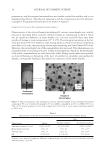
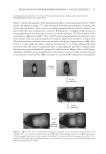
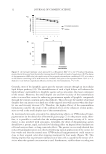
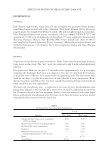
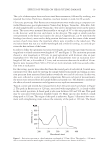
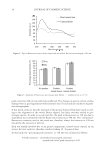
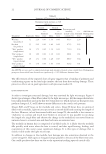
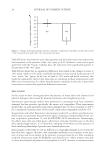
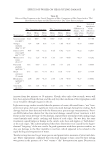
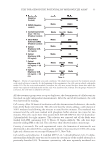
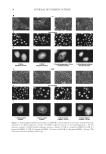
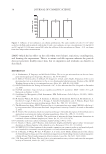
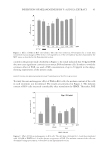
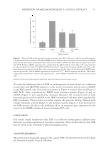
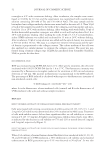
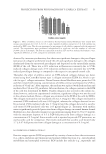
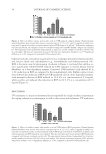
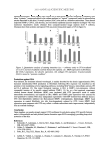
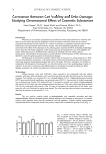
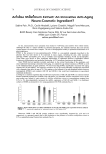
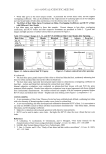
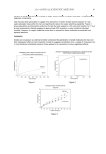
JOURNAL OF COSMETIC SCIENCE 24 Table III shows that both the post-yield gradient and the break stress were reduced by heat treatment in the presence of the “dry” spray (p0.05, Student’s t-test), but in good agreement with the Young’s modulus data, the reductions were signifi cantly greater in the presence of the “wet” spray. Table III also shows that no signifi cant differences were found in the changes in stress at 15% strain, work at 15% strain, and break extension in hair treated in the presence of “wet” versus “dry” sprays. In the case of work at 15% strain and break extension, this might be explained by the fact that these data are calculated without normalization with fi ber cross-sectional areas. It is likely that the greater variability in this data is part of the reason why no statistically signifi cant differences were seen. DISCUSSION In this study we have investigated how the presence of water affects the chemical and physical damage to hair caused by thermal treatments with straightening irons. Fluorescence spectroscopy studies were performed to investigate how heat treatment damaged the hair proteins, specifi cally the amino acid tryptophan. These experiments showed that, in good agreement with other published data (5), heat treatment at 185°C for a cumulative treatment time of 60 seconds could reduce tryptophan levels by 35%. In agreement with other fl uorescence spectroscopy studies (9), we did see good protective effects from our prototype heat-protection spray containing vinylpyrrolidone/vinyl ace- tate co-polymer, quaternium-70, and bis-PEG/PPG-20/20 dimethicone. Interestingly, the effects were only seen when quite a thick layer of product had been put on the hair after repeated applications. It is likely that clumping of the fi bers and the presence of thick insulating fi lms helped provide extra thermal protection. Interestingly, in this study we saw no difference in tryptophan damage in wet versus dry hair. Our data, suggest, therefore, that tryptophan oxidation is not sensitive to the pres- ence of water and occurs simply in the presence of oxygen from the air. This conclusion would fi t observations made by McMullen and Jachowicz (5). These workers were able to show that thermal degradation of tryptophan at 164°C increases as treatment times Figure 5. Changes in Young’s modulus after heat treatment. Comparison of the effects on hair treated with a “dry” heat-protection spray and a “wet” heat-protection spray.

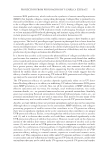
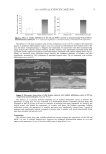
EFFECTS OF WATER ON HEAT-STYLING DAMAGE 25 Table III Effects of Heat Treatment on the Tensile Properties of Hair: Comparison of Hair Treated with a “Wet” Heat-Protection Spray and Hair Treated with a “Dry” Heat-Protection Spray Measurement “Dry” heat-protection spray “Wet” heat-protection spray Mean differences in changes, “wet” spray versus “dry” spray Statistical signifi cance of the differences (Student’s t-test) Mean control Mean treated Mean change Mean control Mean treated Mean change Cross-sectional area (μm2) 4121 4087 −66 3669 3718 −18 48 0.7766 Young’s modulus (Nm−2) × 109 1.97 1.98 0.01 2.17 1.96 −0.26 −0.25 0.0007 Stress at 15% strain (gmf μm−2) × 10−3 8.65 7.54 −1.11 8.14 6.92 −1.33 −0.22 0.2437 Work at 15% strain (J) × 10−4 4.72 4.26 −0.49 4.19 3.57 −0.68 −0.19 0.3202 Post-yield gradient (gmf mm−1) 10.6 9.50 −1.13 9.96 7.47 −2.61 −1.48 0.0005 Break extension (% strain) 67.3 65.2 −2.14 64.1 63.9 −1.47 0.67 0.7354 Break stress (gmf μm−2) × 10−2 2.04 1.80 −0.23 2.04 1.56 −0.50 −0.27 0.0001 Total work (J) × 10−3 3.53 3.04 −0.52 3.07 2.31 −0.79 −0.27 0.1581 increase from fi ve minutes to 30 minutes. Clearly, after only a few seconds, water will have been removed from the hair, and the only way that oxidation of the tryptophan could occur would be through oxygen in the air. Light microscopy studies revealed that the presence of water, delivered from a “wet” heat- protection spray, did cause signifi cant extra structural damage during heat styling. Such damage had not been detected with the fl uorescence spectroscopy measurements. Previ- ous SEM studies have shown that the structural damage caused by heat treatment is dif- ferent on dry versus wet hair (4). On dry hair, repeated heat treatments with curling tongs caused mainly axial cuticle cracking and fusion of scale edges. On wet hair, the same treatments caused bulges or bumps in the cuticle scale faces and ripples or “half-domes” at the scale edges. The authors proposed that these distortions were caused by the hygro- thermal “fatiguing” of the wet cuticle. In good agreement with these previous studies, we also saw damage to the fi ber medulla in wet hair, which appeared to be related to the rapid boiling and evaporation of water. Tensile testing was used to get more precise and quantitative measures of structural dam- age. These experiments confi rmed that structural damage to hair caused by heat styling was greater in the presence of a “wet” versus a “dry” heat-protection spray. Decreases in
Purchased for the exclusive use of nofirst nolast (unknown)
From: SCC Media Library & Resource Center (library.scconline.org)