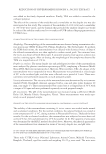
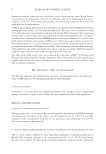
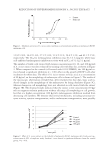
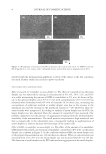
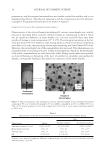
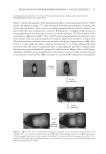
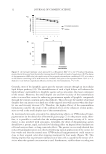
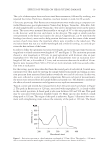
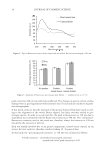
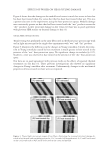
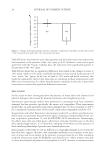
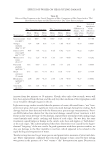
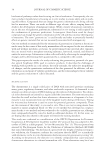
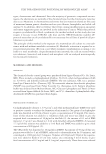
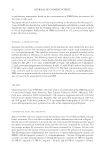
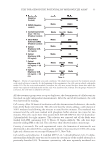
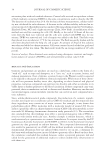
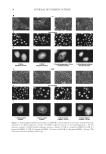
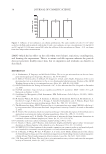
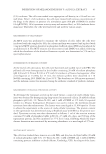
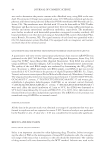
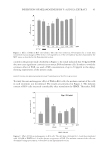
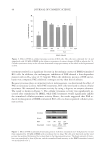
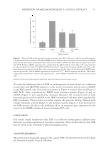
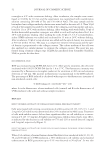
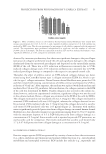
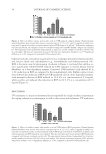
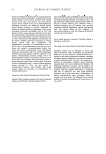
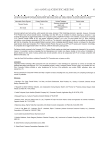
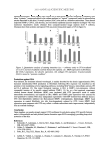
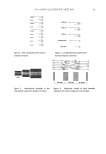
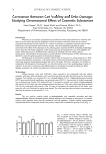
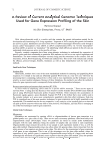
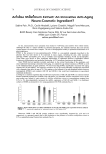
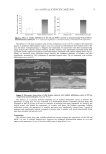
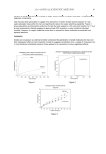
JOURNAL OF COSMETIC SCIENCE 8 involved with the melanogenesis-inhibitory activity of the extract at the low concentra- tion used. Further studies are needed to prove our theory. THE FORMULATED NANOEMULSIONS Effect of ceteareth-10 (emulsifi er) on mean droplet size. The effect of ceteareth-10 on the mean droplet size was observed by varying its concentration of 4%, 8%, 10%, 12%, and 16% w/w while maintaining the amount of GMS (co-emulsifi er) at 5% w/w. As shown in Fig- ure 4, the optimal droplet size of 325 ± 15 nm with a polydispersity of 0.31 ± 0.02 was obtained when formulated with 8% w/w of ceteareth-10. In most cases, increasing the concentration of surfactant resulted in smaller droplet sizes due to the increase in the interfacial area and the decrease in the interfacial tension (17–19). However, these ob- tained results were unexpected. According to analysis of mean droplet size by PCS, the larger droplet size was observed when the amount of ceteareth-10 was increased. One possible explanation was the presence of aggregation resulting from the thermodynamic instability of the nanoemulsions. The small particle size possesses a high interfacial area that is energetically in the suboptimal state, consequently leading to agglomeration of small droplets in order to decrease the free energy of the system (20). Effect of GMS (co-emulsifi er) on mean droplet size. The effect of the amount of co-emulsifi er, GMS mixed with a fi xed concentration of emulsifi er, ceteareth-10 (8% w/w), on the mean droplet size is shown in Figure 5. In the condition without GMS, the mean droplet size of the prepared nanoemulsion was 412 nm (data not shown). When its concentration was increased from 1% to 5% w/w, the mean droplet size was decreased from 413 to 325 nm. The detection of small droplet size by PCS indicated non-aggregation of the small droplets. Figure 3. Morphology of melanocyte B16F1 melanoma cells treated with (A) 0.1% DMSO (control), (B) 40 μg/ml of A. incius extract, and (c) 40 μg/ml of kojic acid for four days (at magnifi cation of 40×).

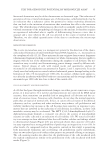
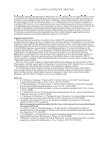
REDUCTION OF HYPERPIGMENTATION BY A. INCISUS EXTRACT 9 In general, GMS at an optimal concentration cannot only decrease the droplet size but also may stabilize the nano-droplet through steric hindrance of the monoester group (21,22) and/or the adsorbed co-emulsifi er layer surrounding the droplet (10). In contrast, when the concentration of GMS was increased (more than 5% w/w), the mean droplet sizes and polydispersity values were obviously increased. The obtained results coincided with those of another study that indicated that increasing the GMS content above 5–10% resulted in larger particles and a broader particle size distribution (23). As GMS is a solid lipid, its high content in the formulation possibly leads to a decrease in homogenization effi ciency and an increase in aggregation of the droplets. From the above-mentioned study, the formulation consisting of 8% w/w ceteareth-10 and 5% w/w GMS provided the smallest droplet size (325 ± 15 nm), with low polydis- persity values (0.31 ± 0.02). This combination was thus selected for nanoemulsion Figure 4. Effect of emulsifi er ceteareth-10 (Brij 56®) concentration on the mean droplet size of the formu- lated nanoemulsions. The concentration of ceteareth-10 varied from 4% to 16% w/w, while that of GMS was fi xed at 5% w/w. Each bar represents mean ± S.D. of three separately prepared batches. Figure 5. Effect of co-emulsifi er GMS concentration on the mean droplet size of the formulated nanoemul- sions. The concentration of GMS varied from 1% to 8% w/w, while that of ceteareth-10 (Brij 56®) was fi xed at 8% w/w. Each bar represents mean ± S.D. of three separately prepared batches.
Purchased for the exclusive use of nofirst nolast (unknown)
From: SCC Media Library & Resource Center (library.scconline.org)