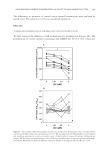
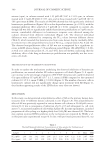
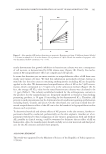
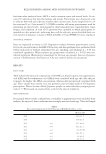
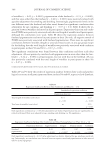
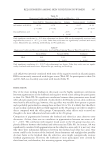
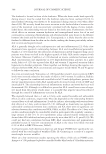
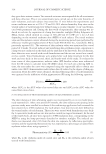
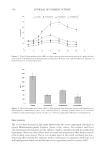
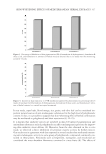
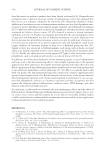
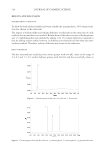
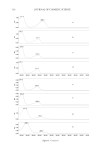
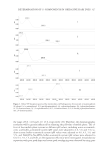
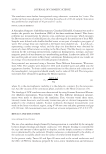
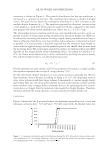
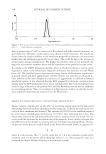
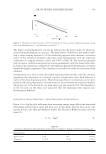
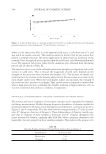
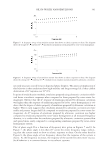
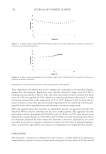
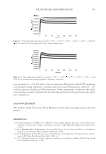
JOURNAL OF COSMETIC SCIENCE 342 RHEOLOGICAL CHARACTERIZATION 4: TIME-DEPENDENT VISCOMETRY Time-dependent viscometry was used to explore the consequences of structural changes during fl oc development. Emulsions were initially sheared at high stress (10 Pa) to breakup any existing fl ocs. After 1 min, this stress was removed and a constant low shear stress (0.1 Pa) was applied for 300 s where viscosity measurements taken every 1 s with increasing temperature in the range from 25°C to 50°C. Figures 9 and 10 show the ap- parent viscosity versus time plot at elevated temperature for the stabilized emulsion pre- pared by rotor–stator emulsifi cation and ultrasonic cavitation, respectively. After the applied stress was removed, an immediate increase in apparent viscosity was observed, which could be attributed to the onset of fl occulation. The apparent viscosity was found to reach a maximum of 109.69 Pa·s and 70.79 Pa·s at 25°C, after which it was followed by a steady decrease to 108.50 Pa·s and 70.09 Pa·s over the remaining time (300 s) for emulsions prepared by rotor–stator and ultrasonic cavitation, respectively. It can be seen that there was no change in emulsion viscosity over the time at elevated tempera- tures, as would be expected for an emulsion not displaying time-dependent fl occulation. CONCLUSION The ultrasonic cavitation as compared to rotor–stator is a viable method for producing nanoemulsions of palm oil esters in water with mean particle sizes down to 62.99 nm and Figure 8. A phase angle graph shows how the phase angle varies with frequency for emulsion system pre- pared by ultrasonic cavitation. Figure 7. A phase angle graph shows how the phase angle varies with frequency for emulsion system pre- pared by rotor–stator homogenizer.

OIL-IN-WATER NANOEMULSIONS 343 zeta potential of -37.8 mV after 5 min of sonication. Physically stable O/W emulsions were prepared using ultrasonic cavitation and rotor–stator homogenizer, where G′ G″ and the emulsion displays gel-like properties. Under appropriate conditions, the emul- sions develop an elastic network that provides the emulsions with good long-term stabil- ity to coalescence. ACKNOWLEDGMENT The authors thank Universiti Putra Malaysia for the fi nancial support given for this project. REFERENCES (1) P. Somasundaran, T. H. Wines, S. C. Metha, N. Garti, and R. Farinato, Emulsions and Their Behavior in Surfactants in Personal Care Products and Decorative Cosmetics (CRC Press, Boca Raton, New York, 2007), p. 504. (2) D. L. Marshall and L. B. Bullerman, Antimicrobial Properties of Sucrose Fatty Acid Esters in Carbohydrate Polyesters as Fat Substitutes (Marcel Dekker, New York, 1994). (3) D. J. McClements, General Characteristics of Food Emulsions in Food Emulsions: Principles, Practice and Tech- niques (CRC Press, Boca Raton, New York, 1999), p. 2. (4) L. L. Schramm, In Emulsions, Foams, Suspension: Fundamental and Application (Wiley VCH Verlag GmbH & Co, Germany, 2006), pp. 1–260. Figure 9. Time-dependent apparent viscosity at 25°C ( ), 30°C ( ), 35°C ( ), 40°C ( ), 45°C ( ), and 50°C ( ) for an emulsion system prepared by rotor–stator homogenizer. Figure 10. Time-dependent apparent viscosity at 25°C ( ), 30°C ( ), 35°C ( ), 40°C ( ), 45°C ( ), and 50°C ( ) for an emulsion system prepared by ultrasonic cavitation.
Purchased for the exclusive use of nofirst nolast (unknown)
From: SCC Media Library & Resource Center (library.scconline.org)