JOURNAL OF COSMETIC SCIENCE 118 step height and its swelling behavior in water as a function of pH was key to understand- ing possible access points to the fi ber for cosmetic ingredients (7). In addition to topographic imaging, one of the earliest AFM modes available to research- ers was lateral force microscopy (LFM), also known as frictional force microscopy. In this technique, the lateral forces or twisting experienced by an AFM probe, as it moves from one side of a sample to the other, can be monitored. This mode of operation provided researchers with many insights into the nanotribology of the outer surface of hair, spe- cifi cally the exposed surface of the cuticle. Early LFM studies sought to elucidate the role that free and covalently attached lipids play on the hair surface (10,11). In addition, AFM friction and adhesion mapping has also provided insight into the structural features of the lamellar layers of the cuticle. In any given area, the different cuticle layers (A layer, exocu- ticle, endocuticle, and inner layer) may be exposed to the surface and observed by AFM (12). Furthermore, the relationship between macro- and microscale friction of hair was investigated with LFM (13). In another LFM study, it was suggested that stretching hair could possibly affect the nanotribological properties (coeffi cient of friction, adhesion, and surface roughness) of the hair surface (14). A rather modern approach for its time, Sadaie et al. (15) modifi ed an AFM probe with a self-assembled monolayer and monitored the frictional interaction between the modifi ed probe and the surface of hair, specifi cally probing the outermost 18-methyleicosanoic acid (18-MEA) layer of the cuticle. In fact, AFM has been an essen- tial tool to demonstrate that 18-MEA plays a paramount role in the structural integrity of the cuticle (16). AFM has also been at the forefront of allowing researchers to monitor intrinsic and extrin- sic aging of hair. Intrinsic aging refers to the natural aging process of the fi ber, and it has been shown by AFM that the surface roughness of hair increases with age, which is ac- companied by a decline in the overall health state of the ultrafi ne morphological struc- tures of hair (17). Extrinsic aging of hair refers to external elements that accelerate the aging process of hair, such as photodegradation or chemical treatments. Photodegrada- tion leads to a substantial increase in the cuticle step height of hair and an increase in the size and depth of micropores apparent in the cuticle cell structure (18). The presence of micropores in the cuticle has been demonstrated by several techniques and their presence increases with photodegradation and bleaching (11,19). Using chemical force micros- copy—achieved by chemically modifying AFM probes with –CH3 and –NH2 groups— allowed for the determination that bleaching of hair leads to the partial removal of the hydrophobic moiety—presumably 18-MEA—on the outermost surface of the cuticle (20). Not surprisingly, great efforts have been made for understanding how AFM techniques could better be used to understand the deposition of cosmetic ingredients onto hair. Mostly, this includes monitoring the deposition of cationic ingredients onto the hair surface and performing frictional measurements with LFM (21–26). Although some ingredients decrease the dry friction of hair, it should be noted that application of cationic polymers to the hair normally increases the dry friction. In the wet state, however, cationic polymers reduce the capillary forces between the fi bers and, as a result, lower the energy required to comb through the hair. Therefore, when conducting AFM measurements, a good under- standing of the targeted state, dry or wet, and its relation to the application is needed. Nanomechanical measurements of hair have also been carried out using AFM. Initial studies in this area included the determination of the mechanical properties (e.g.,

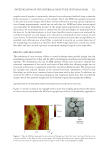
INVESTIGATION OF THE INTERNAL STRUCTURE OF HUMAN HAIR 119 Young’s modulus) of various lamellar constituents of the cuticle (27,28). Other studies focused on elucidating changes in the nanomechanical properties as a result of bleach- ing treatments or by changing the relative humidity. Not surprising, both bleaching and exposure to increasing levels of relative humidity reduce the modulus of the cuticle (29,30). As technology in the fi eld of AFM progresses, so does the analysis of hair by a variety of novel techniques. For example, surface potential imaging experiments—also known as Kelvin probe microscopy—were carried out to determine the electrostatic properties of the hair surface (31–34). Key fi ndings from these studies shed light on the surface poten- tial properties of the cuticle, in particular demonstrating the increased polar nature of the cuticle edge and also the infl uence of lipids on the wettability properties of the fi ber (31,32). In addition, a nanoscale understanding of the electrostatic (static charging) prop- erties of hair was also garnered with Kelvin probe microscopy (33,34). Other important contributions by AFM technologies to understanding phenomena in hair include the use of nanoscale infrared spectroscopy and imaging for the high-resolution localization of structural lipids in hair (35). New insights have also been gained by attach- ing individual hair fi bers to AFM probes and measuring the interaction between the probe fi ber and another hair fi ber (36,37). Furthermore, one of the caveats of any micros- copy technique with human hair is the diffi culty of monitoring the same region before and after treatment, which is circumvented with a practical mounting solution offered by Breakspear and Smith (38). Almost all of the AFM studies investigating human hair have focused on probing the outer surface of the cuticle. From a different perspective—using torsional resonance mode AFM—researchers at Ohio State University analyzed cross sections and transverse sec- tions of human hair (39,40). These studies shed light on some of the internal structures of hair, and the researchers were able to differentiate between the different sublamina of the cuticle and several features of the hair cortex. In this article, we demonstrate how a cross-sectioning technique in combination with contact-mode AFM allows us to visualize the various ultrafi ne structural components of the cuticle and cortex and investigate the infl uence of bleaching and delipidation on these structures. MATERIALS AND METHODS Studies were conducted on Asian hair purchased from International Hair Importers & Products Inc. (Glendale, NY). Before analysis, all hair was washed with a 3% (w/w) sodium laureth sulfate:cocamidopropyl betaine (12:2) mixture. BLEACHING OF HAIR Bleaching was carried out by mixing 120 g of Clairol Professional BW2 powder lightener (The Wella Corporation, Woodland Hills, CA) with 147 mL of Salon Care Professional 20 Volume Clear developer (Arcadia Beauty Labs LLC, Reno, NV). The resulting mixture was applied to damp hair for two 30-min intervals for a total bleaching time of 1 h. Bleached hair was shampooed twice with 3% (w/w) sodium laureth sulfate:cocamidopropyl betaine (12:2) before experiments.
Purchased for the exclusive use of nofirst nolast (unknown)
From: SCC Media Library & Resource Center (library.scconline.org)