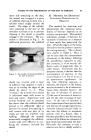
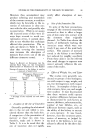
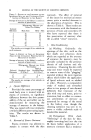
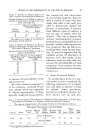
138 JOURNAL OF THE SOCIETY OF COSMETIC CHEMISTS of the hair bed must, therefore have been affected by the lack o.f vascu- larity and nutrition immediately following the operation, since injec- tion studies show that the vascular supply of the graft soon becomes similar to the supply of the sur- rounding area. Once the pigment-forming ability is lost by the cells, there is no resti- rutire capacity to respond to the application of irritants to the skin. Application of irritants to the skin has failed to induce the cells of the hair beds to form pigment again. Growth or production of the hair by the hair bed is also affected by vascularization. Increased blood supply accelerates hair growth. Growth is not affected permanently by poor blood supply, as shown in these experiments, while the pig- ment-forming capacities of the cells are affected permanently. When the skin was incised, all blood supply was eliminated. Nu- trition was supplied to the graft by tissue fluid from below the graft and from around its periphery. This tissue fluid sufficed to supply the cells of the hair bulb with nutri- tion necessary for the survival of their growth potentialities. The tissue fluid, however, did not pro- vide the cells with the substances necessary for the survival of their enzymatic potentialities. Thus, the requirements for growth are less than for pigment formation. SUMMARY AND CONCLUSIONS I have attempted to touch briefly on all of the fundamental points that are of' vital interest and im- portance particularly concerning scalp hair. It was my intention to draw your attention to our woe- ful lack of fundamental information on matters of daily concern to all of us. I trust that I may have suc- ceeded in enlisting your co-operation in attempting to solve: (1) What basic factors are in- volved in keeping alive the vital hair papilla and follicle ? (2) Do only internal mechanisms control the life span of the papilla and follicle or can they be influ- enced by local measures of any type, such as tonics, stimulants, massage, hyperemia, etc.? (3) If local treatment is of value, what form is best, a liquid or an ointment, and what type base whether liquid or ointment, is most acceptable to the scalp and hair? (4) What controls hair pigment? (5) By further study of hair shape, composition, etc., could not some better and perhaps safer methods for curling or straightening the hair be found? (6) What is dandruff and what role does it play in the causation of premature alopecia--if any ? BIBLIOGRAPHY 1. Danforth, C. H., "Hair with Special Reference to Hypertrichoris," Mono- graph A.M.A. (1925). 2. Unna, quoted from McCarthy, L., "Diagnosis and Treatment of Diseases of the Hair," C. V. Mosby Co., St. Louis (1940). 3. Barabal, H. S., and Freeman, N., "Sud- den Graying of Hair, Alopecia and Diabetes Mellitus of Psychogenic Ori- gin," Psychiat. St., 20, 31-38 (Jan., 1946). 4. Hamilton, J. B., "Relationship Between Common Baldness and Male Sex Hor-

THE DERMATOLOGIST LOOKS AT THE HAIR PROBLEM 139 mones," Tr. N.Y. Acad. Sc., 8, 101- 102 (Jan. 1946). 5. Fritsch, Gustav, "Die Menschliche Haupthaaranlage," Gerog Reimer, Ber- lin (1915). 6. Rothman, S., and Flesch, P., "Isolation of an Iron Pigment from Human Red Hair," Proc. Soc. Exper. Biol. & Med., 53, 134-135 (June, 1943). 7. Steggerda, M., "Change in Hair Color with Age," 5 t. Hered., 32, 402-403. 8. Nutritional Review, "Pantothenic Acid, the Adrenal Cortex and Gray Hair," 4, 84-85 (March 1946). 8a. Sabouraud, "Maladies du Cuir Che- velu," Massou et Cie, Paris, 1902, 1910, 1928, 1929, 1932. "Path. of Hair Follicles and of Hair," Bull. Soc. Franc. de Dermat. et Syph., 42, 868 (1935). 8b. Wright, C. S., Sarnitz, M. H., and Brown, N,, "Vitamin B6 (Pyridoxine) in Dermatology," Arch. Derm. Syph., 47, 651-653 (May, 1943). 9. Cotter, L. H., "Thioglycolic Acid Poi- soning in Connection with the Cold Wave Process, y.A.M.A. (June 15, 1946). 9a. Lewis, F., "Danger in the Use of Chem- ical Hair Straighteners," Ibid., 112, 36-37 (Jan., 1939). 10. Bagchi, K. N., and Ganguly, H. D., "Mineral Constituents of Human Hair," Amer. Biochem. & Exper. Med., 1, 83- 86 (1941). 11. Beveridge, J. M. R., and Lucas, C. C., "The Analysis of Hair Keratin," Bio- chem. jr., 38, 88-95 (1944). 12. Clay, R. C., Cook, K., and Routh, J. I., "Studies in the Composition of Human Hair," y. Amer. Chem. Soc., 62, 2709-2710 (Oct., 1940). 13. Bagchi, K. N, , Ganguly, H. D., and Sirdar, J. N.,' Lead-Content of Human Hair," Indian y. M. Research, 27, 777- 791 (1940).
Purchased for the exclusive use of nofirst nolast (unknown)
From: SCC Media Library & Resource Center (library.scconline.org)