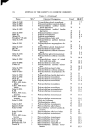
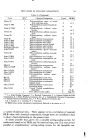
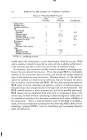
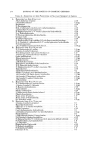
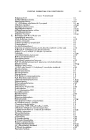
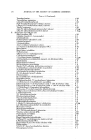
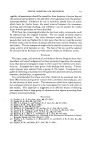
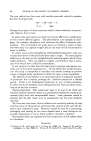
240 JOURNAL OF THE SOCIETY OF COSMETIC CHEMISTS Consistency Melting Sample Composition (Mean of 10) Point, øC. 2907A 2908A 2909A 2910A 2911A 2912A 2913A 2914A Straight white Petroleum Jelly 170 40.9 2907A + 1% paraffin wax 163 41.8 2907A + 5% paraffin wax 158 42.7 2907A + 10% paraffin wax 136 43.6 Straight Yellow Petroleum Jelly 172 40.5 Straight Yellow Petroleum Jelly, different source 158 41.6 Straight White Petroleum Jelly, different source from 2907A 162 42.3 Straight White Petroleum Jelly, different source from 2907A and different grade from 2913A 164 43.4 It will be apparent to you from reading these results that the firmer the jelly, the lower its consistency conversely, a soft jelly will show a high con- sistency and, although the melting point between samples may be only small, the difference in consistency can be large. Whether you require a petroleum jelly with a low or high consistency depends upon your particu- lar problem but to those of you in the audience who have not before used the penetrometer I would say that this instrument is of use in the classifi- cation of petroleum jellies, providing it is appreciated that consistency is not necessarily related to quality. ASSESSING THE QUALITY OF AN ESSENTIAL OIL* By G. W. FERGUSON, B.Sc., Pu.D., F.R.I.C. Parry & Ferguson, London, S.E.I, England "QUALITY" IS a somewhat vague term, especially when applied to essential oils, on account of its wide scope. Its general meaning may be taken as suitability for all purposes for which the product in question may be used. In so far as essential oils are concerned, assessment of quality involves several factors which differ in importance according to the principal use to which the oil is to be put, These factors are in the nature of specific requirements and are quite independent of the intrinsic "genuineness" of the oil, which for the mo- ment may be assumed to conform with recognised trade standards in its * Presented at the April 9, 1954, Meeting, London, England.

ASSESSING QUALITY OF AN ESSENTIAL OIL 241 general characteristics and condition, and may be illustrated by, t'or ex- ample, cassia oil and eucalyptus oil. In the case of cassia oil lead is frequently present, sometimes up to 400 parts per million or even higher, derived from the leaden containers in which the oil is imported from China. This lead content is of no conse- quence if the oil is to be employed for the production of cinnamic aidehyde, but would cause the oil to be rejected if required for pharmaceutical pur- poses where a stringent lead limit is imposed. Similar remarks apply, of course, to aniseed oil from the same source. Eucalyptus oils are commonly designated according to their cineole content, and if cineole manufacture were the objective then preference would be accorded to the oil of highest cineole content. On the other hand, the secondary constituents associated with a 70/75% cineole-con- raining oil derived from, for example, Eucalyptus australiana, might render the latter much more acceptable as a flavouring ingredient in a toothpaste than oil of 80/85% cineole content from other species of Eucalyptus. The steps to be taken in assessing the quality of an essential oil may be divided into: (a) objective tests to ascertain its general characteristics, and (b) subjective tests to determine whether it is the most suitable oil for a particular purpose. The analyst is primarily concerned with objective tests, and when satis- fied with the results obtained by analysis the subjective tests follow. No other sequence is permissible. Objective tests should be carried out by standard methods and the re- sults compared with data in the literature. The objective tests in question include the determination of physical constants, solubilities, and assay of characteristic groups by methods of proved reliability. Notes should be made of the general condition of the sample in so far as freedom from ex- traneous water, dirt, etc., are concerned, and examination of the non- volatile residue obtained by evaporation on the steam bath frequently yields valuable int'ormation in regard to freedom from auto-oxidation, no- tably in the case of citrus oils. Reliable assay methods are given in such works as the British Pharmacopoeia and Codex, or in the new British Standard No. 2073: 1953, "Methods of Testing Essential Oils," the latter being specially recommended for your attention. Many other assay pro- cedures of a high degree of reliability are given in such works as those of Parry, "The Chemistry of Essential Oils and Artificial Perfumes" (1922) (London: Scott Greenwood & Son, Vol. II) Gildermeister & Hoffmann, "Die J•therische (Sle," 3rd edition, 1928 (Miltitz, Schimmel & Co. A.G., Vol. I) and Guenther, "The Essential Oils" (1948) (New York: D. Van Nostrand & Co., Inc., Vol. I), while in the future considerable develop-
Purchased for the exclusive use of nofirst nolast (unknown)
From: SCC Media Library & Resource Center (library.scconline.org)