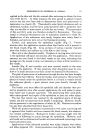
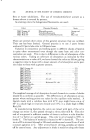
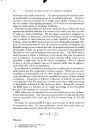
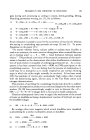
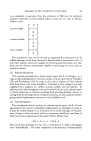
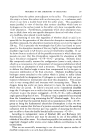
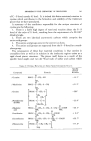
PROGRESS IN THE CHEMISTRY OF DISULFIDES 289 goes during such processing as setting in steam, shrink-proofing, felting, bleaching, permanent waving, etc. (15, 16) as follows: (1) W--(CH2)2--S--S--(CH2),2--W + H,,.O } W--(CH•)2SH + W--(CH,2)2SOH H (2) W--(CH,,.)sSOH -3- W--NH2 • W--(CH•)•S--N--W (3) W--(CH,2)2SOH ) W--CH=CH• + S + H•O (4) W--(CH•)•SOH } W--CH2--CHO + H•S (5) W--CH2--CHO + W--NHo. } W--CH•--C•NH--W Strain relaxation is stated to occur by the occurrence of reaction (1) whereas the setting or crosslinking step proceeds via steps (2) and (5). To quote Speakman on this point (17): "No matter whether borax, sodium sulfite or sodium meta bisulfite is used as an assistant, the main reaction taking place when strained fibers are set in boiling water is -- S -- NH -- bond formation between peptide chains." The profound conviction of the essential correctness of this mech- anism is founded on the observations that either disulfuration or deamina- tion of wool renders it incapable of undergoing permanent set. As a conse- quence it has been assumed that both --SOH and NH2 participate in the crosslinking reaction. It is our feeling that the process of deamination in itself may be so disruptive as to render inoperative any normal relinking steps in which the sulfur might normally be involved. It has been noted (18) that peptides of cystine give anomalously high values when treated with the deaminating agent, nitrous acid, in the Van Slyke amino acid nitrogen determinations. This practice of ascribing the crosslinkage mechanism directly to sulfenic acid or its decomposition products has continued despite the fact that many workers (19, 20) have painstakingly sought in vain to discover the --C= NH--, or--C--S--N--linkages both in wool and in model compounds. Chemists subsequently have come to regard the mechanism of the attack of water on disulfides as being a displacement reaction of hydroxyl ion upon the disulfide linkage: H,,.O (a) OH- -3- R--S--S--R • R--SOH -3- RSH By analogy other ionic reagents which attack disulfides were visualized as proceeding by a similar nucleophilic attack on disulfide: H•O (b) HSO3- d- RSSR • RSSOa d- RSH H20 (c) CN-- d- RSSR ) RSCN d- RSH H•O (d) S- d- RSSR ) R--S--S- d- RSH

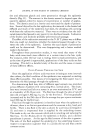
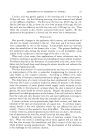
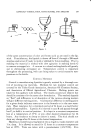
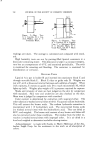
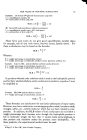
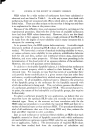
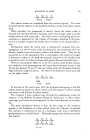
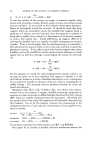
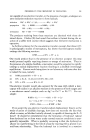
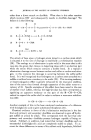
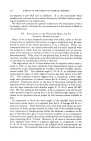
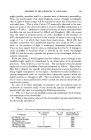
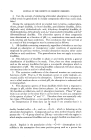
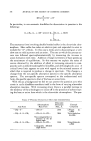
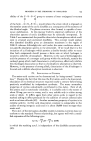
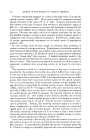
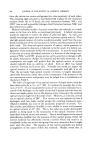
290 JOURNAL OF THE SOCIETY OF COSMETIC CHEMISTS H20 (e) R'--S- d- R--SSR RSSR' + RSH To test the validity of this concept we sought to ascertain whether other anions such as acetate, oxalate, fluoride, azide, cyanate, and sulfate, would function similarly. In no case did we find evidence ofmercaptan formation. Hence no nucleophilic attack has occurred. It should be noted that those reagents which do successfully attack the disulfide (the reagents listed in equations a-e above), save the hydroxyl, have the property in common of being able to readily lose an electron in the presence of an electron acceptor to yield a free radical (21). Stated differently, all reagents effective in cleaving the disulfide bond are capable of readily undergoing one-electron transfer. Thus it would appear that the attacking moiety is essentially a free radical and the reaction which occurs is not ionic at all but a radical dis- placement reaction. If one reflects upon other known reagents that reduce disulfide, such as Zn and HCI or sodium metal in liquid ammonia, it would appear here as well that cleavage is occurring via the attack of a free radi- cal. Zn R--SSR + 2H. ) 2RSH HC1 R--SSR d- 2Na. Na 2RSNa NH, For the present, in writing the radical displacement reaction which is oc- curring, we prefer to be non-committal with regard to whether it is the thiyl radical, formed as a result of disulfide dissociation or as a consequence of a one-electron transfer on the part of the ion, which is attacking the di- sulfide linkage. The principal reaction products obtained by either ap- proach are identical. Speakman (22), Birch (23), Tobolsky (24), and others, have demon- strated that in the absence of oxygen, disulfide-containing compounds on exposure to either ultraviolet or diffuse daylight dissociate into thiyl radicals (RS.) which are capable of polymerizing vinyl monomers. Sch6nberg (25) has equally shown that many SS compounds will thermally dissociate into thiyl radicals. Let us for the moment visualize the consequences of the energized production of such radicals in the presence of ions capable of one- electron transfer. initiation R--S--S--R 2RS. RS. d- HSOa- ) RS- d- HSOa. propagation HSO,. d- RSSR ) RSSOaH + RS- termination RS. d- HSOa. ) RSSOaH The products resulting from these reactions are RS- and RSSOaH. Once again let us consider a possible initiation mechanism wherein the
Purchased for the exclusive use of nofirst nolast (unknown)
From: SCC Media Library & Resource Center (library.scconline.org)