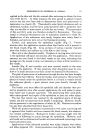
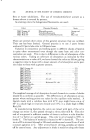
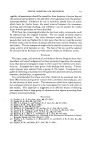
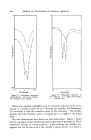
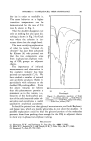
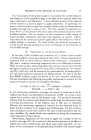
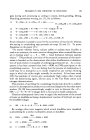
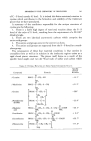
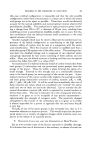
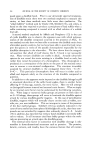
PROGRESS IN THE CHEMISTRY OF DISULFIDES 297 migrated from the carbon atom adjacent to the sulfur. The consequence of this step is to leave the carbon with an electron pair, i.e., a carbanion, with which it can form a double bond with the sulfur atom. This assumption seems justified in view of the fact that tertiary disulfides which have no hydrogens on the carbon joined to the sulfur only show non-specific ultra- violet absorption. Furthermore, compounds which show absorption max- ima in alkali show only non-specific absorption identical with that of terti- ary disulfides, when placed in acid medium. It is interesting to note that regardless of whether alkali or acid is re- sponsible for the generation of the ultraviolet absorption maximum of the disulfide compound, the absorp cion maximum always occurs in the region of 330 mu. This is precisely the wavelength that Calvin has found to corre- spond to the absorption maxima of the very highly strained five-membered disulfide rings found in 6,8 thioctic acid and trimethylene disulfide. It can be shown from an analysis of all the possible structures in which these com- pounds can exist that the chromophore responsible for absorption at 330 mu is the planar conjugated --C=S--S:C-- grouping. Aromatic disul- fide compounds readily assume this configuration (some in acid, others in alkali) as a consequence of an enhancement of resonance stabilization which results from an assumption of such a structure. Thus the energy required to deform the dibedral angle is more than compensated for by the gain in resonance stabilization of the final structure. Aliphatic disulfides having hydrogen atoms attached to the carbon which is joined to sulfur (these shall henceforth be designated as B hydrogens in conformity with our pos- tulated B elimination mechanism) also show this absorption. This occurs only in very strong alkali and increases with increasing time. These hy- drogens being less acidic are more reluctant to leave the carbon atom to which they are joined. In Calvin's strained cyclic 5-membered disulfide rings the • hydrogens are so acidic that they ionize readily in the presence of solvent to give the planar conjugated --C:S--S:C-- with a dihedral angle approaching that of zero. The planar ring is apparently less strained than the 5-membered ring containing the 90 ø dihedral angle. It is of in- terest to recall that the essential feature of our postulation of the group as being the fundamental ultraviolet chromophore is that we were required to assume that the loss of a proton occurred and that the resulting carbanion with its free electron pair was capable of donating the electron pair to sulfur to form the doubly bonded sulfur structure --C:S--. According to independent views of Kimball (40) and Rothstein (41) theoretically, an electron pair may be donated to one of the untilled 3d orbitals of the sulfur atom. It is therefore possible that molecules in which negatively charged sulfur atoms occur make definite contributions to the excited state. What we are essentially measuring in our ultraviolet spectra studies of disulfide compounds is an acid-base phenomenon

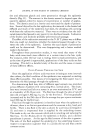
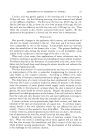
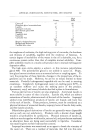
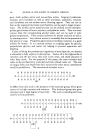
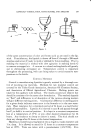
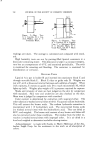
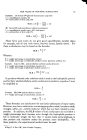
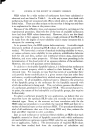
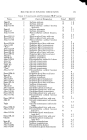
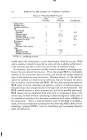
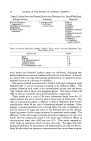
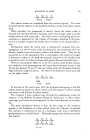
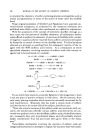
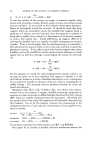
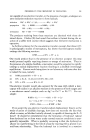
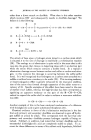
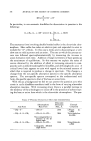
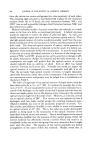
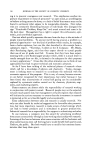
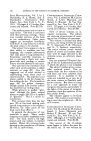
298 JOURNAL OF THE SOCIETY OF COSMETIC CHEMISTS kl BH•B- + H* k• In particular, in non-aromatic disulfides the dissociation in question is the following: R--CH2--S-- q- OH- . ß R--•H--S-- + HOH T R--CH=S-- The resonance form involving doubly bonded sulfur is the ultraviolet chro- mophore. Here sulfur has taken an electron pair and expanded its octet to include the "d" orbitals. In this case a weak acid is dissociating at averv slow rate to yield a proton and an anion. The rate at which this process oc- curs was followed spectrophotometrically by measuring the increase in anion formation with time. Addition of large increments of base speeds up the attainment of equilibrium. In this manner we explain the series of curves obtained by the addition of alkali in increasing amounts to com- pounds such as dihydroxydinaphthyl disulfide, and dithiodiglycolic acid. A critical lower limit appears to exist with regard to the minimal amount of alkali that is required to produce a change in spectrum. This change is a change from the non-specific absorption spectra to the specific absorption spectra. The non-specific spectra correspond to the undissociated acid form, the specific spectra to that of the base or anion form. With this as a background we feel we can answer the question as to why strain in cyclic disulfides manifests itself in the form of varying ultraviolet absorption maxima. With increasing strain there is a parallel increase in the tendency of the • hydrogens to ionize off in the presence of solvent leav- ing the base or anion form which is the ultraviolet chromophore. The pos- TABLE 2--PossIBLE ULTRAVIOLET DISULFIDE CHROMOPHORES Acid Form Ultraviolet (Chromophore) Absorption Example Basic Form Max., Ji.. Compound --CH2--S--S--CH• --CH•--S--S--CH• --CH•---S-- 25OO --CH•---S--S:CH-- 2800 Non-conjugated due to presence of the di- hedral angle --CH--S--S•CH-- Conjugated, dihedral angle absent 3300 n-Propyl di- sulfide Tetra methylene disulfide Trimethylene di- sulfide
Purchased for the exclusive use of nofirst nolast (unknown)
From: SCC Media Library & Resource Center (library.scconline.org)