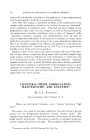
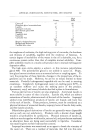
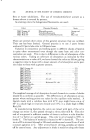
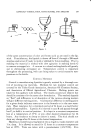
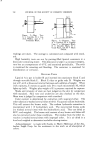
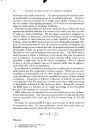
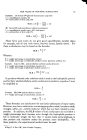
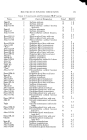
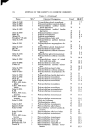
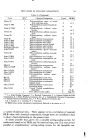
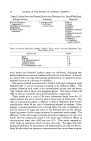
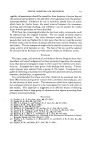
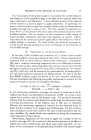
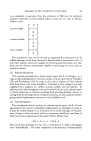
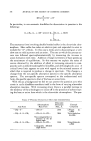
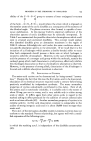
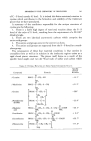
PROGRESS IN THE CHEMISTRY OF DISULFIDES 299 sibility of the C--S--S--C group to assume a linear conjugated structure H H I of the form --C•S--S•---C-- would relieve the strain which is imposed on the member atoms of the cyclic disulfide as a consequence of the existence of the dihedral angle. The planar structure thus formed is capable of reso- nance stabilization. In this manner Calvin's empirical calibration of the ultraviolet spectra of cyclic disulfides may be rationally interpreted. In Table 2 are summarized the possible ultraviolet chromophores which could exist in strained and unstrained disulfides. This concept would explain why dimethyl disulfide gives an absorption maximum in the region of 2500 A. whereas dithiodiglycolic acid under the same conditions shows a non-specific absorption spectra in the ultraviolet. If we recall that it is the ionization of a g hydrogen which permits a double-bonded sulfur to occur then both compounds should possess a finite rate at which hydrogen is ionized to yield the chromophore. However, in the case of dithiodiglycolic acid the presence of a stronger acid group within the molecule, namely the carboxyl group which itself dissociates to yield protons, effectively inhibits the g hydrogen dissociation so that no chromophoric absorption is observed. However, in the presence of strong alkali, dissociation of the g hydrogen is favored and a definite absorption maximum is observed. IV. S,RUC,UR•. OF CYSTINE The amino acid cystine can be characterized by being termed "anoma- lous." Despite the fact that this was the first amino acid to be discovered, elucidation of its chemical structure required nearly a century before being positively established by independent synthesis. The many anomalous properties of cystine undoubtedly contributed to this delay. First of all, this amino acid is notoriously insoluble it is soluble only to the extent of about 20 mg. per cent in water, and is very soluble only in either strong acids or alkali. It differs again from other amino acids in regard to the marked salting-in effect produced by the addition of certain selected salts such as calcium chloride (42). Another anomalous property of cystine is its extreme acidity its first acid dissociation constant is comparable to the acidity of strong inorganic acids and it is about 10,000 times stronger than acetic acid. The e.m.f. of the mercaptan-disulfide system/-cysteine-/-cystine does not conform to the standard Nernst relationship, but agrees well with a modi- fied expression of the following type: RT Eh:Eo - -•- pH - •- In [RSH] in which the resulting e.m.f. is independent of the disulfide concentration (43).

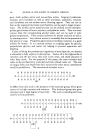
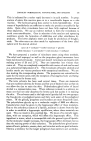
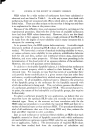
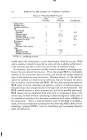
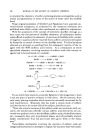
300 JOURNAL OF THE SOCIETY OF COSMETIC CHEMISTS A further remarkable property of cystine is the high value of its specific optical rotation, namely 220 ø. Most amino acids by comparison possess optical rotations of the order of 8 to 15 ø (44). Toennies and Lavine (45) have shown in the case of cystine, that whereas in the isoelectric region of pH 3 to 7, the optical rotation is constant and maximal, in strong acid the rotation drops slightly and in alkaline medium this drop in rotation is pre- cipitous. One may also add to this list of singular attributes the fact that the disulfide linkage in cystine is quite resistant to most chemical attack in comparison with cystine combined in proteins. Furthermore, simple esters of cystine spontaneously decompose to an entire series of degradation products (46). In view of these facts we have sought to interpret these anomalies of cystine in terms of a unique structure. Employment of molecular models of both the Fischer-Herschfelder and Catalin types indicate that the optically active cystine molecule in all likelihood exists as an approximate tridentate pincer or "closed-claw"-like structure. A skeletal molecular model of the cystine molecule revealed that the entire structure appeared to assume the form of a helix. This structure satisfactorily accounts for all the wealth of apparently unrelated data concerning cystine to be found in the litera- ture. The incentive to look for a unique structure in the case of cystine was provided by the evidence that lanthionine, which differs from cystine only in that one of the sulfurs is removed, and djenkolic acid which only differs in the respect that a methylene (CH2) is introduced between the two sulfur atoms, both show lower and more normal values for the optical rotation. Yet it is not the presence of the asymmetric carbons nor the disulfide link- age alone that is responsible for making cystine unique. Penicillamine di- sulfide, which has the S--S linkage as well as the same asymmetric centers, and which differs from cystine only in that the fi hydrogens are replaced by methyl groups (see Table 2) possesses the expected value for its optical rotation, namely 23 ø. Our models of penicillamine disulfide also revealed that the presence of bulky methyl groups in place of hydrogen so restricted the rotation about the C--S and S--S bonds that the "closed-claw" struc- ture is prohibited. Instead, this resulting structure appears to assume a linear configuration in which the two amino acid groups are maintained rigidly apart by a collar of methyl groups. Further indication in favor of the unique structural configuration of d or Lcystine is that a wide number of enzymes which will attack either the amino or disulfide linkage in cystinc will be ineffective against penicillamine disulfide (47). • ,As we have indicated in Section III, the restricted rotation in cystinc is of the order of at least 13-15 kcal., and this favors the formation of the claw- like structure. In penicillamine disulfide the barrier to rotation about thk S--S bond is so large as to probably approach the order of the bond strength
Purchased for the exclusive use of nofirst nolast (unknown)
From: SCC Media Library & Resource Center (library.scconline.org)