140 JOURNAL OF THE SOCIETY OF COSMETIC CHEMISTS Many of the processing applications are dependent on the formation of cavitation bubbles within liquids. For this reason it is worthwhile to consider the basic processes associated with cavitation before discussing the applications. The transmission of sound waves through a liquid is attended by periodic variations of pressure. With sound waves of high intensity, these varia- tions in pressure may be sufficient to develop tensions within the liquid provided the liquid does not rupture. In most cases, cavitation occurs within the liquid before tensions are developed. The nucleation of the cavitation bubbles, however, is a problem since the cohesive forces within the liquid are usually equivalent to tensions far greater than can be pro- duced acoustically. Under ordinary circumstances, a liquid contains micro dust particles which have at least partially hydrophobic surfaces. If the liquid also contains a dissolved gas, micro bubbles filled with both vapor and the gas are expected to exist within the cracks or surface irregu- larities of these particles even though the liquid is not completely saturated with the gas. With the introduction of sound waves into the liquid, these bubbles periodically vary in size. More dissolved gas diffuses into a bubble during the rarefaction than redissolved during the compressional part of the acoustical cycle. This results in the growth of the bubbles with each cycle through rectified diffusion to a size which may be considerably larger than that of the partially hydrophobic particles. When a bubble attains a size corresponding to a resonance condition, the expansion and partial collapse of the bubble with each cycle of the sound waves become extreme. Instantaneous pressures within the cavitation bubbles and in the liquid immediately adjacent to the bubbles may reach in excess of 10 a arm. primarily because of the finite momentum of the liquid as the bubbles partially collapse. The situation is somewhat analogous to the well- known water hammer which occurs when liquid flow is stopped abruptly within pipes. The destructive effects of the shock waves originating from these resonating cavitation bubbles are far greater than any associated with the sound waves responsible for the cavitation. Since the compression of the gases within the bubbles is at least partially adiabatic, relatively high instantaneous temperatures are believed to be realized within the bubbles (e.g., 1000øC.). Furthermore, there is evidence that larger cavitation bubbles in higher order resonance modes generate many addi- tional small bubbles (51) which in turn grow until a resonance condition is reached. For a more detailed discussion of cavitation, the reader is referred to references 3, 7, 16 and 51. With commercially available equipment cavitation can be produced easily at frequencies from a few hundred through two megacycles per second. In water only a fraction of a watt/cm. 2 is ordinarily required. At frequencies below 1 mc./sec., cavitation does not appear to be a partic-

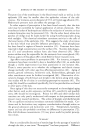
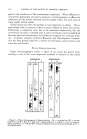
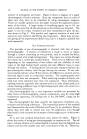
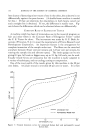
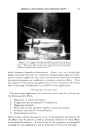
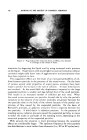
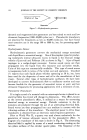
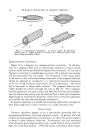
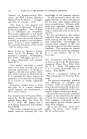
CHEMICAL APPLICATIONS FOR ULTRASONIC WAVES 141 Figure 1 .--Cavitation in water produced by focused ultrasonic waves at n frequency of 600 kc./sec. from a concave barium titanate sound source. The white blur in the center represents intense cavitation at the convergence of the ultrasonic waves. ularly frequency dependent phenomenon. Above I inc. sec. increasingly higher acoustical intensities are required to produce appreciable cavitation until at several megacyclcs per second the acoustical intensities awfilable for practical purposes are insut-Ecient to produce cavitation effects. Since the majority of the processing applications involve cavitation, this means that a wide range of frequencies is available for such applications. PROCESSING AI'I'LICATIONS The processing applications fi•r ultrasonic waves may be resolved into the following basis effects. 1. l)ispersion of solids and liquids. 2. Coagulation and precipitation of suspensions. 3. Degassing of liquids. 4. Promotion of mass and heat transfer in gases and liquids. 5. Initiation and control of crystallization. 6. Sonochemical reactions. Each of these will be discussed in terms of the proposed mechanisms for the effects and the present as well as potential utilization of these effects in the chemical industry. A brief review of the equipment commercially available for such applications will be presented at the end of the paper.
Purchased for the exclusive use of nofirst nolast (unknown)
From: SCC Media Library & Resource Center (library.scconline.org)