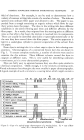
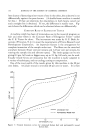
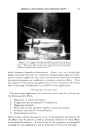
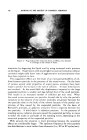
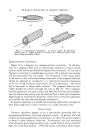
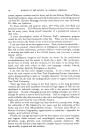
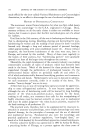
144 JOURNAL OF THE SOCIETY OF COSMETIC CHEMISTS • 2:•"•i :5. :...• •. .5 .!: ß ??" ,.- "%5: .=. "- ß '-'" :q •. .... •. 5:.: .4• -,.'•.:. %.':5 '•. ':'. . •,• '•. ... Figure &--Fog produced bv ultrasonic waves at 600 kc./sec. focused to converge at the surface of water. intensities by degassing the liquid and by using increased static pressure on the liquid. Experiments with much higher acoustical intensities without cavitation might yield faster rates of agglomeration and precipitation than have been reported to date. The coagulation effects are the result of an increased probability of col- lision between particles in the presence of the sound waves. On the basis of various second order properties of sound waves, attempts have been made to predict the increase in the rate of collision. At least three factors are involved. In the sound field the displacement imparted to the large suspended particles is smaller and lags behind that of the small particles. This results in an increased number of collisions per unit time. When the sound waves encounter two particles located side by side, the periodic variations in the velocity of the solvent molecules are greater between the two particles than in the bulk of the solvent because of the partial con- striction of flow caused by the suspended particles. On the basis of Bernoulli's principle, an apparent attractive force is expected between the two particles. A third factor is radiation pressure. In the presence of standing waves, radiation pressure caused the suspended particles to move to either the nodes or antinodes of the standing waves, • depending on the acoustical properties of the suspended particles. With aerosols the situation is more promising because the acoustical effects are considerably larger. The optimum frequency for most particle size distributions is sonic rather than ultrasonic (i.e., 10 a to 10 4 cycles/sec.).

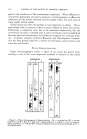
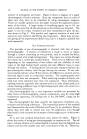
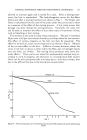
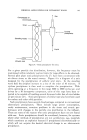
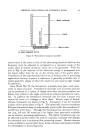
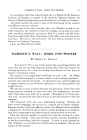
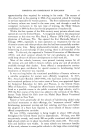
CHEMICAL APPLICATIONS FOR ULTRASONIC WAVES 145 Go$ Compressed oir • Siren Stonding woves Liquid Influent mist Cyclone precipitotor Figure 4.--Sonic precipitator for mists. For a given particle size distribution, however, the frequency must be maintained within relatively narrow limits for large effects to be obtained. Several pilot plant sonic precipitators (8, 27) have been constructed with air driven sirens as the sound sources. Figure 4 is a diagram of a unit designed for the precipitation of sulfuric acid mists. In the standing wave field the droplets increase to a size of the order of 10 microns. A cyclone precipitator is then used to complete the precipitation. With sirens operating at a frequency in the range 1000 to 4000 cycles/sec. and driven by a 10 horsepower compressor, units of this type have been re- ported to be capable of handling several thousand cubic feet of mist ladden air per minute (27). Sonic precipitators of similar type also have been used for carbon and other solid particles. Such precipitators have several disadvantages compared to conventional electrostatic precipitators. These include large power consumption, costly maintenance, corrosion problems in the sirens and erratic per- formance with changes in the particle size distribution in the influent. These are some of the reasons why sonic precipitators have not yet found wide use. Sonic precipitators should be considered, however, for systems where other methods of precipitation are not satisfactory, e.g., materials which constitute an explosion hazzard if precipitated electrostatically or which will not acquire the desired electrical charge in an electrostatic precipitator.
Purchased for the exclusive use of nofirst nolast (unknown)
From: SCC Media Library & Resource Center (library.scconline.org)