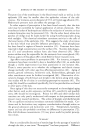
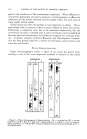
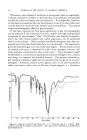
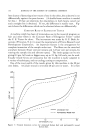
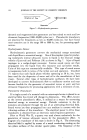
150 JOURNAL OF THE SOCIETY OF COSMETIC CHEMISTS cavitation in their experimental work and have made mathematical assumptions in their theoretical treatments which do not appear to be justified. The majority of the workers (19, 30, 33, 49) believe that cavita- tion is required for ultrasonic degradation. Recent measurements in the author's laboratory (33) indicate that degradation does not occur with solutions of polymers such as polystyrene in the absence of cavitation even at an intensity of 1000 watts/cm. •', a value some 30 fold higher than used by previous workers. The mechanical effects associated with res- onating cavitation bubbles are far greater than those associated with the sound waves which give rise to the cavitation. The extreme rates of shear near the surface of the cavitation bubbles probably lead to the rupture of the polymer molecules. The graph in Fig. 6 indicates (33) the extent of the degradation of poly- styrene dissolved in toluene as a function of acoustical intensity and frequency under the conditions stated in the legend. The relative viscos- ities of the polymer solutions are represented on the left ordinate while the viscosity-average molecular weights are represented on the right. The initial molecular weight was 3.3 X 10⁶. The threshold intensity for degra- dation in Fig. 6 correlates with the threshold for cavitation. While the rate of degradation increases with increasing ultrasonic in tensity, the ultimate degree of degradation is not a function of intensity (19, 28, 30, 35) provided there is cavitation. This is in accord with cavitation theory (16, 28, 35). A molecular weight of approximately 30,000 has been reported 3.0 • q3 o- 300 kc. - •.• ,• Undegraded -• •-- 800 kc. x •Qx •. -O 0-1 rnc. : 2.5 • -•' •'-2 rnc. - 2.75 o 2.0 - 1,65 x n., 1.5 - 0.83 -- 1.o , I , I , I , I , I , I , I [ o.oo o 1 2 $ 4 5 6 7 8 INTENSITY, WATTS PER CM,' Figure 6.--Uhrasonic degradation of polystyrene dissolved in toluene. Concentration of polymer: 0.5% exposure time: 10 min. temperature: 25øC. Viscosity average molecu- lax weight of original polymer: 3.3 X 10⁶.

CHEMICAL APPLICATIONS FOR ULTRASONIC WAVES 1•! to be the limiting value for polystyrene solutions (36). Similar results have been found for other polymers. If the molecular weight distribution of the polymer before ultrasonic degradation is relatively wide, distribution for the degraded polymer is considerably narrower. No extensive industrial use of ultrasonic waves for the degradation of polymers is anticipated since most chemists are interested in increasing rather than decreasing the molecular weight of polymers. In addition to the mechanical degradation associated with cavitation, intense ultrasonic waves can cause thermal degradation. The absorption of the sound energy within a liquid results in the progressive heating of the system. As a result, it is important to provide a means for cooling the liquid in order to prevent pyrolysis. The absorption coefficient for sound waves increases as the square of the frequency in most cases hence, proc- essing applications involving viscous liquids should be carried out pref- erably at relatively low frequencies to minimize thermal problems. Of the various processing applications mentioned above, the most promising with respect to cosmetic chemistry appear to be the production of colloidal suspensions (particularly emulsions), the degassing of liquids and the expediting of mass and heat transfer in fluids. While all of these applications can be accomplished relatively easily, engineering data are generally not available. ULTRASONIC EQUIPMENT FOR PROCESSING APPLICATIONS For the most part, the choice of frequencies for processing applications is not critical since cavitation occurs over a wide range of frequencies. When cavitation is to be produced throughout a relatively large tank, low ultrasonic frequencies (e.g., 20 kc./sec.) are used because the sound energy can be distributed more uniformly throughout the tank. Often very high intensities are required in a restricted region as is the case with continuous flow processing systems. In such instances, higher ultrasonic frequencies in the range 105 and 106 cycles/sec. are favored since ultrasonic waves of shorter wavelengths are more readily focused. Several excellent reviews (3, 6, 7, 16, 17) on ultrasonic equipment for industrial applications have been published in recent years. Only a brief r•sum• of ultrasonic generators will be presented in this article. Samsel (34) has also considered a number of the factors involved in the choice of generating devices fo'r various applications. The majority of the processing applications involve the propagation of ultrasonic waves through liquids. Three types of ultrasonic generators have been used extensively for this purpose: (a) hydrodynamic devices, (b) piezoelectric transducers and (c) magnetostrictive transducers. The term transducer refers to any device which changes one form of energy to another, e.g., alternating electrical energy 'to sound waves. • The hydro-
Purchased for the exclusive use of nofirst nolast (unknown)
From: SCC Media Library & Resource Center (library.scconline.org)