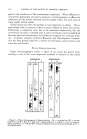
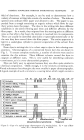
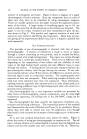
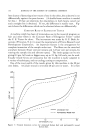
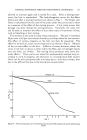
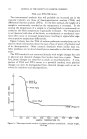
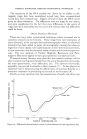
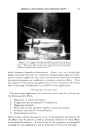
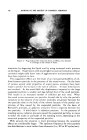
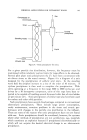
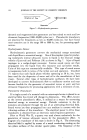
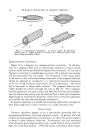
154 JOURNAL OF THE SOCIETY OF COSMETIC CHEMISTS Figure 9.--Ferroelectric transducers. A--circular plate, B--spherically concave bowl, C--hollow cylinder, D--trough type. Electrical leads to me- tallic coatings on parallel surfaces. Magnetostriction Transducers Figure 10 is a diagram of a magnetostriction transducer. In the pres- ence of a magnetic field with an alternating component, certain metals such as nickel will be periodically elongated and contracted. If one end of the bar is connected to a diaphragm in contact with a liquid, sound energy will be transmitted into the liquid. The frequency of the sound waves is the same as that of the alternating component of the magnetic field but should be adjusted to correspond to a mechanical resonance frequency of the bar if high intensity sound waves are to be generated. The metal bar is laminated to reduce eddy currents. The magnetic fields are pro- vided through the current through the coils in. Fig. 10. Since magneto- striction generators are used at sonic and relatively low ultrasonic frequen- cies, the alternating current may be obtained from a relatively inexpensive high-frequency motor-driven generator rather than an electronic generator as is usually the case with piezoelectric transducers. In general equipment is available for processing applications through the pilot plant stage and in many instances on a large industrial scale. CONCLUSIONS Cosmetic chemistry appears to be a particularly promising field for processing applications involving ultrasonic waves. In general the scale of these processing applications is expected to be relatively small compared to those in other chemical industries. Furthermore, the cost associated with ultrasonic processing should be only a small fraction of the relatively high cost of the final product. While the author is optimistic about poten-

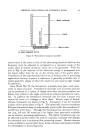
CHEMICAL APPLICATIONS FOR ULTRASONIC WAVES 155 Liquid Metal container A.C. power source D.C. power source II Laminated nickel bar FmuRv. 10.--Magnetostrictive transducer. tial processing applications, the engineering know-how must be obtained before these applications can become realities. REYERENCES (1) Alexander, P., and Fox, M., 5 •. Polymer Sci., 12, 533 (1954). (2) Astolfi, E., Italian Patent No. 440,738 (1948). (3) Bergmann, L., "Der Ultraschall und seine Anwendung in Wissenschaft und Technik," 6th Ed., Stuttgart, S. Hirzel Verlag (1954). (4) Bouyoucos, J., "Self Excited Hydrodynamic Oscillators," •lcoust. Research Lab., Har- vard Univ. Tech. Mem. No. 36 (1955). (5) Brafier, M., Melliand Textilber., 32, 701 (1951). (6) Butterworth, J., "Kilowatts of Ultrasonic Power for Industry," in reference 45, pp. 77-84. Crawford, A., "Ultrasonic Engineering," New York, Academic Press (1955). Danser, H., Chem. Eng., 57, 158 (1950). Del Luca, M., Yeager, E., and Hovorka, F., 5 •. •lcoust. Soc. •lm., 28, 798A (1956). Demann, W., and Asbach, H., Tech. Mitt. Krupp, 1, 12 (1940). Frenkel, J., •lcta Physiochim. U.R.S.S., 12, 317 (1940). Frenzel, H., and Schultes, H., Z. physik. Chem., B27, 4:21 (1935). Griffing, V., 5 •. Chem. Phys., 18, 997 (1950) Ibrd., 20, 939 (1952). Harvey, E., 7. •lm. Chem. Soc., 61,239:2 (1939). Henglein, A., Makromol. Chem., 14, 1:28 (1954). (7) (8) (9) (lO) (ll) 02) 03) (14) 05)
Purchased for the exclusive use of nofirst nolast (unknown)
From: SCC Media Library & Resource Center (library.scconline.org)