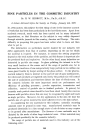
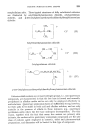
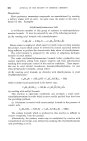
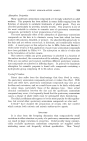
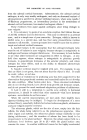
CATIONIC SURFACE-ACTIVE AGENTS 223 morpholinium salts. Three typical structures of fully substituted cationics are illustrated by cetyltrimethylammonium chloride, cetylpyridinium chloride, and p-tert-octylphenoxyethoxyethyldimethylbenzylammoni chloride. H• + C.H • •--N--CH • I C1- (II) Cetyltrimethylammonium chloride CH = CH C•6H33 -- N CH CH -- CH C1- (III) Cetylpyridinium chloride c 8H. OC2H 40C2H 4N (CH CH• C1- (IV) p-tert-Octylphenoxyethoxyethyldimethylbenzylammonium chloride Cationics which contain one or more hydrogen groups, i.e., non-quate• nary compounds, are characterised in that the free base is formed and normally precipitated in alkaline media and so can only be employed effectively in acid solutions. Quaternary ammonium bases are sufficiently strong, however, for their salts to be stable in both acid and alkaline solution, and are only unstable in the presence of alkalis in those instances (e.g., quaternary pyridinium salts) where the free base undergoes decomposition. For this reason, together with the fact that many free amines are primary skin irritants, the surface-active quaternary ammonium compounds are the sole class of cationic agent employed in cosmetic, toilet and pharmaceutical preparations, and discussion will be limited to this type of compound.

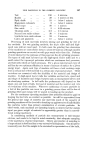
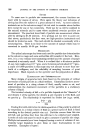
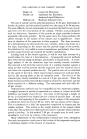
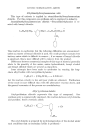
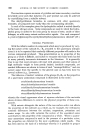
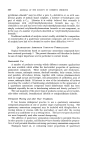
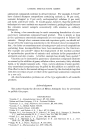
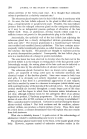
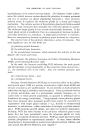
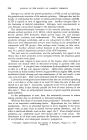
224 JOURNAL OF THE SOCIETY OF COSMETIC CHEMISTS Manufacture Most quaternary ammonium compounds are manufactured by reacting a tertiary amine with an ester. In some cases the amine or the ester is formed in situ. Examples: Alkyltrimethylammonium Salts A well-known member of this group of cationics is cetyltrimethylam- monium bromide. It may be prepared by one of the following methods: (a) By reacting cetyl bromide with trimethylamine: + -- C•0H•Br + (CH•)•N C•0H•N(CH•)•Br. Excess amine is employed, which must be totally removed when isolating the product, traces which cannot be detected by normal analytical methods being sufficient to produce the characteristic fishy odour of trimethylamine. The cetyl bromide is prepared by the action of anhydrous hydrogen bromide on cetyl alcohol. The crude cetyltrimethylammonium bromide before purification may contain impurities arising from impure reagents and from side-reactions resulting from inadequate control of the reaction conditions. These impuri- ties can be cetyl alcohol, hexadecene, hexadecyldimethylamine, tri- and tetra-methylamine bromides, among others. (b) By reacting cetyl bromide (or chloride) with dimethylamine to yield cetyldimethylarnine: C•6H•Br + (CH•)•NH--•C•0H•N(CH•)• + HBr which is isolated and quaternised in the further step: + -- C•6H•N(CH•)• + CH•Br--C•0H•N(CH•)•Br. by reacting with methyl bromide. This reaction is vigorously exothermic and produces a crude cetyl- trimethylammonium bromide which is more readily purified than that from the preceding synthesis. (c) Cetylamine is reacted with excess methyl bromide in the presence of caustic soda: C•0H•NH• + 3CH•Br -- C•0H0•N(CH•)•Br + 2HBr. The sodium bromide which is produced in this reaction is difficult to remove completely from the product. Alternatively, the primary amine may be methylated by reaction with formaldehyde and formic acid, followed by isolating the cetyldimethylamine and proceeding as in (b).
Purchased for the exclusive use of nofirst nolast (unknown)
From: SCC Media Library & Resource Center (library.scconline.org)