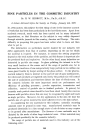
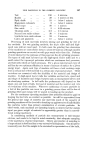
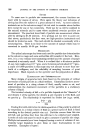
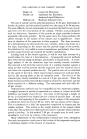
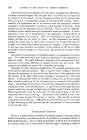
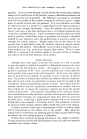
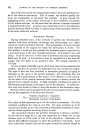
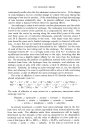
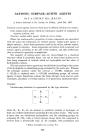
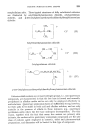
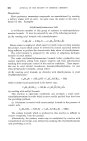
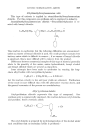
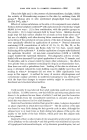
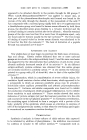
CATIONIC SURFACE-ACTIVE AGENTS 225 Alkyldimethylbenzylammonium salts This type of cationic is typified by stearyldimethylbenzylammonium chloride. For this compound, one synthesis only is employed in industry. Stearyldimethylbenzylammonium chloride.--Stearyldimethylamine is re- acted with benzyl chloride: C•sH3,N(CH•)• +•CH•C1 -+C•sH•7N(CC1ICH• I This reaction is exothermic but the following difficulties are encountered: unless an excess of benzyl chloride is used, the crude product contains free tertiary amine which is difficult to remove if an excess of benzyl chloride is employed, this is more difficult still to remove from the product. Differences between commercial samples of this type of material generally relate to the quantity of free amine, amine hydrochloride, benzyl alcohol and benzyl chloride which are present as impurities. Some attempts have been made to synthesise by reacting the long- chain alkyl halide with benzyldimethylamine: C•H37C1 + (CH•)•NCH• • S.D.B.A.C. but the reaction velocity is low and poor yields are obtained. Purification of the crude is more difficult 'than with the alternative reaction above, and the general economics of the process a•e unsatisfactory. Alkyl pyridinium halides Cetylpyridinium chloride represents this type of compound. One synthesis only is commercially employed, the reaction between cetyl chlcride and pyridine, itself a tertiary amine. N• • C•H•C1 + x • + C1- N I The cetyl chloride .ks prepared by hydrohalogenation of the alcohol under such conditions that no secondary halide is produced. •

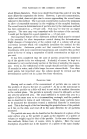
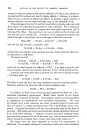
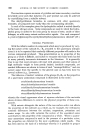
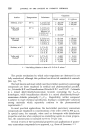
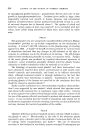
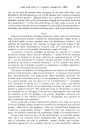
•26 JOURNAL OF THE SOCIETY OF COSMETIC CHEMISTS The reaction requires an excess of pyridine and some secondary reactions invariably occur such that isolation of a pure product can only be achieved by crystallising from a suitable solvent. The alkylpyridinium bromides, in common with other quaternary bromides, are prepared more easily than the corresponding chlorides. In each of the examples given the hydrophobic radical is united directly to the basic nitrogen atom. Some compounds are used in which the hydro- phobic group is united to the ionic group by means of ester, amide or ether linkages, as with many anionic surface-active agents. One such compound is p-tert.octylphenoxyethoxyethyldimethylbenzylammonium chloride• (IV.) GENERAL PROPERTIES With the infinite number of compounds which may be produced by vary- ing the nature of the radicals R•--R4 attached to the quaternary nitrogen atom it is to be expected that markedly different properties will reside in the various compounds produced. Thus generalisation as to properties of the group as a whole is difficult, and failure to recognise this basic truth has led to many patently inaccurate statements in the literature. It is generally true to say that most cationics will react with anionics and other anions of high molecular weight to form poorly ionised, insoluble compounds, yet marked differences are shown in terms of stlch "incompatibilities," and one cannot argue from the specific to the general case as has been done by several authors (e.g., Lawrence3). The influence of modest variation of the groups R•-R4 on the properties of a quaternary ammonium compound is illustrated in the series: cetyltrimethylammonium bromide stearyltrimethylammonium bromide cetyldimethylbenzylammonium bromide stearyldimethylbenzylammonium bromide stearyldimethylethylammonium bromide wherein the visual appearance alone of aqueous solutions of the materials shows obvious differences to exist in the physical properties of these com- pounds. With anionic detergents the nature of the non-surface-active ion affects the properties of the molecule as a whole, as, for example, the well-known cosmetic differences between the calcium, magnesium, potassium and amine soaps. So also with cationics the nature of the associated anion contributes to the properties of the compound as a whole. Where a quater- nary ammonium compound is used in the presence of a particular anion, the properties are dictated by the ionic equilibrium which results. This has been used as the basis of a technique whereby it is possible to prepare
Purchased for the exclusive use of nofirst nolast (unknown)
From: SCC Media Library & Resource Center (library.scconline.org)