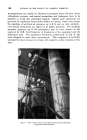
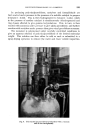
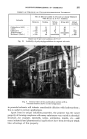
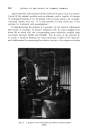
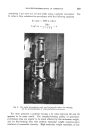
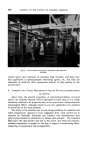
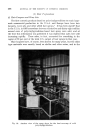
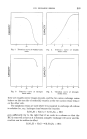
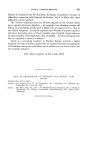
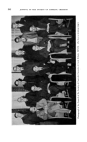
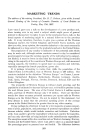
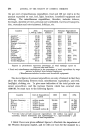
FINE PARTICLES IN THE COSMETIC INDUSTRY 189 Single cut Gonell Air Elutriator. Double cut Andreasen Air Elutriator. Andrews Liquid Elutriator. Mul.tiple cut Haultain Infrasizer (Ai•). The size of sample used in such instruments is 10-50 grns. depending on density of particle, and the method is useful over the range of 10-50 microns. The main difficulty in such instruments is to maintain the fluid stream steady and even over the cross-section of the column. Further, and particularly with air elutriators, dispersion of the powder as single particles is almost impossible with some powders. By the same token the rising particles will adhere strongly to the surface of the column and re-agglomerate. Some form of vibration of the apparatus is often required. The time necessary for a determination by this method is very variable---from a few hours to a few days, depending on the nature and the particle range of the powder. Nevertheless it is very useful in some circumstances, particularly when close particle-range fractions are required for further examination. Looking back to the Stokes equation, it will be seen that increase of g would reduce the time of a determination. Consequently several methods have been devised using centrifuges, particularly in liquid media. A centri- fugal method of the air elutriation type has recently become available. The matehal is fed from the central point of a rotating chamber against a spiral air flow and the powder thereby separated into two fractions above and below the required particle size cut. The particle size cut is controlled by the speed of the rotor, which must be kept constant for each size limit, and by the spacing plate at the air induction point. The feed is of the vibrator type, closely controlled to a rate of 1-2 gm. per minute. When the finest fraction has been removed the residue is returned to the feeder and the whole repeated at a different setting. The instrument will deal with 10- 40 grn. sample. Sedimentation methods may be exemplified by the Andreasen pipette. A weighed amount of powder is suspended in a column of volume about 600 millilitres and height about 25 cm. The time of fall through a height of 20 cm. is calculated from Stokes Law for a series of particle sizes. At such times after the beginning of the operation a 10 mi. sample of the suspension is withdrawn from the level at 20 cm. below the top surface of the column. This is transferred to a dish, the suspension evaporated to dryness and the residue weighed. This residue is the weight fraction of the sample which is less than the particle size which had been used to calculate that particular period of settling. In this method 7-20 gm. of sample may be used, corre- sponding to 1 per cent by volume of the suspension. Many refinements of the sedimentation method have been attempted. One such incorporates a scale pan in the bottom of the suspension and gives a continuous register of the amount of deposition.

190 JOURNAL OF THE, SOCIETY OF COSMETIC CHEMISTS Other devices have been based on the fact that a suspension has effectively a density somewhat ,higher than the pure fluid, and which can be measured by means of a hydrometer. As the suspension settles out its density falls off and so gives a corresponding change in the hydrometer reading. Unfor- tunately, the hydromeier has to be removed from the suspension between readings to avoid deposition of particles on the shoulder of the bulb. Such disturbances of the suspension are not desirable. There is also the difficulty of surface tension effects where the hydrometer breaks the surface. A better alternative is the use of small divers in the suspension. Several divers of different densities are required. They are streamlined in shape and the falling particles do not settle on them. As the suspensions are usually opaque the divers may be fitted with a ferrous core so that they may be brought to the side of the column by means of a magnet. A later refinement of this has been detection ,electrically of the position of the divers (with permalloy cores) by means of a thin search ring around the outside of the column. Mariometric measurements of changing density of. a suspension have been used. Two tubes fitted with pure liquid are immersed in the suspension at different levels. The slight difference in heights of the manometers is pro- portional to the mean difference in density between the two levels. The manometric readings are made with a travelling microscope. Probably the most attractive modification of the simple Andreasen type is the photo-extinction method. Here a narrow beam of light is directed through the suspension at a set level below the surface of' the suspension and the fraction of the light which passes through is measured by a photocell system. As the particles settle out less light is obstructed and the increasing light intensity picked up by the photocell gives a measure of the particle range. This method has the great virtue that the suspension is not disturbed during the course of the determination. It can be made more rapid than the pipette method by moving the light beam to higher levels for finer particles. Much experimental work has been done on this method since it was first examined some twenty years ago. The theory of the method is very com- plex. Its range is about 25 microns--1 micron. The amount of sample examined is about 0.01 gin. Difficulties in interpretation occur on account of light scattering by the particles and the transparency of some materials at low particle sizes. , . PERMEABILITY METHODS We have considered the movement of particles against a moving stream of fluid '(elutriation), and the movement of particles in a standing column of fluid (sedimentation). The so-called permeability methods first investigated by Carman make use of movement of fluid through a standing column of
Purchased for the exclusive use of nofirst nolast (unknown)
From: SCC Media Library & Resource Center (library.scconline.org)