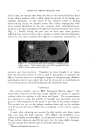
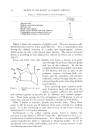
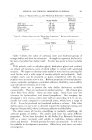
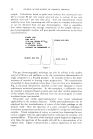
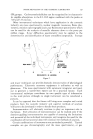
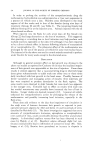
EFFECT OF VARIOUS METALLIC IONS 315 ... • :.•: .. • .? "!•,: '.•7. ß ß: :'•- •: • ?-5 Figure 2.--Culture tubes one month after seeding. Left to right: Achorion quinckeanum (3 tubes) Ag + 10/3/1 milliatomgr./liter, Penicillium glaucum (3 tubes) Ag -• 10/3/1 milliatomgr./ liter, ,lspergillus niger (3 tubes) Ag -• 10/3/1 milliatomgr./liter. an inhibiting effect on the fungi is about 100 times greater than the one observed in parallel experiments with Staph. aureus (limit 0.03 milliatom- gram Ag in one liter of broth). The other metals which have been studied, vis., copper and zinc, though less active, can also be used, as they are practically inoffensive and well tolerated by the skin. It is well to call to mind that it may not be possible to transpose into practice the results found in these experiments. On one hand, re- actions could take place between the metallic ions and the substances to be preserved, reactions which might effect a diminution of the antimicrobial power on the other hand the culture medium used for these experiments being very favorable to the growing of fungi, lower inhibitory concentrations might be found adequate in practice. SUMMA RY Experiments in vitro indicate that some metal ions inhibit the growth of zlchorion quinckeanum, Penicillium glaucum and zlspergillus niger. The most active ions are, in decreasing order: Cd, Ni and Ag, Cu and Zn.

THE PHYSICAL AND CHEMICAL PROPERTIES OF SHELLAC By H. S. COCKEKAM and S. A. LEv•E* Presented May 12, 1961, New York City Revived interest in shellac as a hair wave setting material points up a need for wider dissemination of technical information on shellac. It also reveals the widely scattered state of shellac literature. In most cases, gathering information is quite difficult, as there is no modern mono- graph or similar comprehensive source. A natural result of this situation is that most technical people regard shellac as a commodity. When we look at shellac as the complex of chemicals which it is, we find many points both interesting and unexpected. Of prime interest to the cosmetic chemist are purity and toxicity. Bleached shellac, either regular or wax-free, is nontoxic. It may be ingested without harm. Considerable amounts of bleached shellac are employed as coatings in the confectionery and pharmaceutical industries. There have been no substantiated cases of allergy or sensitization. It is free from arsenic and rosin. In our own plant it is specially handled to insure its acceptability as an ingredient of foods, drugs and cosmetics, in accordance with all the regulations of the Federal Food, Drug and Cosmetics Act, as amended. From the chemical standpoint, shellac is a mixture of polyhydroxy polycarboxylic esters, lactones and anhydrides (1). On theoretical grounds it is most probable that polyesters predominate. These may be both linear and cross linked. The esterification of the constituent acids takes place during and after the exudation of a resinous substance from the body of the lac insect (Tachardia lacca Kerr). When first exuded the lac resin is a viscous, almost colorless liquid. It gradually liardens and darkens, forming "sticklac." This is the primary raw material from which orange shellac and commercial bleached shellac are manufactured. When }leated, shellac po]ymerizes further to an insoluble, in fusible product. Shellac appears to be a rather tough, springy network of hydroxy fatty acid esters and sesquiterpene acid esters. The interstices orerain a * Acme Shellac Products Co., Newark, N.J. 316
Purchased for the exclusive use of nofirst nolast (unknown)
From: SCC Media Library & Resource Center (library.scconline.org)