J. Soc. Cosmet. Chem. 22 421-437 (1971) ¸ 1971 Society of Cosmetic Chemists of Great Britain The water absorption lanolin properties of E. W. CLARK* Presented on 6th October 1970 in London at the Symposium on "New developments in lanolin and its derivatives", organised by the Society of Cosmetic Chemists and the Society of Cosmetic Chemists of Great Britain. Syn0psi•WATEI• ABSORPTION is affected by variations in (a) test method and temper- ature, (b) free alcohol content, and (c) presence of soap or detergent. A new METHOD for determining concentrations 0.04 •o of five NONIONIC DETERGENTS of the ethoxylated alkylphenol or ethoxylated linear alcohol type in LANOLIN or centrifuged wool grease is described:- detergent is extracted into 70 •o v/v isopropanol from a solution of the sample in octane, precipitated with molybdophosphoric acid, degreased with diethyl ether, oxidized with perchloric acid, reduced with metol/sulphite to molybdenum blue and the colour intensity measured on a photoelectric colorimeter using a red filter with reference to an individual or composite calibration graph. Accuracy is _ 0.03 as •o sample (detergent known) or --0.06 to +0.05 •o (detergent unknown). Stated detergents are recoverable sufficiently pure for identification by infra-red spectra and their bulk removal from lanolin and wool grease by extraction with 45 •o isopropanol is demonstrated. An addendum names two further amenable detergents. INTRODUCTION One of the most important properties of anhydrous lanolin, its powerful w/o emulsifying action, was utilized in Otto Braun's original patented process (1, 2) for refining crude wool grease to lanolin by repeated kneading with cold water to remove water-soluble impurities. Most national pharmacopoeia include a monograph not only on anhy- drous lanolin but also on the hydrous version, a w/o emulsion. Sometimes *Westbrook Lanolin Company, Laisterdyke, Bradford, BD4 8AU. 421

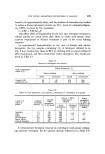
422 JOURNAL OF THE SOCIETY OF COSMETIC CHEMISTS the addition of an oil is specified (3) to reduce stickiness. Simple prepara- tions of this type including well-known proprietary products have been marketed for many years. A German trade mark of 1904 refers to a "lanolin toilet cream" (4). DEFINITION AND SIGNIFICANCE OF "WATER ABSORPTION" The amount of water which a given quantity of lanolin will emulsify or "absorb" is known to have an upper limit which varies from sample to sample. The maximum amount capable of being absorbed as a smooth emulsion without visible excess is sometimes used as a criterion of quality for lanolin, an absorption of 200%, i.e. twice the weight of the anhydrous substance, being usually regarded as an acceptable minimum. A test for maximum water absorption, sometimes referred to as "water number" or "water index", is of limited significance, since it is rarely that lanolin emulsions containing anywhere near the maximum possible water content are contemplated commercially. Stability of emulsions at more practical water contents is of greater importance, but there appears to be no fixed relationship between emulsion stability and maximum water absorp- tion. METHODS OF TEST FOR WATER ABSORPTION The first method published was that of Casparis and Meyer (5) who added cold water to molten lanolin in stages, with constant stirring, using a pestle and mortar, until no more water could be emulsified and the emulsion began to slip around the mortar. The mass was then spread out on a glass sheet at 0øC and turned over at intervals of several hours by a spatula, any separated water being removed by soaking up with filter paper. When separation of water ceased, the water remaining emulsified was determined by azeotropic distillation from an aliquot sample. Casparis et al (5) recognized that the water absorption was dependent on temperature, but offered no experimental evidence. The effect of temper- ature on a different test method is shown in Table I, but small vari- ations in ambient temperature are indicated to be of little practical signi- ficance. The method of Casparis et al (5) is inconvenient as regards time, large weight of sample and type of apparatus, since emulsion builds up around the pestle and frequent scraping is necessary. The method also has an
Purchased for the exclusive use of nofirst nolast (unknown)
From: SCC Media Library & Resource Center (library.scconline.org)