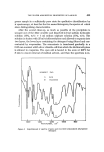
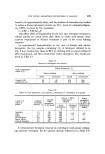
THE WATER ABSORPTION PROPERTIES OF LANOLIN 435 found to be approximately unity, and the number of extractions {n) needed to reduce a known detergent content, say D%, down to a stipulated figure, say 0.05%, is given by the expression: n=4.33 q- 3.33 log10 D This effect offers an explanation for the fact that detergent contents in refined lanolin are much lower than those in crude wool grease, since aqueous isopropanol or ethanol treatment is part of the usual refining sequence. As experimental demonstration in the case of lanolin and known detergents, the two samples containing 1% of detergent referred to in Fig. 2 were washed four times at 60øC by shaking with an equal volume of 45% isopropanol, and then retested for water absorption. The results are given in Table VI. Table VI Removal of detergent from lanolin Type of detergent added (1%) Nonidet P40 Tergitol 15-S-9 Water absorption, % before washing after washing Hand Mixmaster Hand Mixmaster 55 35 60 100 310 310 340 360 Table VII Effect of water absorption, and removal, of detergent in centrifuged wool grease After 4 x 45 •o Water I Original isopro panol absorption Country of Original water washes % after a origin of I detergent absorption, further 2 X 4• grease , content, % % (by hand) water detergent isopropanol absorption, content washes Australia [ 1' 1 95 380 -- __ Italy , 1.3 110 280 0.05 400 Japan O. 1 210 400 -- -- New Zealand 0.5 130 400 -- -- South Africa 1.7 40 190 0.12 400 United Kingdom 0.3 150 400 -- -- To demonstrate detergent removal on centrifuged wool grease contain- ing unknown detergent, the five greases already referred to in Table VII

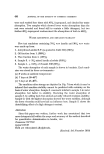
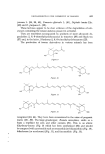
436 JOURNAL OF THE SOCIETY OF COSMETIC CHEMISTS were each washed four times with 45% isopropanol, and checked for water absorption. Two samples which showed lower water absorptions than the rest were retested and found still to contain a little detergent, but two further 45% isopropanol washes raised the absorptions of both to 400%. WATER ABSORPTION AND EMULSION STABILITY Five test emulsions containing 70ø//o w:w lanolin and 30% w:w water were made up from: 1. Anhydrous Lanolin B.P. (as quoted in Table III) (310%) 2. Oil fraction from 1. ($80%) $. Wax fraction from 1. (155%) 4. Sample 3. -1- 3% mixed lanolin alcohols ($10%) 5. Sample 1. -5 0.6% of Nonidet P•IO (65%). The water absorption of each sample is shown in brackets. Each emul- sion was stored in three environments:- (a) 8 weeks at ambient temperature (b) 7 days at 39-40øC (c) 7 days at 45-46øC. The emulsions after storage are depicted in Fig. 7 from which it may be inferred that emulsion stability cannot be predicted with certainty on the basis of water absorption. Sample 3. was much inferior to sample 1. in water absorption but better in stability. Restoring the water absorption of sample 3. by adding back free alcohols actually reduced emulsion stability. Sample 2. with the highest absorption showed the worst stability, although the lower viscosity could have had an influence here. Sample 5. shows the alestabilizing effect of a high detergent content. Addendum Since this paper was written, further work has ascertained that two more detergents fall within the scope and accuracy of the method described for quantitative determination in lanolin, viz.: Dumacene NP7710 Igepal C0710 Both are ethoxylated alkylphenols. (Received: $rd November 1970)
Purchased for the exclusive use of nofirst nolast (unknown)
From: SCC Media Library & Resource Center (library.scconline.org)