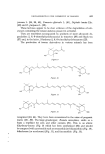
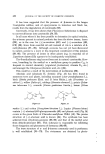
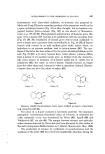
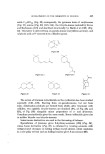
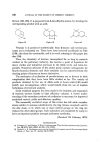
DEVELOPMENTS IN THE CHEMISTRY OF IONONES 443 isomerisation with ultra-violet radiation. cis-a-ionone was prepared by Btichi and Yang (74) and a secondary product of the isomerism would not be a spiro-cyclopropyl isomer (Fig. 15) as they thought, but an isomeric con- iugated dienone (retro-¾-ionone (Fig. 16)) as was shown by Mousseron- Canet et al (75, 76, 50). Photochemical isomerisation of [3-ionone gives this same retro-¾-ionone (77) but this is in equilibrium with the pyranose form (Fig. 17) (50, 78). Irradiation of [3-ionol gives retro-¾-ionol oxidisable to retro-¾-ionone and a pyranose form autoxidisable to Fig. 18 (79). [3-Ionone treated with o-esters in an acid medium gives enolic ethers which, on hydrolysis in an aqueous medium, lead to retro-a-ionone (80). The syn- thesis of the latter has been achieved by the action of methyl-lithium on the acid Fig. 19 (81). a, [3 and )' ionones have violet odours )'-ionone differs from a-ionone in its marked woody note, as distinct from the character- istic cedar nuance of [3-ionone. cis-a-Ionone smells not of violets but of cedarwood (82), the same as retro-¾-ionone. Dihydro-ionones no longer have the violet odour and, contrary to what is sometimes claimed, dihydro- ),-ionone does not have the odour of amber (83). Figure 15 Figure 16 Figure 17 •• •COOH Figure 18 Figure 19 Ionones, chiefly the [3-isomers, have been studied as insect attractants (e.g. termites) (18, 84). The odour of a, • and ? ionones is extremely powerful. The minimum perceptible concentration (threshold value) of a-ionone, in molecules per •ubic centimeter of air, was determined by Naves (85), Appell (86) and Voitkevitch (87, see also 88). The margin between racemic and optically- active ionones observed by Naves has just been discussed by this author at the sixth Symposium Mdditerran•en sur l'Odorat, Monte-Carlo, May, 1969. The production of ionones by cyclization of pseudo-ionones and the synthesis of the latter (89) have received considerable attention during the

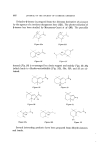
444 JOURNAL OF THE SOCIETY OF COSMETIC CHEMISTS past twenty years, chiefly on account of the needs of the synthetic vitamin and carotenoid industries (32, 90, 39, see also 91, 28). The classical methods of cyclizing a- and IMonones made use of strong acids, such as sulphuric, phosphoric and formic. The use of Lewis acids, in particular boron trifluoride, dates back about twenty years. In a dry aprotic medium, this gives excellent yields of a-ionone (92). In these various cases, •,-ionone appears only in negligible proportions (93). The production of a-and [Monone by means of various concentrations of sulphuric acid is affected by the added solvent (84, 95--97). The equilibrium between the isomers has been studied by Kergomard (98). The study of cyclization by means of D2 SO 4 or D3 P04 has shown that the reaction starts first of all by the production of a-ionone which is isomerised to [Monone (99--103). The stereochemistry of the cyclization has been studied by Mursakuler et al (104). If boron trifluoride is replaced by its complexes, a significant proportion of ¾-ionone is produced from all-trans pseudo-ionone. Acceptable yields are obtained when using the following as complexing agents: methyl, ethyl and butyl ethers, tetrahydrofuran, anisole, dioxane, acetic esters and anhydride, dimethylsulphoxide, acetone. Even better is to operate in the presence of proton acceptors such as nitrogenous bases (dimethyl- formamide, pyridine, etc.) or buffers (acetic acid with sodium acetate). Nerylidene-acetone leads to the bicyclic ethers described by Naves and Ardizio (105--107). The cyclization reaction can be applied to 2-alkoxy-2, 3-dihydro- pseudo-ionones (108). These are produced either from 6-alkoxy-methyl- heptanones or from 2-alkoxy-2, 3-dihydro-dehydrolinalol by means of an alcohol with an alkaline or acid catalyst. The advantage of this procedure over those using the reactions of Carroll and of Kimel and Cope, is that it avoids the formation of cyclopentenic ketones (pentiones). Ionones obtained by the normal agents are accompanied by secondary products which are recovered in the heads of distillation (called ionone terpenes in the industry) and in the tails. Many of these products are formed in more or less increased proportions if the classical cyclizing agents are replaced by Lewis acids other than boron trifluoride and its complexes (109--111). These secondary products can be monocyclic compounds such as spiro- dihydrofuran (trig. 20), conjugated dienones (trigs. 21a and 21b), and 4- dehydro-dihydro-lMonone, bicyclic dihydropyrano-p-menthenicderivatives described by Naves and Ardizio (112) (C • 3H 200 isomers to which a saturated
Purchased for the exclusive use of nofirst nolast (unknown)
From: SCC Media Library & Resource Center (library.scconline.org)