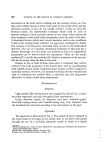
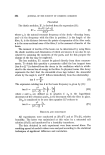
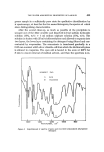
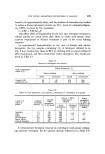
THE WATER ABSORPTION PROPERTIES OF LANOLIN 423 Table I Effect of temperature on maximum water absorption* Temperature, øC water absorption, % 20 280 30 290 40 440 48 550 55 620 (after difficult start) 63 no emulsification *Mixmaster method, 50 g sample. inherent source of inaccuracy, occasioned by the deliberate addition of excess water which can break down part of the emulsion already formed. This is similar to the effect of adding too much water at any one time during the emulsification, an effect common to the preparation of w/o emulsions in general, whether experimental or commercial. As illustration, two emulsions were made by the Casparis and Meyer technique, incorporating respectively less than, and more than, the maxi- mum water absorbable without excess. After removing separated water from the glass plate (none separated from the first emulsion) final water absorptions were determined by azeotropic distillation as shown in Table Table II Effect of adding excess water to a lanolin emulsion (2 different samples) Water originally added, Water finally present, 200, 200 195, 195 300, 300 150, 160 (•aximumpossibleabsorptionwithout excess=280%) This inaccuracy in their first method was apparently recognized but not demonstrated by Cusparis and Meyer, who proposed a second method in- volring the preparation of successive emulsions with increasing water con- tents to establish the maximum water absorption without exceeding it. If one accepts this principle, however, the method may be simplified by carrying out step-wise emulsification only, just to the end point, and sub- tracting from the total water added that which was added as the last portion. The remainder is the "water absorption". Simplified procedures of

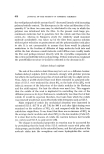
424 JOURNAL OF THE SOCIETY OF COSMETIC CHEMISTS this type have been proposed by Truter (6), and also by Aguiar and Huyck (7), and it is the method preferred by myself, using a 10 g sample in a porcelain dish about 75 mm diameter and stirring with a round-ended glass rod 125 mm long by 8 mm diameter. Water is added from a burette 0.5 ml at a time, or less if emulsification is difficult. The materials of construction of the apparatus are of some importance. For example, it is almost impossible to work with a glass pestle and mortar, due to premature slippage of emulsion around the walls. Different materials were compared by Velon and Picot (8) who recommended a stainless steel dish and a horn spatula. A special, hand-operated kneading machine was described and used by Jencic (9), whilst other workers (10) have passed the lanolin emulsion through a roll-mill as a means of expressing excess water. The use of a mechanical mixer has been proposed by Conrad (11), and I too have used this method with success, as have others, although makes of machine differed. As pointed out by Conrad (11) the results from different machines cannot necessarily be equated, and, as results presented here show, mechanical mixing tends to give higher results than hand mixing. The DAB (12) specifies a pestle and mortar method and a minimum absorption of 200%, whilst the OAB (13) stipulates a method similar to the first method of ( asparis and Meyer involving excess water, materials not being named. Even this list of test methods is not exhaustive, and rarely, if ever, can the results from one method be equated with those from another thus is the complexity of the present situation. FACTORS INHERENT IN LANOLIN WHICH AFFECT WATER ABSORPTION Free alcohols The percentage of free fatty alcohols in wool grease is already known to vary naturally, but it can also be affected by certain methods of processing. Lifschiitz (14) reported natural variation between 2% and 8% in wool grease and showed, as did Tiedt and Truter (15) later in more detail, that the pure esters were devoid of emulsifying power whereas the free alcohols were powerful emulsifiers. The natural free alcohol content of lanolin is altered during the commer- cial production of lanolin oil, wherein the liquid lanolin esters are separated from the hard, waxy esters by refrigerated fractional crystallization from
Purchased for the exclusive use of nofirst nolast (unknown)
From: SCC Media Library & Resource Center (library.scconline.org)