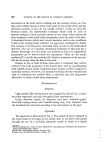
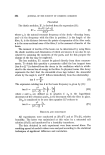
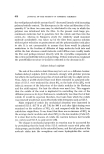
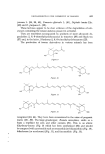
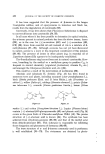
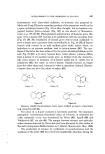
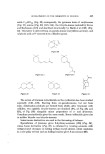
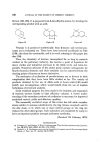
DEVELOPMENTS IN THE CHEMISTRY OF IONONES 447 Cyclization of geranyl acetones by means of boron trifluoride produces hexahydrochromenes with camphoraceous odours (122) and one constituent of this mixture is isomerised easily to dihydro-13-ionone (Fig. $4). Smit et al (123, 124), by treating dihydro-13-ionone with sulphuric acid in the presence of a nitroparaffin, obtained trans-2,5,5,9-tetramethylhexahydro- chromene whilst dihydro-a-ionone gave a mixture of 70% cis and $0% trans. From this they deduced a mechanism for the cyclization. In the case of dihydro-¾-ionone, they obtained the decalinic derivatives Figs. $5 and $0. The first of these is an a-ambrinol obtained by Stoll et al as early as 1955 along with 13-ambrinol (Fig. $7) (7, $0, 12, 125, 126). Figure 34 Figure 3• Figure .•0• Figure 37 The cyclization into ambrinols can be effected by means of dilute mineral acids, other acids such as phthalic, salicylic, tartaric etc., and boron trifluoride. These alcohols have a warm amber odour, particularly marked at great dilution. Whilst Stoll et al (127), by treating dihydro-a-ionone with boron trifluoride or an acid such as dilute hydrochloric obtained 2,5,5,9-tetra- methylhexahydrochromenes, in an alcoholic medium the products were bicyclic alcohols and ethers (Fig. 38) (OR replacing OH) exhibiting woody and amber odours with a camphoraceous mustiness. The ketals of dihydro-13-ionone (128) give rise to Fig. $0 which are very useful in perfumery. They are obtained, instead of the keto-glycols which could be expected, by oxidising dihydro-¾-ionone with osmium tetroxide or potassium permanganate. 5-oxo-dihydro-a-ionone or 4-oxo-dihydro-13- ionone on treatment with sodium methylate (129) give decalinic dieno- ketones such as Fig. 40 which have been suggested for flavouring tobacco. X¾-hilst the 2,5,5,9-tetramethylchromanes are devoid of olfactory interest (150), 2,5,5,9-tetramethylchroman-7-one can be used as a tobacco

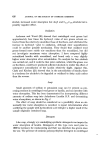
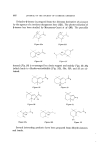
448 JOURNAL OF THE SOCIETY OF COSMETIC CHEMISTS flavour (131,132). It is prepared from 5-oxo-dihydro-ionone by treating the corresponding alcohol with an acid. Figure 88 Figure 89 Figure 40 Vitamin A is produced synthetically from [Monone and several pro- cesses are in industrial use. These have been reviewed excellently by Isler (133), also those for carotenoids, and it is worth referring to this paper (see also 134). Thus, the chemistry of ionones, monopolised for so long by research workers in the perfumery industry, has become a point of departure for many studies and industrial processes in the fields of di- and tetra-ter- penoids. Numerous odorants of the amber group contain cyclo-geranic (or bicyclo-farnesic) elements and their synthesis can be conceived from the starting points of ionones or ionone derivatives. The mechanics of cyclization of pseudo-ionones are so diverse in their complexities that they have been little studied so far. The variety of products obtained by the use of dilute acids or Lewis acids (110) would justify new investigations, which would benefit from the use of modem techniques of structural analysis. Great technical progress has been made in the isolation and separation of isomeric ionones thanks to high efficiency columns. A better under- standing of the secondary products of cyclization is necessary for improved analytical control, yields and olfactory qualities. The necessarily restricted scope of this review has left aside consider- ations relative to ionones substituted in the ring (irones excepted) and in the side chain, or in which one or more methyl groups on the ring are replaced by other alkyl groups. Such substances are considered by many to have an important position amongst perfumery synthetics. (Received: 7th February 1970) REFERENCES (1) Tiemann, F. and Kriiger, P. •Jber Vei]chenaroma. ]•ber die Semicarbazone des e-Jonons. Bet. 2õ 2675, 2693 (1893), 81 808, 1736 (1898). (2) Penfold, A. R. Preliminary note on the chemistry of concrete otto of Boronia megastigma {Nees). J. Pro& Soc. W. Austral. 14 2 {1927).
Purchased for the exclusive use of nofirst nolast (unknown)
From: SCC Media Library & Resource Center (library.scconline.org)