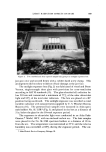
660 JOURNAL OF THE SOCIETY OF COSMETIC CHEMISTS to 80 mesh Chromosorb W • is used at a temperature of 150øC and a he- lium flow rate of 80 cc per minute. In order to achieve maximum sensi- tivity, a flame ionization detector is employed. The 10-cc vapor sample is mostly air which causes extinction of the flame in the detector. The lat- ter has to be reignited for each sample. The relative concentration of the organics in the vapor sample is determined by measuring its peak height. During the course of a particular test it is necessary to have the sub- ject perspire in order to release the perfume. This is best accomplished by "heating" the subject with the aid of an electric blanket and sitting on an electric heating pad. The sipping of hot tea by the subject also facili- tates perspiration. Another technique, again based upon gas-liquid chromatography, was developed in order to measure water vapor caused by the perspiration of the subjects. A 3-ft, 1/4-in. o.d. copper column with 50% Carbowax 20Ml' on 60 to 80 mesh Chromosorb W is used with a helium flow rate of 10 cc per minute at 130øC. The unusual 50% substrate is a development that allows water vapor to be quantified since it gives symmetrical peaks. The high liquid ratio lessens adsorption phenomena. A thermal-conduc- tivity detector is used since the hydrogen flame detector is insensitive to water vapor. The same sampling device is used and again it is allowed to equili- brate for one minute in the axillary region. A 10-cc smnple is taken, again utilizing a gas-tight hypodermic syringe. The water vapor in the air due to atmospheric humidity gives us a background reading. As the subject perspires, the water vapor reading obtained in the gas chromatograph increases to a maximum. After the subject perspires for a given time and cooling is desired, the electric blanket and electric heating pad are removed. A marked reduction in the axillary water vapor is subsequently observed. RESULTS AND DISCUSSION The purpose of the analytical procedure was to obtain objective, quantitative data on the performance of encapsulated perfumes in aerosol products. Our original oilactive observations described the performance of the encapsulated perfumes as having sustained release, delayed release, and maintainence of freshness. The initial in vitro tests confirmed that repeated release of volatiles from the encapsulated perfume did occur. The results shown in Fig. 4 * Chromosorb W is available from Arialabs, Inc., Hamden, Conn. t Carbowax 20'M is available from Union Carbide, New York, N.Y.

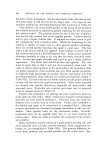
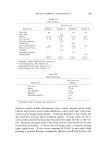
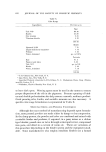
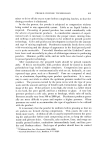
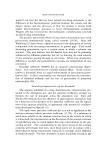
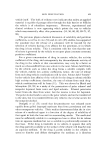
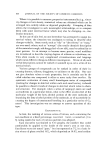
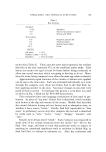
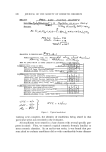
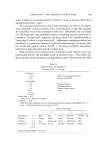
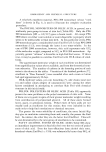
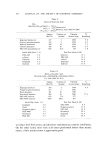
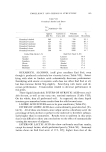
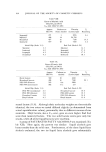
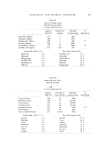
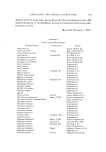
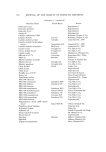
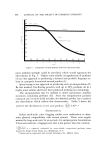
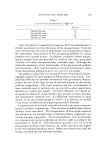
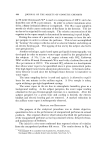
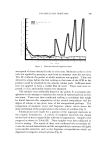
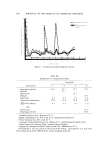
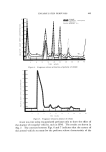
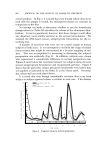
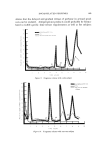
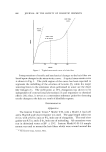
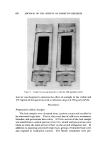
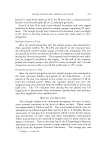
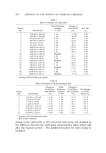
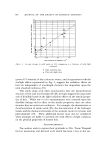
ENCAPSULATED PERFUMES 661 IIIIII ENCAPSULATED OIL i i I 2 3 4 5 6 7 8 9 I0 TIME HOuRs Figure 4. Moisture-induced fragrance release are typical of those obtained in the in vitro tests. Moisture in the in vitro tests was applied by spraying a mist from an atomizer onto the test area. The W's indicate the points at which moisture was applied. Time was allowed to elapse before the first wetting so that some of the IPM in the product could be absorbed by the silicone rubber pads. Sufficient mois- ture was applied to form a visible film of water. These tests were re- peated, in vivo, and similar results were obtained. The subjects were artificially heated at the points, P, to promote per- spiration in an attempt to simulate the results of normal activity at vari- ous times. Tests were then conducted seeking a correlation that might be found between the composition of the aerosol formulation and the degree of release, at any given time, of the encapsulated perfume. The comparison of moisture vapor and fragrance release curves shows the close correlation of the perspiration to the release of volatiles (Fig. 5). Substitutions were made for a portion of the isopropyl myristate in the original formulation. A variety of nonpolar materials was chosen on the basis of their compatibility with the encapsulation. Samples were prepared as shown in Table III. These samples were then subjected to in vitro testing. The results of these tests confirmed the correlation be- tween the aerosol formulation and the susceptability to moisture of highly water-soluble materials, such as the fragrance encapsulations which are dispersed in nonpolar aerosol systems (Fig. 6).
Purchased for the exclusive use of nofirst nolast (unknown)
From: SCC Media Library & Resource Center (library.scconline.org)