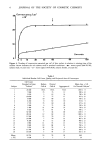
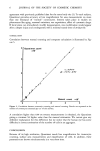
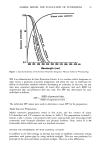
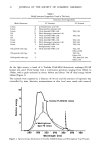
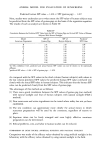
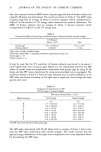
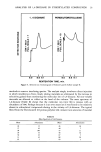
12 JOURNAL OF THE SOCIETY OF COSMETIC CHEMISTS Table I Model Sunscreen Preparations Tested in This Study Sunscreen Active Ingredients Model Sunscreen UV Absorber UV Scatterer Lotion Lotion Lotion Oil Oil Oil Cream Cream Cream A p-Aminobenzoic acid 3.0% B Homomenthyl salicylate 8.0% C Octyl dimethyl PABA 3.0% D Ethyl diisopropyl cinnamate 1.5% E Octyl dimethyl PABA 2.0% F Octyl dimethyl PABA 2.0% G Octyl dimethyl PABA 1.0% H Ethyl diisopropyl cinnamate 1.0% ! Octyl dimethyl PABA 2.5% Benzophenone-3 0.5% Oily powder stick type J Octyl dimethyl PABA 1.5% TiO2 1.0% Others 45.0% Oily powder stick type K TiO• 15% Others 35% Solid powder cake type L TiO• 20.0% Talc 55% Others 15% TiO 2 1.0% TiO2 1.0% TiO2 1.0% TiO• 5.0% TiO2 6.5% As the light source, a bank of 6 Toshiba FL40-SE30 fluorescent sunlamps (FL-SE lamps) was used. These lamps emit a continuous spectrum ranging from 280nm to 370nm, with a peak emission at about 305nm and about 73% of total energy below 320nm (Figure 2). The animals were exposed at a distance of 30 cm and the amount of exposure was controlled by time. Intensity measurements at skin level were made with research 10- shiba FL40SE 0 lamps I -': x,,.. ,', ] ./e- Westinahouse • II /s' Type F$ lamps •-•.. •, 280 300 320 340 360 380 400 Wavelength (nm) Figure 2. Spectral energy distributions of Toshiba FL40SE30 lamps and Westinghouse Type FS lamps.

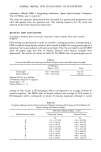
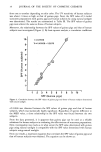
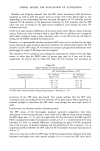
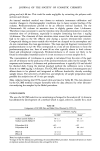
ANIMAL MODEL FOR EVALUATION OF SUNSCREENS 13 radiometer (Model RMi-1 Integrating radiometer, Japan Spectroscopic Company). The UV-B flux was 1.1 mw/cm 2. The series of exposures administered was increased in a geometrical progression, and each 30% greater than the previous one. The starting exposure for the series was selected on the basis of previous experience. RESULTS AND DISCUSSION SUNSCREEN TESTING WITH NATURAL SUNLIGHT USING GUINEA PIGS AND HUMAN SUBJECTS Field testing was performed in order to establish a testing procedure corresponding to FDA's method (using human subjects with natural sunlight) by using guinea pigs as a substitute for human subjects with natural sunlight. First, the untreated (control) MED value of guinea pigs and that of human subjects with natural sunlight were determined. The results are shown in Table II. The MED value of guinea pigs was an Table II Untreated Site MED of Guinea Pigs and Human Subjects Determined With Natural Sunlight • UV-Monitor 2 (Mean _+ S.D.) Time Guinea pigs 3 1921 _+ 520 counts 47.2 rain Human subjects 4 1076 __ 340 counts 25.8 min 'Okinawa (26 ø N.L. July, Midday). 2UV-Monitor: Sunburn UV integrator. 3Guinea pigs n = 50. 4Human subjects n = 73. average of 1921 counts in SU-Integrator, which corresponds to an average of about 47 minutes exposure. The MED value of human subjects was average of 1076 counts in SU-Integrator which corresponds to' about 26 minutes exposure, although it varied Table III Comparison Between the Sun Protection Factors Obtained by Guinea Pig Testing and That Obtained by Human Testing with Natural Sunlight Model Sunscreen Tested SPF Values Obtained (Mean _+ S.D.) Guinea Pig Testing Human Testing (n) (n) B 2.21 + 0.73 (14) 2.10 + 0.53 (38) D 1.76 _+ 0.30 (5) 1.40 _+ 0.70 (13) F 2.10 _+ 0.70 (7) 1.83 +_ 0.46 (31) G 2.68 _+ 0.41 (10) 2.40 + 1.00 (13) H 3.19 + 0.87 (16) 3.15 + 0.72 (15) I 5.24 + 1.34 (5) 5.56 + 2.80 (21) J 2.79 +- 0.40 (5) 2.50 + 0.80 (5) K 7.68 _+ 0.69 (7) 9.99 -+ 2.37 (26) L 4.14 _+ 0.94 (7) 5.00 +_ 1.80 (13)
Purchased for the exclusive use of nofirst nolast (unknown)
From: SCC Media Library & Resource Center (library.scconline.org)